
 User:
User:


Universidad Austral de Chile, UACh
Storyboard

At the beginning of the 2010s I also began teaching at the Universidad Austral de Chile, in Valdivia. Initially, I traveled periodically from Santiago to teach my courses, until I later assumed a permanent academic position and moved permanently to Valdivia.
This new stage was marked by the development and incorporation of innovative teaching methods, especially aimed at career students whose training was not directly linked to Physics and who, in many cases, had limited mathematical preparation. The challenge was to teach complex physical concepts without sacrificing scientific rigor, adapting the form of presentation to the needs of each discipline.
The results were very positive, allowing courses to be taught with a solid level of Physics and, at the same time, ensuring that students understood and successfully applied this knowledge in the context of their respective professional areas.
ID:('ky', 1786)
Innovating in the Teaching of Physics for Other Disciplines
Storyboard
At the end of the 2000s, I began a new academic stage by joining the Universidad Austral de Chile, in Valdivia, as a teacher. From the beginning my work was mainly oriented towards teaching Physics for students of careers other than Physics and Engineering, such as Medicine, Kinesiology, Dentistry, Agronomy, Sciences, Architecture and other specialties where Physics constitutes a fundamental tool to understand the phenomena of each discipline.
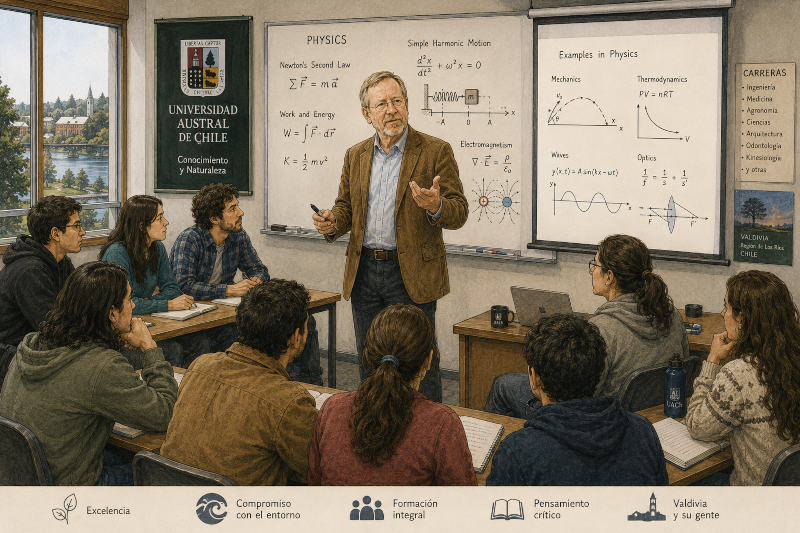
This challenge presented a particular difficulty. Most students had limited training in both Physics and Mathematics, while the phenomena they had to understandbiomechanics, physiology, biophysics, heat transfer, fluid mechanics, optics or electromagnetismcorrespond to areas of considerable complexity. Traditionally, this forced the content to be excessively simplified, restricting teaching to very basic principles and leaving out many of the models actually used in professional practice.
ID:('gp', 581)
Using the analogy of building a LEGO model
Storyboard
To overcome this limitation I developed a methodology based on the progressive construction of scientific models. Instead of starting with abstract equations, the process began with the observation of nature and the identification of relevant variables. Each variable was incorporated into the model as if it were a LEGO piece, allowing students to visualize how each new element expanded the explanatory capacity of the system. These relationships were later translated into mathematical equations organized as a network of interconnected models, which could finally be implemented in computational tools to perform calculations, simulations and analysis of real scenarios.
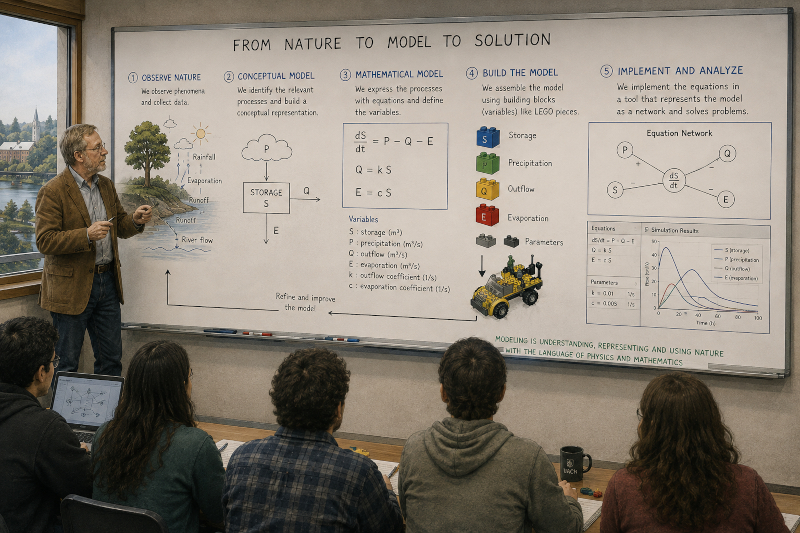
This approach made it possible to considerably reduce the initial mathematical barrier without losing scientific rigor. Students first learned the physical structure of the problem and only then the mathematical formulation necessary to describe it. As a result, it was possible to address considerably more complex phenomena than those traditionally taught in introductory courses, always maintaining a close relationship with the applications of each career and with the way in which these models are used in research and professional practice.
ID:('gp', 582)
Larning Physics like playing with bricks
Storyboard
When beginning the scientific modeling process, one of the most difficult concepts to understand is that of variable. To facilitate this idea, a very simple analogy is used: each variable is represented as if it were a LEGO brick. In the same way that one brick can be joined with others to build an increasingly complex structure, each variable can be related to others by an equation to form a part of the model.
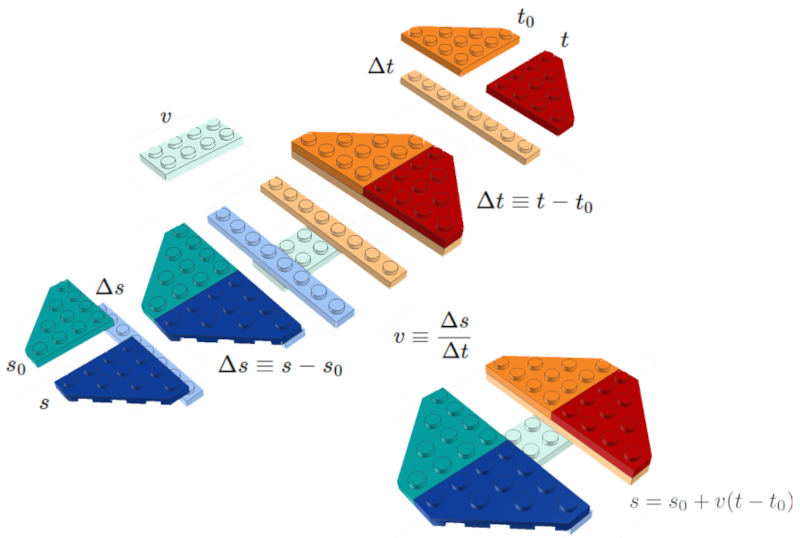
In this representation, an equation is not initially presented as a mathematical expression, but as the assembly of the variables that compose it. Each new equation brings together a set of previously defined "pieces" to build a larger structure. Subsequently, these new structures can be combined again with others, allowing the model to grow in an orderly manner until it represents the entire phenomenon.
It is important to note that this analogy is used only as a teaching tool at the beginning of learning. We are not working with real LEGO blocks nor are we intended to represent all aspects of the modeling process through them. Its sole purpose is to help understand that a variable constitutes a basic element of the model and that the equations represent the way in which these elements are progressively assembled to build increasingly complete scientific models.
ID:('gp', 583)
Identification of Variables and Construction of the Model
Storyboard
The first step in building a scientific model is to clearly define the phenomenon you want to describe. In this example, the objective is to model the uniform rectilinear motion of a body moving on a laboratory rail. From this definition, a systematic process of identifying the variables necessary to represent the phenomenon through a mathematical model begins.
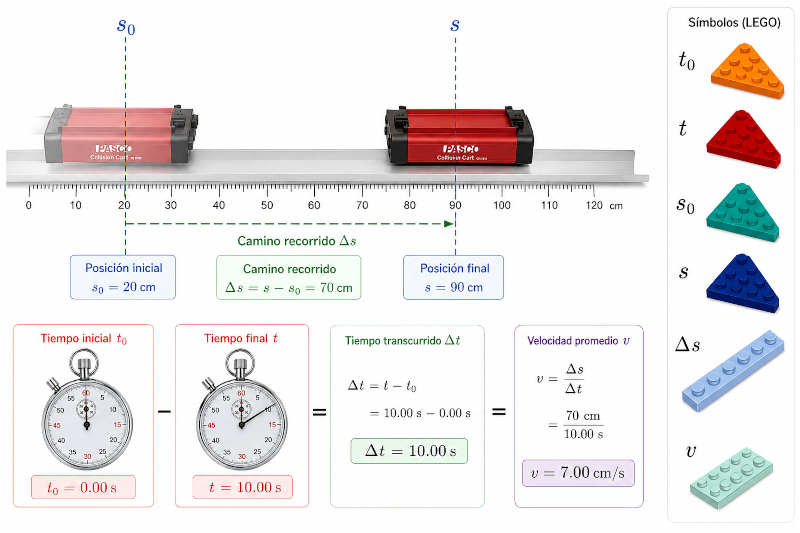
First, the fundamental variables that describe the state of the system are identified. In this case they correspond to the position of the body $s$ and the time $t$. Next, the necessary parameters are incorporated to fully characterize the movement, such as the initial position $s_0$, the initial time $t_0$ and the constant velocity $v$. Each of these variables is clearly defined and associated with a symbol that will later be part of the model.
Once the variables have been identified, the next step is to determine the equations necessary to relate them. For this example, the equations that allow calculating the elapsed time $\Delta t=tt_0$ and the distance traveled $\Delta s=ss_0$ are first introduced. Finally, the equation that relates both magnitudes is incorporated through the average velocity $v=\Delta s/\Delta t$. With this, a complete model is defined capable of quantitatively describing the uniform movement of the body.
ID:('gp', 598)
Variables as Building Blocks of a Model
Storyboard
When beginning the scientific modeling process, one of the most difficult concepts to understand is that of variable. To facilitate this idea, a very simple analogy is used: each variable is represented as if it were a LEGO brick. In the same way that one brick can be joined with others to build an increasingly complex structure, each variable can be related to others by an equation to form a part of the model.
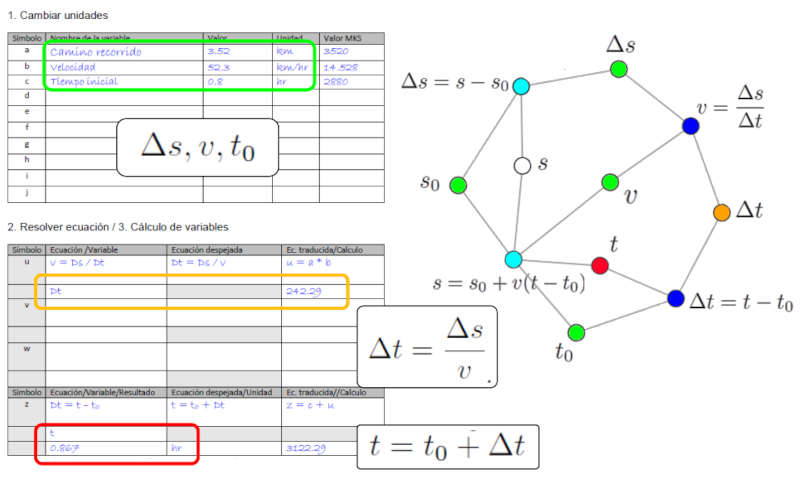
In this representation, an equation is not initially presented as a mathematical expression, but as the assembly of the variables that compose it. Each new equation brings together a set of previously defined "pieces" to build a larger structure. Subsequently, these new structures can be combined again with others, allowing the model to grow in an orderly manner until it represents the entire phenomenon.
It is important to note that this analogy is used only as a teaching tool at the beginning of learning. We are not working with real LEGO blocks nor are we intended to represent all aspects of the modeling process through them. Its sole purpose is to help understand that a variable constitutes a basic element of the model and that the equations represent the way in which these elements are progressively assembled to build increasingly complete scientific models.
ID:('gp', 584)
The Network of Equations: the "Octopus"
Storyboard
Once all the variables have been defined and the equations that describe their relationships have been established, the final result of the modeling process is a list of variables and a network of equations that represents the complete structure of the model. Each equation connects a set of variables and, when joined with the others, forms a network capable of describing the behavior of the system studied.
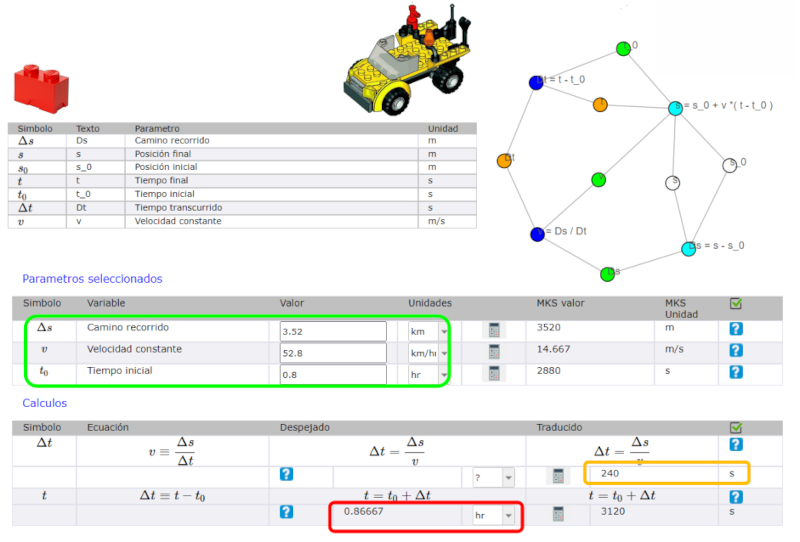
This network is loaded into a computational tool that represents it graphically. The nodes correspond to variables and equations, while the connections show the dependencies between them. The representation is completely interactive: the user can move the diagram with the mouse and the "arms" of the network dynamically adjust in all directions to keep the relationships between its components visible.
Over time, students began to affectionately refer to this representation as "the octopus," due to the appearance the network took on as it extended and moved its connections on the screen. The expression became naturally incorporated into the everyday language of the course and it was common to hear phrases like: "Now let's solve the problem with the octopus."
This name was never a formal concept of the course, but rather a nickname that arose spontaneously among the students themselves to refer to the graphic tool with which they explored and used the models built during the learning process.
ID:('gp', 585)
Manual Problem Solving Using the Network of Equations
Storyboard
The first use of the equation network is as a support tool for manual problem solving, complemented by a worksheet that the student can complete by hand. The objective is not to automate the calculation, but to systematically guide the reasoning necessary to reach the solution.
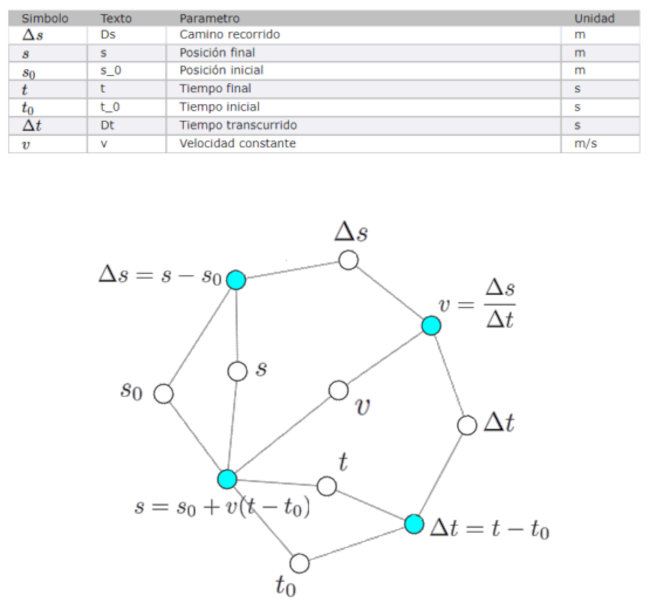
The process begins by reading the problem statement and identifying the variable you want to calculate. This is marked on the network as the target node (red node). Subsequently, the variables whose values are given by the statement are identified and marked as known data (green nodes).
From this information, the structure of the network itself allows us to determine which intermediate variables must be calculated to reach the objective. Throughout the process a very simple rule is maintained: each equation can only be used when it has a single unknown. In this way, the student advances step by step successively calculating the intermediate variables (yellow nodes) until finally obtaining the desired value.
Although this rule may seem restrictive, in practice it is not a limitation. The network already contains previously identified all possible paths between the equations, including those that involve systems of equations. As a result, the student can focus on physical reasoning and the logical sequence of calculations, without having to reanalyze the mathematical structure of the model for each problem.
ID:('gp', 586)
From Paper Form to Computational Tool
Storyboard
Once the manual resolution procedure using the equation network is understood, a computer version of the work form is introduced. This tool maintains the same logic used in manual resolution, but makes it easier to handle variables, equations and conversions during the development of the exercises.
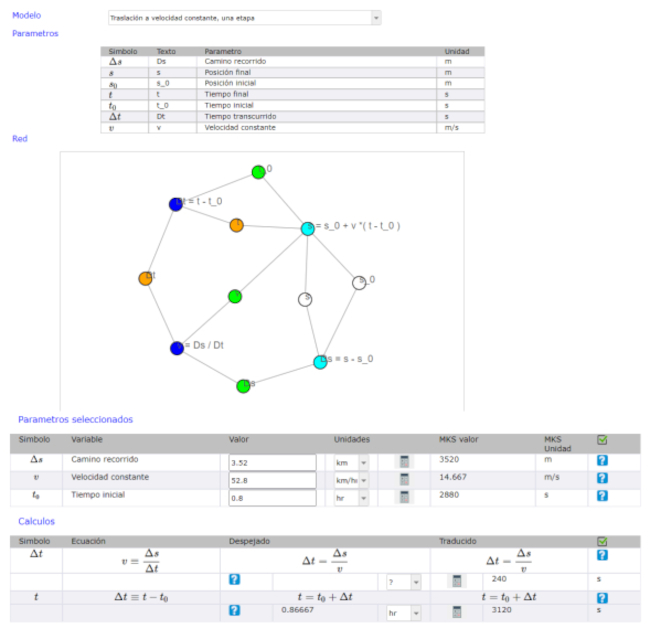
The application is organized into two main areas. The first corresponds to the variables section, where the student can consult all the variables in the model, enter known values and use an integrated unit converter. In this way, quantities can be entered in the available units, while the system automatically performs the necessary conversions to maintain the consistency of the model.
The second corresponds to the calculation section, intended for working with the equations. There are fields to enter each equation in its original form and also its corresponding cleared version, allowing you to have all the forms necessary to carry out the calculations. This facilitates the construction and documentation of the model, maintaining an explicit representation of the mathematical relationships used.
The tool reproduces the same procedure followed in the manual form, but provides a more organized environment to record variables, manage units and document the equations that are part of the scientific model.
ID:('gp', 587)
Computational Support for Algebraic Work
Storyboard
Once the digital form has been incorporated, it is possible to complement it with symbolic algebra tools, such as wxMaxima, which allow operations such as solving equations to be automatically performed. In this way, the student can obtain the different algebraic forms of an equation without having to manually carry out all the transformations.
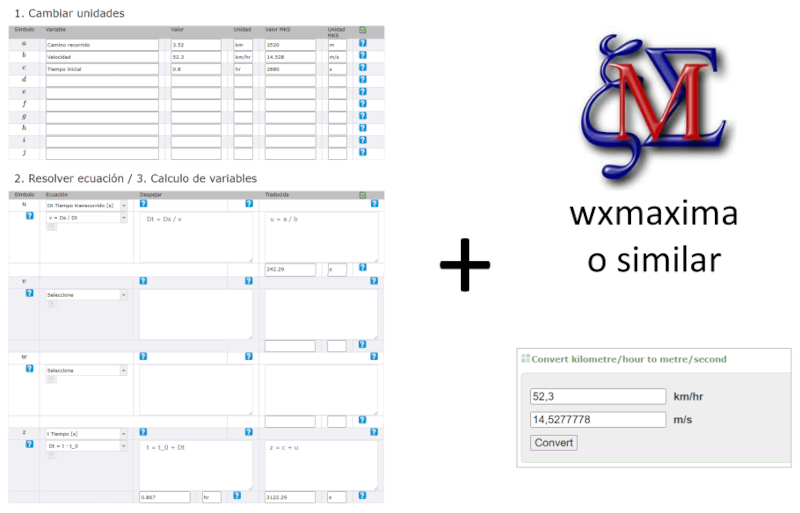
The purpose of this support is not to replace the learning of algebra, but to prevent the difficulties derived from insufficient practice in manipulating equations from becoming an obstacle to the study of Physics. In many cases, mastery of algebraic work corresponds to skills developed in previous Mathematics courses and is not the main objective of the Physics course.
By having a tool that automatically solves equations, the student can concentrate their efforts on understanding the physical phenomenon, selecting the appropriate model, identifying the relevant variables and correctly interpreting the results obtained. In this way, attention remains focused on physical reasoning and model construction, while routine algebraic operations are supported by the software when appropriate.
ID:('gp', 588)
Assisted Selection of Equations and Variables
Storyboard
The next step is to replace the open worksheet with a more guided tool, in which the student can directly select the equation they want to use and the variable they need to solve. The system is responsible for automatically presenting the corresponding algebraic form, simplifying the calculation procedure.
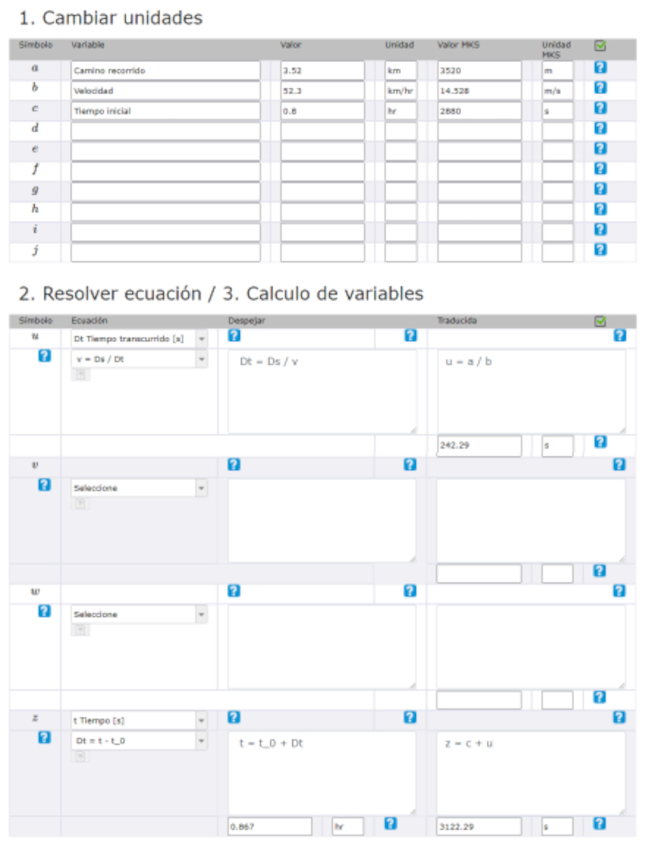
With this evolution, the emphasis of learning stops being on the manual manipulation of the equations and begins to focus on the really important part of the process: understanding the problem, correctly identifying the variables involved and selecting the appropriate equations to describe the physical phenomenon.
As the tool takes on more mechanical tasks, the student spends more and more time on physical reasoning and less on routine operations. The main challenge becomes deciding what information is relevant, how the variables relate to each other and what is the logical sequence of equations that leads to the solution. Once these elements are identified, the calculation process is reduced to executing the necessary operations to obtain the final result.
ID:('gp', 589)
The Integrated Modeling and Calculation System
Storyboard
The final stage consists of integrating all the previous elements into a single tool based on the network of equations or "octopus". The user begins by identifying the known variables and entering their values and units. Based on this information, the system uses the network structure to automatically display the variables and equations related to the problem being solved.
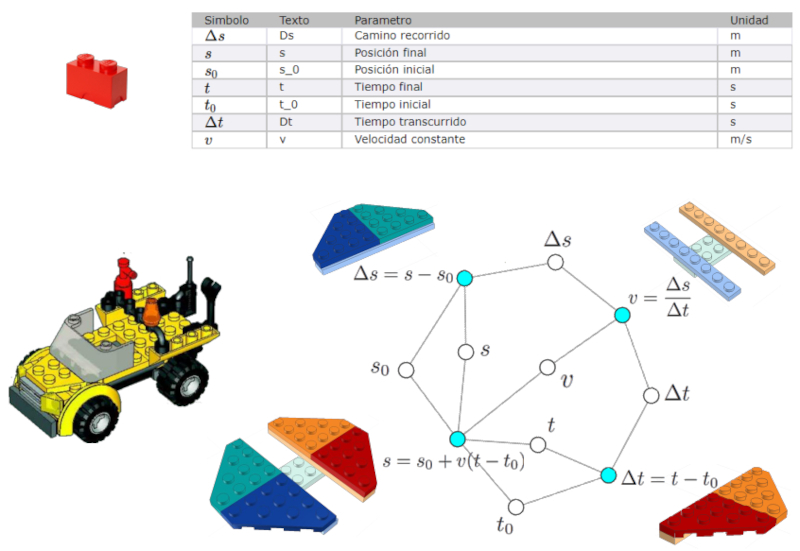
The "octopus" itself becomes the central work element. From there, the variables that participate in each calculation are selected and the necessary operations are successively executed to advance towards the final result. Each calculation carried out is recorded, forming a complete documentation of the procedure followed and allowing the origin of each value obtained to be subsequently reviewed.
As the variables maintain their respective units associated throughout the process, the system allows the necessary conversions to be carried out at any stage of the calculation without losing the consistency of the model. In this way, the tool integrates the identification of variables, the selection of equations, the execution of the calculations and the complete registration of the solution in a single environment, always keeping the structure of the physical model that gives rise to the results visible.
ID:('gp', 590)
Comprehensive Problem Resolution Using Scientific Models
Storyboard
The fully integrated version of the system allows the student to use scientific models in a very similar way to how a professional would. Faced with a problem, the first challenge is to identify which is the appropriate model to describe the phenomenon. Each topic developed during the course normally has between 10 and 20 models, each intended to represent a specific physical situation.
Once the model is selected, the student identifies the known variables, defines their units and performs the necessary conversions. Subsequently, it determines the resolution strategy, establishing the sequence of intermediate calculations required to achieve the target variable. The system accompanies this process using the network of equations to support the application of the model, until finally obtaining the result and expressing it in the requested units.
Consequently, the emphasis of teaching stops being on the mechanical execution of calculations and begins to focus on the truly relevant aspects of learning Physics: understanding natural phenomena, identifying the mechanisms involved and understanding the equations that describe them. The function of the "octopus" is to provide an environment where the student can demonstrate that he is capable of correctly selecting the model, recognizing the variables and appropriately applying the knowledge acquired to solve the problem posed.
ID:('gp', 591)
Physics of Kinesiology
Storyboard
The Physics of Kinesiology course introduces the fundamental principles of Physics that allow us to understand, quantify and analyze human movement. Its goal is to provide students with a scientific basis for interpreting the functioning of the musculoskeletal system, evaluating functional performance, and understanding how physical laws govern both normal locomotion and rehabilitation processes.
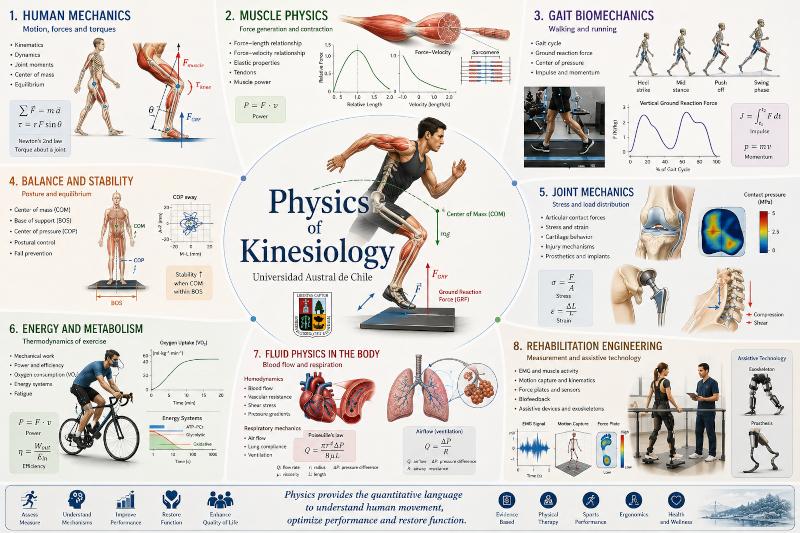
The contents cover the main physical phenomena involved in human biomechanics. The mechanics of movement, the generation and transmission of muscular forces, gait, postural balance, stability, joint mechanics, energy metabolism and fluid transport within the body are studied. The course also introduces concepts related to rehabilitation engineering, including assistive technologies, prosthetics, orthoses, and analysis tools used in clinical evaluation.
The approach integrates physical models, quantitative analysis and examples applied to real Kinesiology situations, allowing concepts such as force, energy, momentum, pressure, flow and balance to be related to the normal and pathological function of the human body. In this way, Physics ceases to be a set of abstract principles and becomes a tool that allows us to understand movement, support clinical decisions and objectively analyze the functioning of the musculoskeletal system.
ID:('gp', 592)
Physics of Marine Biology
Storyboard
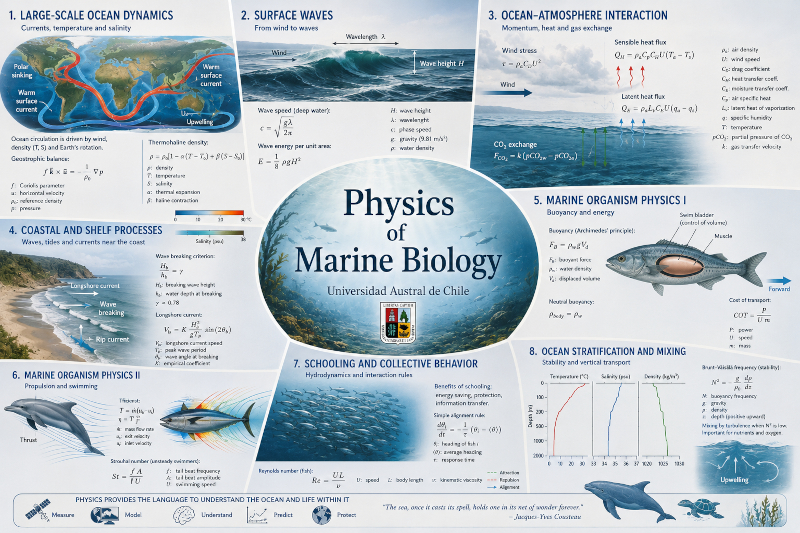
The Physics of Marine Biology course presents the physical principles that govern the functioning of the oceans and their influence on marine organisms. Its purpose is to provide students with a quantitative understanding of the processes that regulate the ocean environment and how the laws of Physics determine the distribution, behavior and adaptation of life in the sea.
The contents cover the dynamics of large ocean currents, the formation and propagation of waves, the interaction between the ocean and the atmosphere, coastal processes, the stratification and mixing of water masses, as well as the physical mechanisms involved in the locomotion, buoyancy and collective behavior of marine organisms. The exchanges of heat, mass and gases between the ocean and the atmosphere are also analyzed, along with the transport processes that determine the biological productivity and functioning of marine ecosystems.
The course integrates concepts from fluid mechanics, thermodynamics, heat transfer, wave dynamics, hydrodynamics and environmental physics to explain phenomena ranging from the global circulation of the oceans to the interaction of fish and marine mammals with their environment. In this way, students acquire an integrated vision of Physics as a fundamental tool to understand the processes that support marine life and the dynamics of ocean ecosystems.
ID:('gp', 593)
Physics of Forest Sciences
Storyboard
The Physics of Forest Sciences course introduces the physical principles that allow us to understand the functioning of forest ecosystems and the interactions between soil, vegetation, atmosphere and climate. Its objective is to provide a quantitative basis to analyze the processes that regulate forest growth, tree stability, the water cycle and the response of ecosystems to environmental conditions.
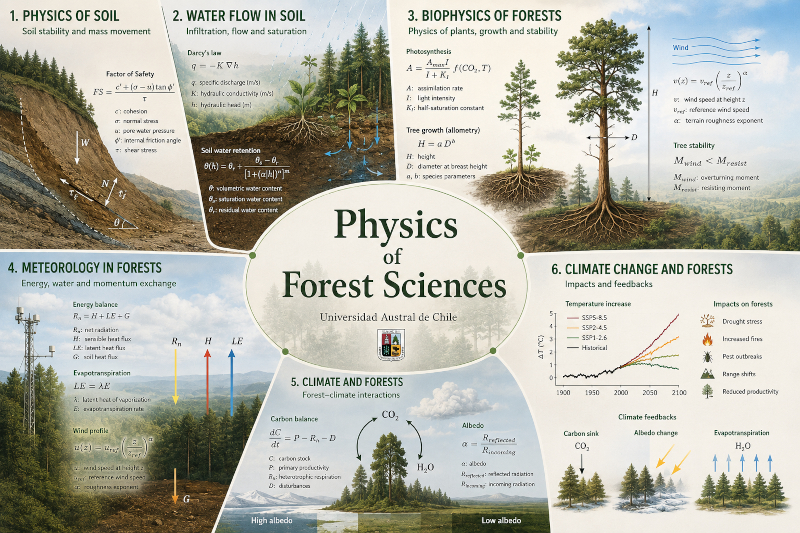
The contents cover soil mechanics and slope stability, the flow of water in the soil, the absorption and transport of water by plants, the biomechanics of trees, forest meteorology and the exchanges of energy, water and momentum between the forest and the atmosphere. Likewise, the interactions between climate and forest ecosystems are studied, including carbon balance, evapotranspiration, albedo, carbon storage and the effects of climate change on the productivity, distribution and stability of forests.
The course integrates concepts from mechanics, fluid mechanics, thermodynamics, heat transfer, environmental physics and biomechanics to explain the physical processes that support the functioning of forest ecosystems. In this way, students acquire a scientific vision of the mechanisms that control the development, stability and dynamics of forests, as well as their role in the hydrological cycle, the climate system and environmental conservation.
ID:('gp', 594)
Physics in Medicine
Storyboard
The Physics in Medicine course introduces the physical principles that explain the functioning of the human body and constitute the basis of numerous diagnostic, monitoring and treatment techniques used in medical practice. Its purpose is to provide students with a quantitative understanding of the main physiological processes, showing how the laws of Physics allow us to describe and analyze the behavior of the different systems of the organism.
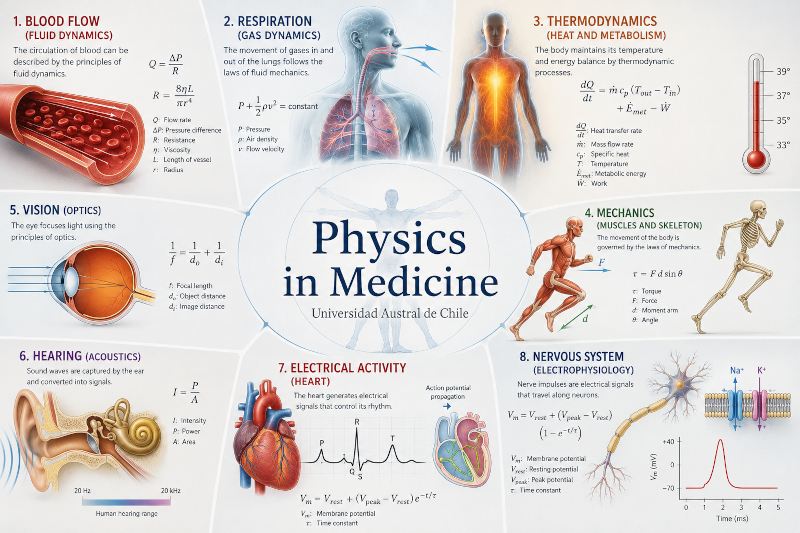
The contents cover the dynamics of blood flow, the mechanics of respiration, the thermodynamics of metabolism and the regulation of body temperature, the biomechanics of the musculoskeletal system, the optics of the eye, the acoustics of the auditory system, the electrical activity of the heart and the electrophysiological foundations of the nervous system. Each of these topics is studied using physical models that allow us to relate physiological variables with the mechanisms responsible for their normal functioning and their alterations.
The course integrates concepts from mechanics, fluid mechanics, thermodynamics, optics, acoustics, electricity and electromagnetism to offer a unified vision of Physics applied to Medicine. In this way, students acquire a scientific basis that allows them to understand both the physiological processes and the physical foundation of numerous technologies used in the diagnosis and treatment of diseases.
ID:('gp', 595)
Medical Technology
Storyboard
The Medical Technology course presents the physical and engineering foundations that support the development and operation of the technologies used in modern medicine. Its objective is to provide students with an integrated vision of how Physics, Engineering and Biomedical Sciences converge for the design, operation, evaluation and optimization of equipment and systems intended for the diagnosis, monitoring, treatment and rehabilitation of patients.
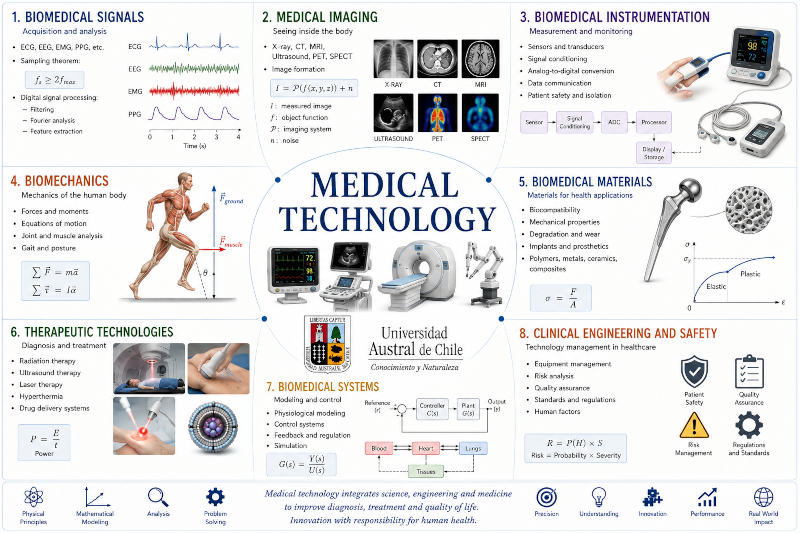
The contents cover the acquisition and processing of biomedical signals, the main medical imaging modalities - such as radiography, computed tomography, magnetic resonance, ultrasound, PET and SPECT -, biomedical instrumentation and its measurement systems, biomaterials used in implants and prostheses, biomechanics applied to the human body, therapeutic technologies, modeling of physiological systems and the principles of clinical engineering, including technological management, patient safety and quality assurance of medical equipment.
The course integrates concepts from electronics, signal processing, mechanics, materials science, image physics, automatic control, and biomedical engineering to provide a quantitative understanding of the technologies used in the healthcare field. In this way, students acquire a scientific basis that allows them to understand both the physical operation of medical equipment and the principles that guarantee its correct performance, safety and clinical application.
ID:('gp', 596)
Basic Mechanics
Storyboard
The Basic Mechanics course provides the foundations of Classical Mechanics, constituting the basis on which most of the other areas of Physics are subsequently developed. Its purpose is for students to understand the laws that describe the movement, forces, energy and dynamics of physical systems, developing a quantitative vision of the mechanical phenomena present both in nature and in numerous applications of engineering and science.
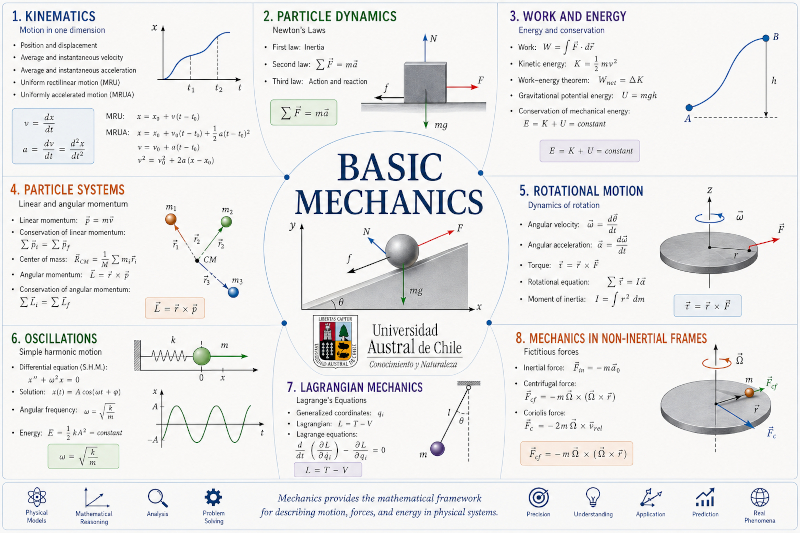
The contents cover the kinematics of motion in one and several dimensions, Newton's laws and particle dynamics, work and energy, conservation of momentum, particle systems, rotational dynamics, simple harmonic motion, the foundations of Lagrangian mechanics and the description of motion in non-inertial reference frames. Throughout the course, the main physical quantities, mathematical models and conservation laws are introduced that allow the analysis of a wide variety of mechanical problems.
The course integrates concepts from geometry, differential calculus, vector algebra and physical modeling to provide a rigorous description of the behavior of bodies subjected to forces. This knowledge constitutes the basis for subsequent courses in thermodynamics, fluid mechanics, electromagnetism, statistical physics, biomechanics and numerous other areas where Mechanics represents the starting point for the construction of scientific models.
ID:('gp', 597)
Palos Verdes, Costa de Corral, Región de los Rios, Chile