
 User:
User:


Hilti, Fastening Systems
Storyboard

My first job as a physicist began at the end of 1979 at Hilti Befestigungstechnik, in Schaan, Principality of Liechtenstein. At that time the company had already established itself as an international organization, with approximately 6,500 employees and a turnover of close to 800 million Swiss francs. Four decades later, in 2025, Hilti exceeds 35,000 employees and 6 billion Swiss francs in annual sales, reflecting the extraordinary growth it experienced during that period.
I was hired to join the Research Center, initially in the area of applied acoustics. My job was to support the company's efforts to reduce the noise level of its tools and develop acoustic techniques that would allow, for example, to diagnose the operating status of the equipment based on the sound signals they emitted.
However, my scientific curiosity and interest in understanding the physical functioning of products meant that I soon began to participate in much more diverse projects. Applied physics offered a different way of approaching engineering problems: it allowed us to identify the fundamental causes of a failure, explain seemingly inexplicable behaviors, and discover opportunities for innovation that were not evident from a purely technological approach. Over time, this way of facing challenges became the hallmark that would mark much of my professional career.
I stayed at Hilti for almost ten years, an extraordinarily enriching period both from a professional and personal point of view. There I learned to look at each problem as a physical phenomenon that could be understood through observation, experimentation and reasoning, developing a way of working that has accompanied me throughout my life. I have always felt that physics is in my blood and that my greatest motivation has been to understand how the world works in order to, based on that knowledge, find solutions and promote innovation.
They were intense, challenging and deeply rewarding years. I had the opportunity to work alongside top-level engineers and researchers, participate in the development of new products and contribute to solving complex problems that came from different areas of the company. More than a workplace, Hilti was a true school of applied research, and during that period I came to fully feel like a "Hiltianer", sharing not only the company's objectives, but also its culture of innovation, technical excellence and commitment to quality.
ID:('ky', 1779)
When physics transformed a tool into a secure system
Storyboard
In the early 1950s, Martin Hilti identified the enormous potential of a technology that allowed steel elements to be fixed directly to concrete using a nail driven by an explosive charge. Instead of simply manufacturing the original design, he acquired the rights to the patent and began an in-depth redesign process based on physical principles. Its objective was not only to improve performance, but also to solve the main safety problem: that the nail could be ejected with sufficient energy to behave like a projectile.
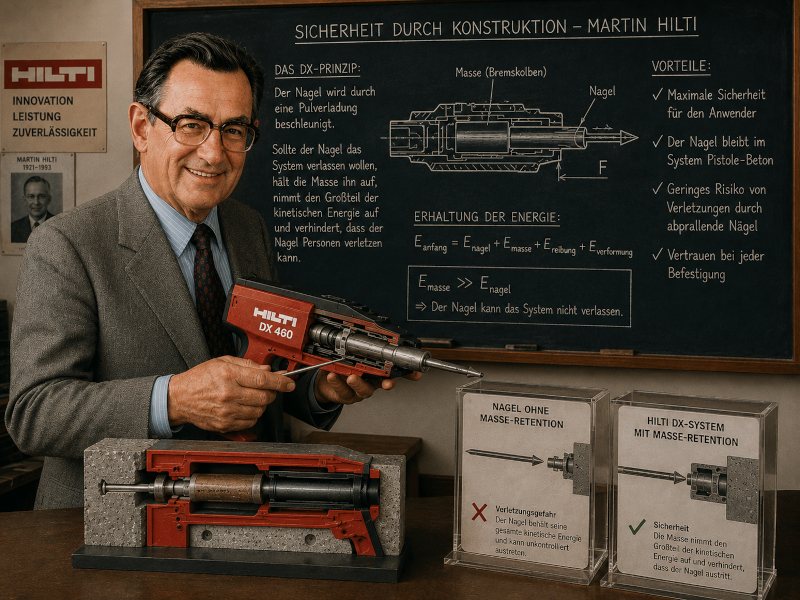
The decisive innovation consisted of incorporating a retaining mass between the explosion gases and the nail. Instead of the expansion of the gases directly accelerating the nail, it first propelled a much larger mass that transmitted the momentum to the fastener. In this way, most of the kinetic energy was stored in the mass of the system and only a fraction was transferred to the nail. The result was a nail that retained the energy needed to penetrate concrete, but traveling at a considerably slower speed.
From the point of view of physics, the system simultaneously takes advantage of the conservation of linear momentum and the distribution of kinetic energy between bodies of different masses. By increasing the mass involved in the movement, the speed reached by the nail decreases, drastically reducing the risk of it leaving the tool as a dangerous projectile.
This solution also had a practical consequence of enormous importance. By not firing a free projectile at high speed as occurs with a firearm, the equipment could be legally classified as an industrial tool and not a weapon. Thanks to this, its use in construction did not require permits to carry weapons in numerous countries, facilitating its mass adoption and at the same time raising safety standards at work.
The combination of mechanical engineering, physical analysis and understanding of the regulatory framework made this innovation one of Hilti's most influential developments. More than an incremental improvement, it was an example of how to apply physics to simultaneously solve a technical problem, a safety problem and a legal barrier, transforming a good idea into a technology widely used in the construction industry.
Note on the illustration: The image corresponds to an artistic reconstruction of Martin Hilti together with a team representative of the type of fastening tool that he developed from his innovation. This is not a historical photograph, but an illustration created for educational purposes to represent the operating principle and the technological context of the time.
ID:('gp', 604)
Hilti DX 36 system operation
Storyboard
The Hilti DX 36 system uses the principle of powder-actuated fastening to drive steel nails into materials such as concrete or steel quickly and safely. Unlike a conventional firearm, the nail is never directly affected by combustion gases. Instead, power is transmitted by an internal piston that remains retained within the tool throughout the operating cycle.
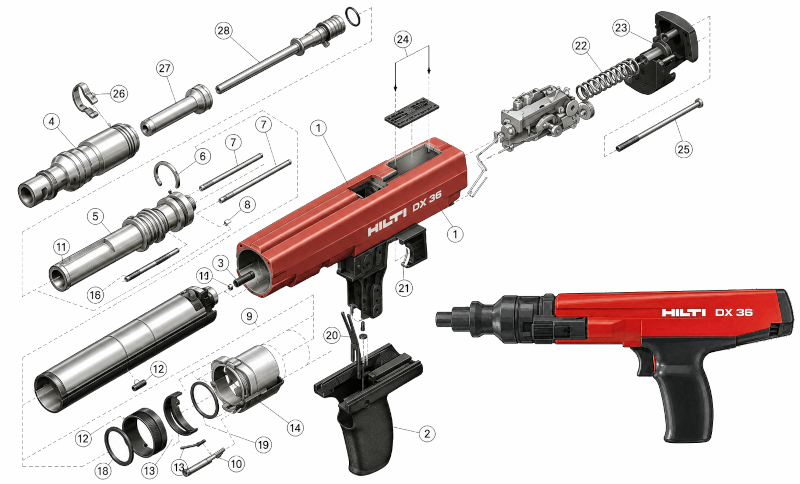
The process begins by placing the nail at the tip of the equipment, where it is aligned with the drive piston. The powder cartridges are housed in the magazine located in the handle of the tool, allowing multiple fixations to be made without the need to reload after each shot.
When the operator presses the tool against the work surface and activates the firing mechanism, a cartridge is automatically moved to the combustion chamber. When the trigger is pressed, the firing pin hits the primer of the cartridge, initiating the combustion of the gunpowder.
The gases generated by combustion rapidly increase the pressure inside the chamber and propel the piston forward. This piston transmits its mechanical energy to the nail, accelerating it to the speed necessary to penetrate the construction material. In this way, the piston acts as an intermediary between the explosion and the nail, controlling the transfer of energy.
Once the nail reaches the setting depth, the piston continues a short path until it is mechanically retained within the tool. The design prevents the piston from leaving the equipment, absorbing much of the remaining energy and preventing it from becoming a projectile.
Finally, the combustion gases are evacuated through the equipment's exhaust ducts, the internal pressure decreases and the mechanism automatically returns to its initial position. Simultaneously, the next cartridge is prepared to advance into the chamber during the next shot, leaving the Hilti DX 100 ready to perform a new chambering with speed, precision and a high level of safety.
ID:('gp', 605)
Compression fixation and metallurgical anchoring in concrete
Storyboard
When a direct fastening nail penetrates concrete at high speed, it does not simply act as a material displacer. The enormous pressure exerted on the tip and the intense friction developed during penetration generate a series of physical phenomena that allow obtaining an extraordinarily resistant fixation without the need to first drill the material.
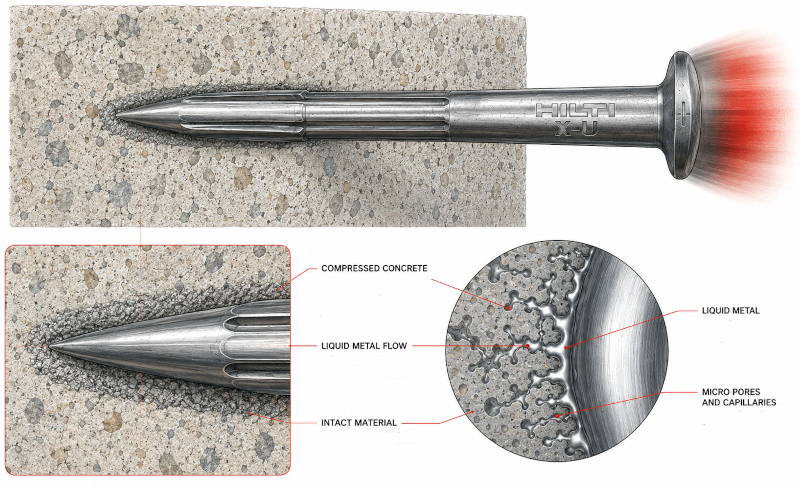
In the first stage of penetration, the tip of the nail compresses the concrete in front of it. The aggregates and cement paste are displaced laterally and undergo very intense compaction around the body of the nail. Far from fracturing the material in a generalized way, this process creates a densified zone that acts as a confinement ring, considerably increasing the extraction resistance.
At the same time, the high relative velocity between the steel and the concrete produces intense frictional heating on the surface of the nail. During an extremely short interval, the most superficial layer of the steel can reach temperatures sufficient to undergo plastic behavior and even localized melting. This softened or partially liquefied metal is pushed by the enormous pressure towards the micropores, capillaries and irregularities existing in the concrete matrix.
When the penetration is complete, the steel cools almost instantly and solidifies within these microscopic cavities. The result is additional mechanical anchorage that complements the compression of the concrete, forming an extremely strong interface between the nail and the base material.
The load capacity of the system is, therefore, a consequence of two mechanisms that act simultaneously. On the one hand, the compressed concrete exerts strong radial pressure on the body of the nail, increasing friction and making it difficult to extract. On the other hand, the steel that has penetrated the surface microstructure of the concrete generates a microscopic interlocking that further increases the retention force.
The combination of both phenomenacompression of the surrounding material and surface metallurgical anchoringexplains why fixings made using direct firing systems can achieve high mechanical resistance using very short installation times and without causing significant damage to the concrete surrounding the nail.
ID:('gp', 606)
Drill with rotation and percussion
Storyboard
In the Hilti TE 17, the electric motor forms the heart of the drive system. Its rotor, mounted vertically at the bottom of the drill, transforms electrical energy into a continuous rotation movement. Unlike a conventional drill, this rotation is not transmitted directly to the drill bit, but rather first reaches a gearbox where the mechanical power is divided into two independent paths.
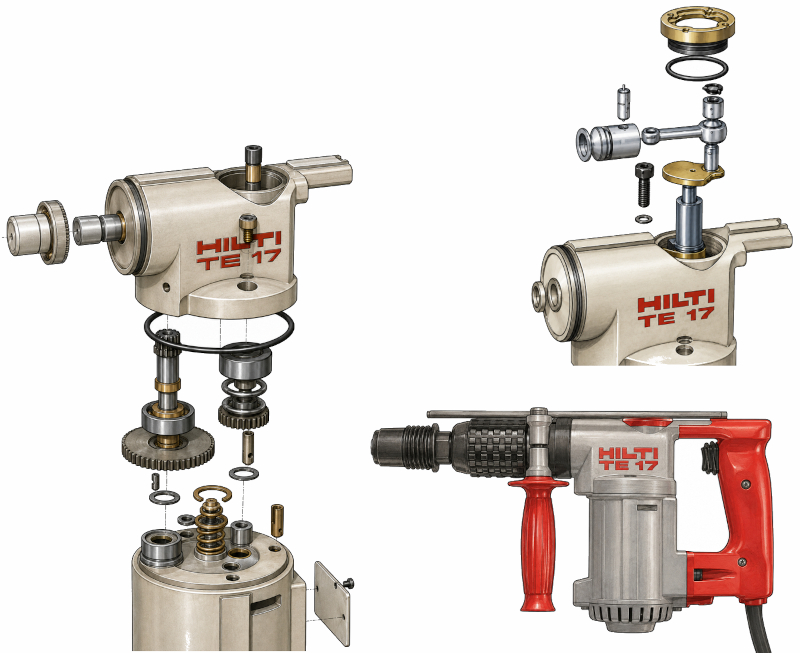
The first path corresponds to the left axis, responsible for transmitting rotation to the drill chuck. Through a set of gears and shafts, the movement reaches the front end of the tool, continuously rotating the bit during drilling.
The second path corresponds to the right axis. In this case, the rotation is driven towards a mechanism that transforms the circular movement into the reciprocating displacement of the percussion piston. Each turn of the mechanism moves the piston forward and backward, generating a succession of impacts that are transmitted to the hammer and finally to the drill bit.
Thanks to this mechanical division of power, the Hilti TE 17 can perform two functions simultaneously: the drill bit rotates continuously to evacuate the drilled material, while the percussion system produces thousands of impacts per minute that fracture the concrete or rock. The synchronized combination of both movements is the characteristic that distinguishes a rotary hammer from a conventional rotary drill and explains its high efficiency in highly hard materials.
ID:('gp', 607)
The spiral of the drill bit: continuous transport of the drilled material
Storyboard
The high drilling capacity of a rotary hammer depends not only on the energy of the impacts, but also on the way in which the drill bit removes loose material. With each stroke of the percussion mechanism, the carbide tip fractures the concrete and transforms a small amount of solid material into particles and grains of different sizes. Without an efficient evacuation system, these fragments would quickly fill the bottom of the hole, preventing the drill bit from continuing to penetrate.
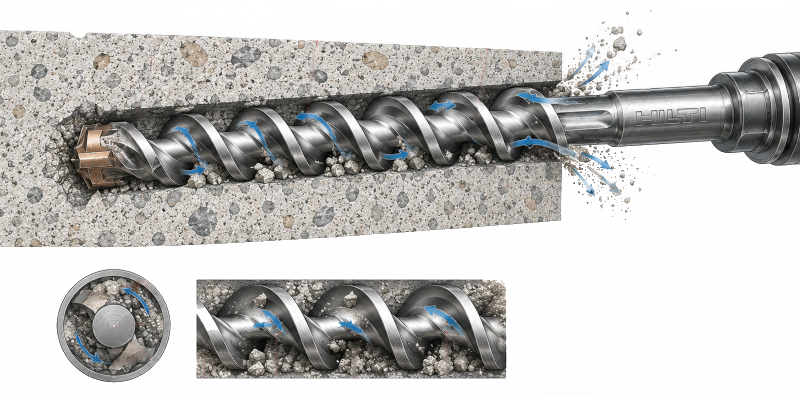
The continuous rotation of the drill bit solves this problem through its drilling spiral. Each revolution causes the released particles to fall into the helical channels and are progressively dragged towards the exit of the hole. The spiral acts as a conveyor screw that converts the rotation movement into a longitudinal movement of the material, keeping the area where the drilling tip acts clear.
While the hammer generates the impacts that fracture the concrete, the rotation simultaneously displaces the spiral, transporting the granulated material towards the outside of the hole. Both processes work synchronously: the percussion produces new particles and the spiral continuously evacuates them, preventing them from being crushed again or blocking the progress of the drill bit.
Thanks to this combination of impact fracture and helical transport, drilling maintains a high feed rate, reduces tool heating and allows the carbide tip to always act directly on solid material, increasing both the efficiency and the useful life of the drill bit.
ID:('gp', 608)
Bit vibrations and noise generation during drilling
Storyboard
The characteristic noise of a rotary hammer is the result of several physical phenomena that occur simultaneously during each impact. The percussion mechanism strikes the back of the drill bit at a very high frequency, transmitting pulses of force that travel along the steel to the tip that is in contact with the concrete. Each blow generates deformation waves that travel through the drill at high speed and produce small radial expansions and contractions of the material. These vibrations constitute the main source of periodic sound, whose fundamental frequency coincides with the operating frequency of the hammer.
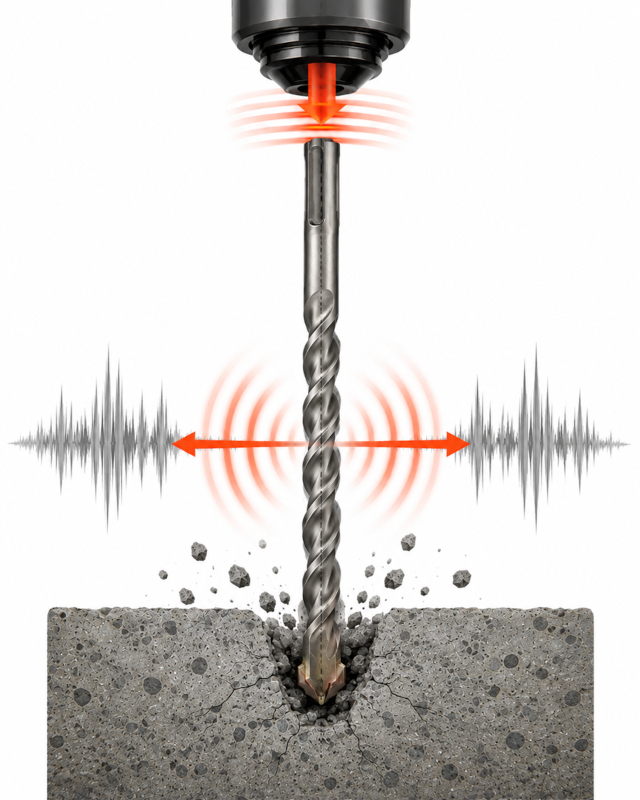
At the same time, the drill bit does not behave like a perfectly rigid body. Because its ends remain restrainedone by the chuck and the other by contact with the concreteperiodic excitations cause it to oscillate laterally according to its natural modes of vibration. These flexes are very small, but enough to displace the air surrounding the drill bit.
The lateral movement successively compresses and decompresses the surrounding air, generating pressure waves that propagate as sound. In this way, the acoustic spectrum observed during drilling results from the combination of the tone associated with the impact frequency of the hammer with a set of additional frequencies produced by the resonances and vibration modes of the drill bit. The interaction with the concrete, the progress of the drilling and the geometry of the drill bit continually modify these components, giving rise to the characteristic noise of the process.
Understanding these mechanisms allows us to identify the main sources of acoustic emission and constitutes the basis for developing solutions that reduce the noise level. These include the design of percussion mechanisms with less vibratory excitation, drill bits with optimized dynamic properties, materials with greater damping and isolation systems between the tool and the operator. The final objective is to reduce exposure to noise, improving both the operator's working conditions and the acoustic impact on the environment where the drilling work is carried out.
ID:('gp', 609)
Diamond core drilling: controlled wear and self-renewal of diamonds
Storyboard
Drilling with a diamond core bit uses a completely different mechanism than with a rotary hammer. Instead of fracturing the concrete through impacts, cutting is done by abrasion. Numerous industrial diamonds are embedded in the edge of the crown, which, when rotating at high speed, continually tear and wear away the concrete surface. Each diamond eliminates microscopic particles of cement and aggregates, producing a fine powder that, when mixed with the cooling water, forms a suspension that is constantly evacuated from the cutting area.
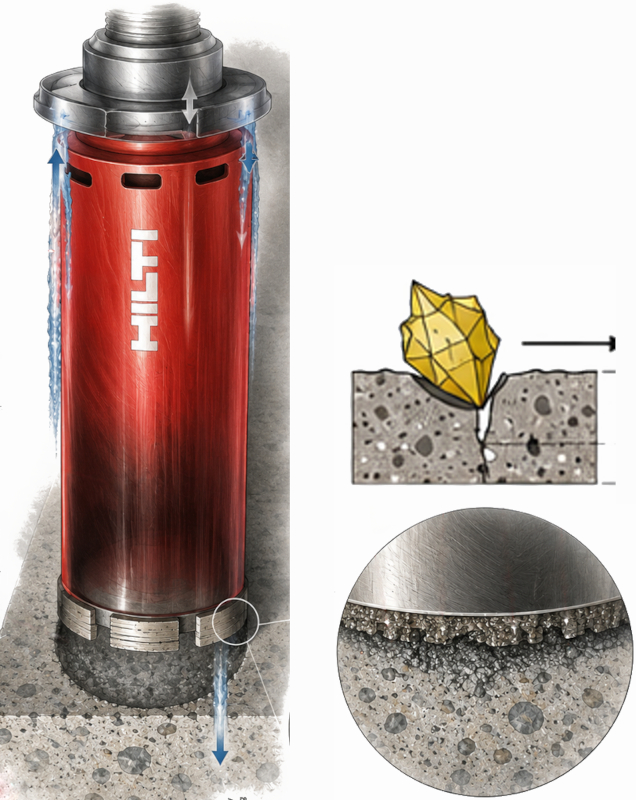
Water performs several essential functions during this process. In addition to transporting the ground material to the outside of the hole, it cools both the crown and the diamonds, reducing the heating produced by friction and reducing tool wear. In this way, an adequate temperature is maintained to preserve the mechanical properties of the diamonds and the metal matrix that supports them.
As diamonds work, their cutting edges wear down and progressively lose their ability to continue removing material. However, the tool is designed to self-renew. The metal matrix that secures the diamonds also slowly wears away through abrasion, leaving more and more of the diamonds exposed until they eventually fall off. At that moment, new diamonds appear, originally embedded in the matrix, which immediately begin to participate in the cutting process. Thanks to this controlled wear of the matrix, the bit maintains a practically constant drilling capacity for much of its useful life.
As only the material corresponding to the thickness of the crown is removed, the center of the hole remains intact, forming a concrete cylinder. Once the desired depth has been reached, this core can be detached or extracted, leaving a perfectly circular hole, with a diameter equal to that of the crown and with smooth, polished walls. This procedure allows obtaining highly precise drilling, with minimal vibration and without producing significant cracks in the surrounding material, which makes it the preferred technique for installations of large diameter pipes, ducts and anchors.
ID:('gp', 610)
Mechanical expansion anchors: pressure fixing against concrete
Storyboard
Mechanical expansion anchors allow structural elements to be securely fixed to concrete, taking advantage of the resistance of the material itself. The process begins by drilling a hole with the specified diameter and depth for the anchor. Once drilling is complete, it is essential to completely clean the hole, removing dust and all loose material generated during drilling. If these residues remain inside, the anchor can slide on them, significantly reducing the fixing capacity.
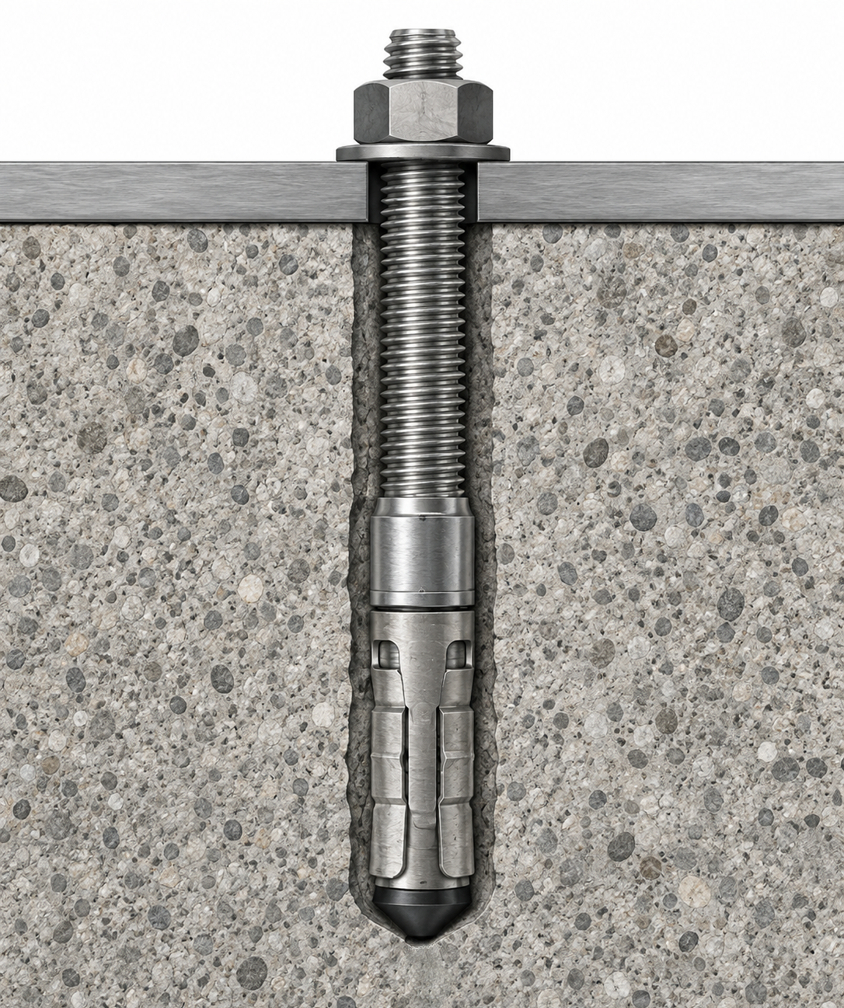
After cleaning the hole, the piece to be fixed is placed in its final position and the anchor is introduced through the hole in the piece until the expandable body is completely lodged within the concrete. At this stage the anchor does not yet transmit significant forces, since its expansion sheets remain retracted.
The next step is to tighten the top nut. When rotated, the threaded shaft begins to move axially with respect to the anchor body. This movement causes an expansion cone to rise towards the interior of the sheets or "legs" of the dowel. The conical geometry forces these sheets to open radially, pressing them firmly against the walls of the drilled hole.
As the tightening increases, the radial pressure between the metal sheets and the concrete generates high friction and a strong mechanical interlock. The anchor is immobilized inside the hole and the clamping force keeps the fixed piece firmly together against the concrete surface.
The result is a joint capable of resisting significant tensile and shear forces. The capacity of the system depends on factors such as the quality of the concrete, the diameter and depth of the anchor, the tightening torque applied and the correct cleaning of the hole before installation, the latter being one of the most important stages to guarantee a safe and reliable fixation.
ID:('gp', 611)
Bell Bit Oscillation and Fatigue Failure While Drilling
Storyboard
Large diameter drill bits with bell geometry are subjected to significant dynamic stresses during drilling. Although the tool rotates continuously, contact with the material is not always uniform around its entire perimeter. As a consequence, the drill bit can develop small lateral oscillations that, if they increase in amplitude, generate high alternating stresses in the metal structure.
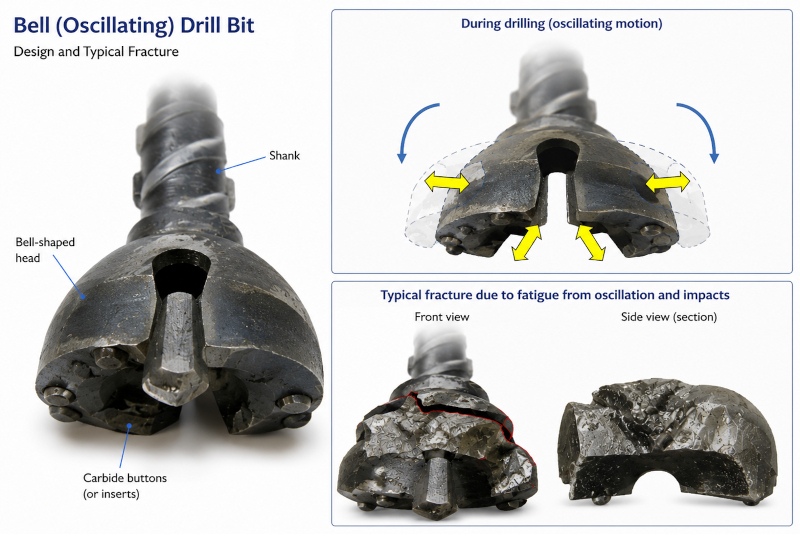
Ideally, both sides of the bell remain in contact with the material being drilled. This contact provides a mechanical reaction that limits the amplitude of the oscillations and distributes the forces relatively uniformly. However, during drilling cavities, irregularities or unevenness may appear that cause one of the sides to temporarily lose contact with the rock or concrete.
When this occurs, the supported side continues to be cushioned by the material, while the non-contacting side is virtually free to oscillate. By decreasing the opposition to the movement, the amplitude of that oscillation can increase considerably. Each revolution of the tool then subjects the bell to an alternating bending cycle, concentrating the forces in certain areas of the structure.
If this condition persists for a high number of cycles, the material begins to suffer mechanical fatigue. Initially, invisible microcracks appear and, over time, progressively propagate under repeated loads. Finally, when the crack reaches a critical size, the resistant section no longer supports the stresses and the bell can suddenly fracture during operation.
For this reason, the design of the tool seeks to minimize the probability that there will be unsupported sectors of the perimeter during drilling. An effective strategy is to increase the number of teeth or cutting elements distributed around the bell. With a greater number of contact points, it is much more likely that there will always be one interacting with the material, reducing free oscillations, reducing fatigue stresses and significantly increasing the useful life of the tool.
ID:('gp', 612)
From the product to the person: discovering the true effect of the color red
Storyboard
In order to better understand why customers preferred certain equipment, a model was developed that analyzed the purchasing decision process for drills used in construction. Among the numerous variables considered price, performance, reliability, durability, technical service and ease of use an unexpected result appeared: the color of the tool was one of the factors with the greatest influence on the perception of the product.
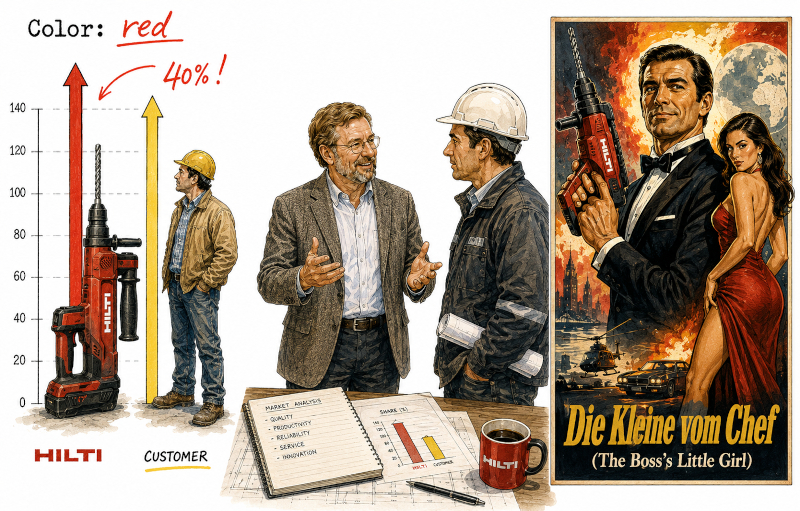
At that time, most manufacturers used colors such as green, blue, yellow or silver to identify their tools. Hilti, on the other hand, used a characteristic red color, easily recognizable in any work. The statistical analysis showed that approximately 40% of the product perception was associated, directly or indirectly, with this visual attribute. However, color alone could hardly explain such a high influence on the purchase decision.
To understand the underlying mechanism, opinion gathering was carried out directly at the construction sites, interviewing operators, foremen and supervisors. The study revealed that the true causal factor was not the color itself, but the social meaning that it had acquired within the work environment.
Hilti equipment was recognized as the highest priced and highest performing tools on the market. Because of this, companies tended to assign them to workers considered more experienced or more responsible. As a consequence, the color red ended up becoming a visible symbol of professional status: anyone who used a Hilti tool was perceived by their colleagues as an operator of greater importance within the organization.
This discovery changed the way we understand the business process. The color red did not directly generate the purchase; It acted as an indicator of recognition and prestige, influencing the perception of the user and those around him. Likewise, it showed that the sales strategy had to consider not only the technical characteristics of the product, but also the profile of the end user, especially when they performed more relevant functions within construction companies. In this way, the model made it possible to distinguish between an apparent correlationthe color red and the purchaseand the true underlying cause: the symbolic value and professional recognition associated with the use of the tool.
ID:('gp', 613)
Palos Verdes, Costa de Corral, Región de los Rios, Chile