
 User:
User:


Price Waterhouse, Chile
Storyboard

For several years I was Senior Manager at Price Waterhouse, mainly developing projects in Chile, although I also participated in consultancies in other South American countries and the United States.
My work was characterized by introducing into consulting an approach based on the scientific method, incorporating tools from Physics, and in particular concepts that today are associated with sociophysics and econophysics, for the analysis and solution of business problems. This approach aroused the interest of various Price Waterhouse offices in South America and even in the United States, opening up the possibility of joining me as a partner of the firm.
However, the conditions offered did not match my professional and personal expectations, so I finally chose to withdraw and continue my activity as an independent consultant.
ID:('ky', 1781)
From the scientific method to business consulting
Storyboard
The incorporation to Price Waterhouse occurred as a result of an alliance around projects of common interest, in which experience in management consulting coincided with a different way of approaching business problems. This collaboration opened the opportunity to join the firm as Senior Manager in the Business Consulting area, with the mission of developing projects that combined the rigor of the scientific method with the practical needs of the business world.

One of the main contributions that motivated this incorporation was the introduction of unusual tools in consulting at the time: the construction of explicit models of business processes, the causal analysis of operations and the use of simulations to evaluate scenarios before implementing real changes. Instead of basing recommendations solely on historical indicators or accumulated experience, the approach sought to understand the internal logic that governed the functioning of each organization and use that understanding to anticipate the effect of different decisions.
This approach made it possible to apply principles of physics and the scientific method to the study of companies in various sectors, transforming management problems into analyzable, verifiable models that could be improved through virtual experimentation. The possibility of basing recommendations on causal models and simulations was one of the differentiating elements of the work developed during this stage and marked the beginning of a line of research and consulting that would continue to evolve in the following years.
One of the characteristics that I assumed during that stage was the permanent use of the humita, which over time became a personal hallmark and an easily recognizable feature within the firm. More than an element of clothing, it sought to reflect a professional identity closely linked to the world of science and the use of the scientific method as a basis for the analysis and resolution of complex problems.
ID:('gp', 663)
From the company to the model: systematization of organizational knowledge
Storyboard
One of the first challenges was to transform the daily operation of the company into a structured model that could be objectively analyzed. To do this, it was necessary to systematize all the relevant information about the organization, documenting not only what activities were carried out, but also how they were related to each other, who executed them, what resources they used and what information they exchanged. This stage made it possible to convert people's tacit knowledge into explicit, verifiable and reusable knowledge.
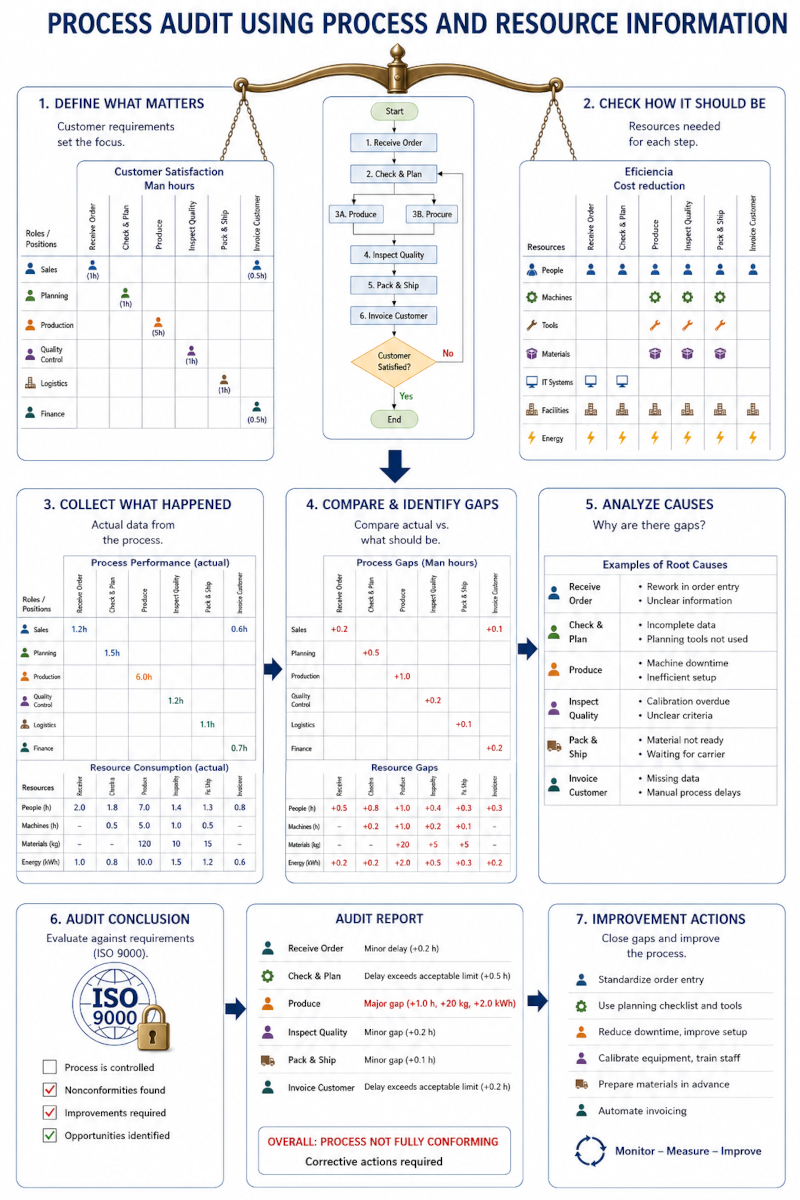
The survey began with the identification of the sequence of activities that made up each business process, recording their inputs, transformations and results. At the same time, the human resources involved were documented, specifying their functions, responsibilities, competencies and work capacity. In the same way, the material resources used by each process, their availability, use and operational restrictions were identified.
An equally important part of the work was the analysis of the flow of information. The sources of information that each activity consulted were recorded, as well as the documents, records and indicators that it generated for the rest of the organization. This made it possible to understand how knowledge circulated within the company and detect information losses, duplications or bottlenecks.
The analysis was complemented by the study of market behavior. The process by which customers made their purchasing decisions was modeled, identifying the attributes they most valued in the product or service, the factors that influenced their choice, and the way in which they perceived quality. In this way, the model integrated both the internal operation of the company and the logic with which the market evaluated its results, providing a solid basis for the analysis, simulation and subsequent redesign of business processes.
ID:('gp', 664)
Optimization of logistics systems: from diagnosis to improvement
Storyboard
The logistics optimization projects aimed to understand in detail the actual functioning of the supply chain before proposing any changes. To this end, a systematic survey of the processes involved in reception, storage, inventory control, order preparation, dispatch and replacement of products was carried out, documenting the sequence of activities, those responsible for each stage and the human and material resources used during the operation.
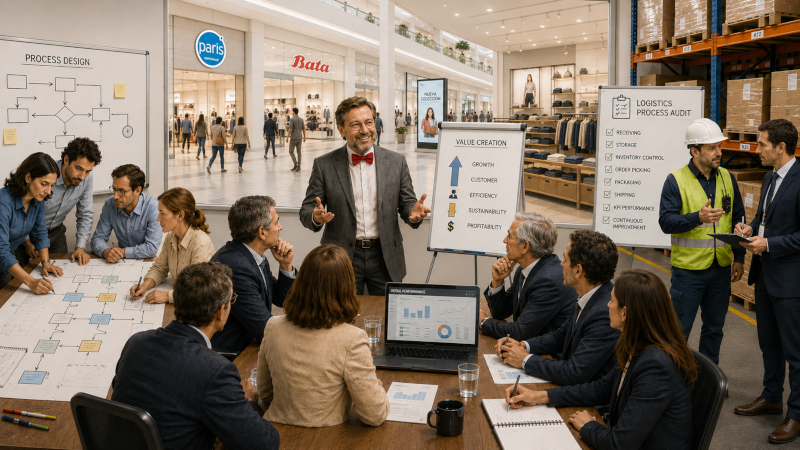
From this information it was possible to build a complete model of the logistics system and identify the factors that limited its performance. The analysis made it possible to detect inventory losses (shrinkage), registration errors, storage problems, inefficiencies in order preparation and bottlenecks that affected the normal flow of materials. Likewise, the timely availability of products was evaluated, identifying stockouts, delays in replenishment and other situations that prevented customer demand from being adequately met.
The study was not limited to describing the existing operation, but sought to understand how each of these problems impacted the company's management indicators. Lack of product availability reduced sales, while excess inventory and shrinkage increased operational costs and decreased profitability. On this basis, improvements were designed in processes, work organization and inventory management, relying on models and simulations to previously evaluate the effect of the different alternatives before their implementation.
Among the most representative projects of this line of work are those developed for the logistics systems of Almacenes Paris, whose partner responsible for the relationship with the client was Luis Enrique Álamos, and of Bata, where that function corresponded to Leslie Hemery. In both cases I was in charge, as Senior Manager, of the technical direction of the projects, coordinating the process survey, the construction of analysis models, the evaluation of improvement alternatives and the formulation of recommendations for the company. The methodology allowed us to obtain a comprehensive view of the operation, identify opportunities for improvement and propose solutions aimed at increasing product availability, reducing inventory losses, optimizing the use of resources and simultaneously improving operational efficiency, service quality and business profitability.
ID:('gp', 665)
Institutionalizing improvement: documentation and management control
Storyboard
A fundamental part of the consulting projects was to ensure that the improvements implemented remained over time and did not depend solely on the people who had promoted them. To achieve this, survey, documentation and control methodologies were applied that allowed the new practices to be transformed into formal procedures of the organization, integrating them into the daily management of the company.
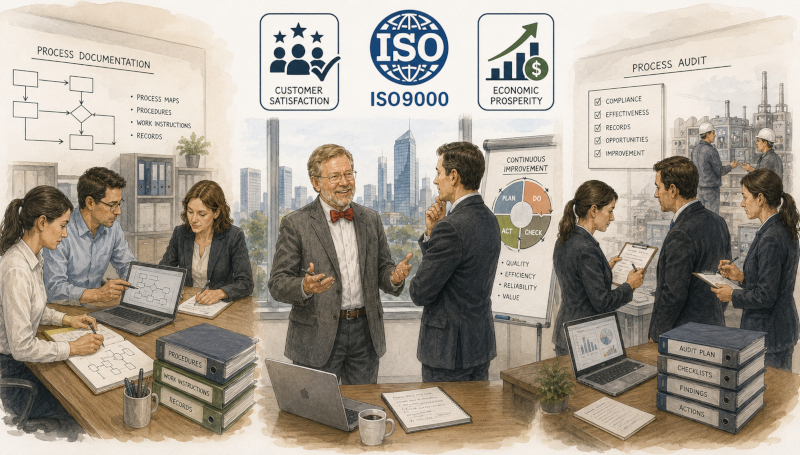
The work began with detailed documentation of the processes, clearly defining their objectives, activities, people responsible, resources, performance indicators and associated records. On this basis, management control mechanisms were established that made it possible to monitor compliance with the processes, detect deviations and promote a permanent cycle of continuous improvement. In this way, knowledge stopped depending on the individual experience of people and became an institutional asset of the company.
The methodologies used were based on the principles of ISO 9000 standards and management control techniques developed for modern administration. Although in many projects the objective was not to obtain formal certification, the system was structured following the same criteria of traceability, standardization, documentation and continuous improvement required by these standards. This made it possible to consolidate the organizational changes, facilitate their maintenance over time and leave the company in a position to subsequently initiate a certification process if it deemed it appropriate.
ID:('gp', 666)
FCAB: efficiency financed with the results
Storyboard
One of the most challenging projects of this stage was the one developed for the AntofagastaBolivia Railway (FCAB), whose objective was to comprehensively analyze the company's management to identify opportunities to increase its operational and administrative efficiency. The work began with a detailed survey of the processes, organization and use of resources, allowing the construction of an operating model that would serve as a basis for evaluating improvement alternatives.
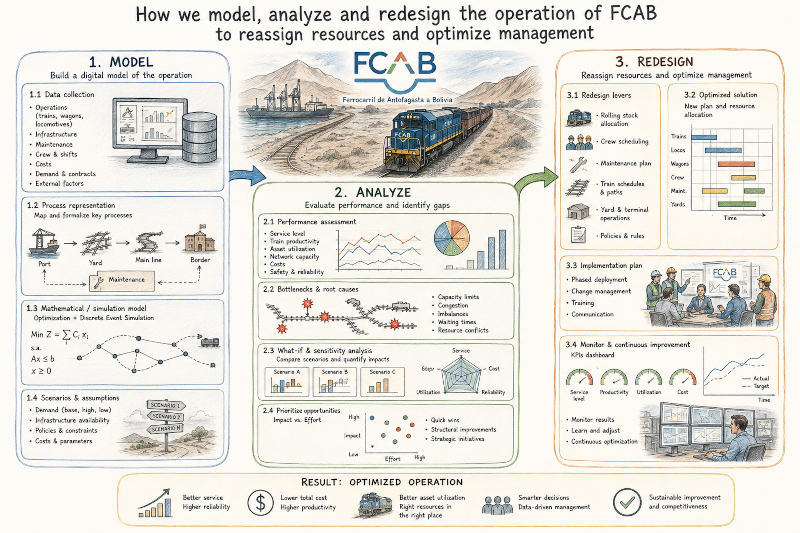
The analysis revealed a set of rationalization opportunities that allowed reducing costs, optimizing the allocation of resources and improving the overall performance of the organization without affecting the quality of service. Estimates made during the diagnostic stage indicated that the proposed improvements could generate savings on the order of one million dollars during the first year of implementation.
The institutional relationship with the client was led by partner Alan Mackenzie, who actively participated in defining the project's commercial strategy. Trusting in the solidity of the diagnosis and the magnitude of the expected benefits, he proposed to the General Manager MS an unusual modality for the time: that the consulting fees be financed with a part of the savings actually obtained during the first year of rationalization. This proposal reflected confidence in both the work methodology and the team's ability to transform technical analysis into concrete economic results for the company.
The project was an example of how the systematic application of process analysis, organizational modeling and the quantitative evaluation of alternatives could be translated into measurable efficiency improvements, demonstrating that evidence-based management could generate benefits significantly greater than the cost of consulting.
ID:('gp', 667)
FCAB: when the success of the project changed the rules of the game
Storyboard
The project for the AntofagastaBolivia Railway (FCAB) was developed for approximately one year with a permanent team on the ground dedicated to surveying and analyzing the company's management. The objective was to deeply understand the functioning of the organization, documenting processes, activities, responsibilities and resource utilization to identify opportunities for streamlining and improving efficiency.
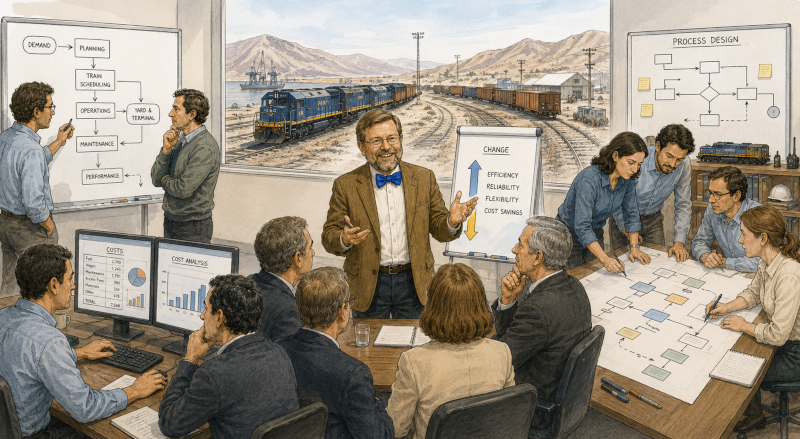
At the beginning of the project there was a budget of close to 300 thousand dollars for consulting work. However, during the negotiations the client itself proposed replacing this scheme with another based on results: Price Waterhouse would be remunerated with a participation in the savings actually obtained during the first year as a result of the improvements implemented. The firm accepted this modality, convinced that the analysis would generate concrete benefits for the company.
As the study progressed, increasingly important opportunities for improvement began to be identified. Redundant activities, processes susceptible to simplification and even an organizational unit whose functions could be redistributed without affecting the operation were detected. During the development of the project, the company also obtained an important additional contract. The analysis showed that this new business could be served using resources that until then had been underutilized, without the need to increase staff or make significant investments.
As a consequence, estimates indicated that the savings in the first year would no longer be of the order of 300 thousand dollars originally considered, but would exceed one million dollars. It was at that moment when the General Manager, identified here only by his initials M.S., stated that a result of that magnitude would reveal to the Board of Directors important inefficiencies that existed during his administration, whichas he expressedwould put his permanence in office at risk.
From this, M.S. requested to annul the agreement originally proposed by the company itself and return to the initial scheme of fixed fees close to 300 thousand dollars, ignoring the modality of participation in the savings that had previously been accepted by both parties. During that conversation he also indicated that, if he did not agree to this modification, he would ensure that Price Waterhouse would lose the other contracts it had with companies in the Luksic Group. From my perspective, this constituted a form of pressure inappropriate for a professional relationship.
Faced with this situation, Alan Mackenzie, partner responsible for the institutional relationship with the client, chose to accept the requested modification in order to protect the global interests of the firm and avoid putting the relationship with the rest of the group's companies at risk. Afterwards I never had contact with M.S. My personal impression which corresponds only to an interpretation of the facts and not to official information is that Alan Mackenzie subsequently discussed this episode with executives of the Luksic Group and that this could have influenced the departure of M.S. of the organization. What is a fact is that, since then, I have never heard from him again in the professional field.
ID:('gp', 668)
A path to the Price Waterhouse partnership
Storyboard
The incorporation of methodologies based on the scientific method, process modeling and the use of simulations began to differentiate the work carried out within Price Waterhouse. The results obtained in different projects aroused growing interest among the firm's partners, who began to incorporate this approach in new proposals and request my participation in increasingly complex and strategic initiatives.
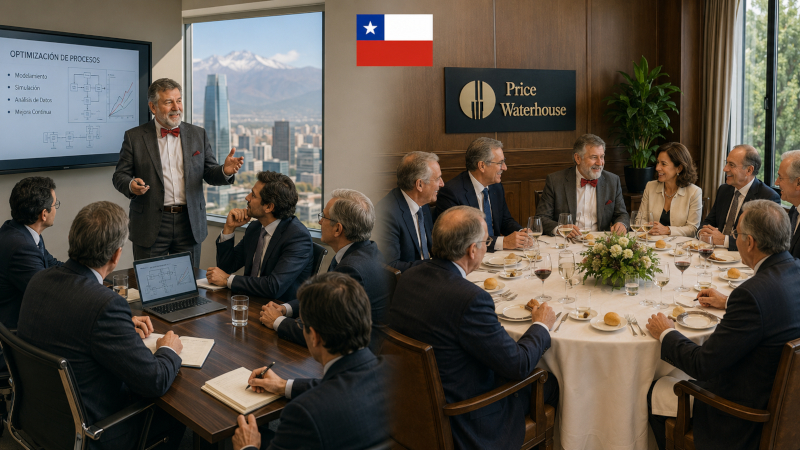
This recognition was also reflected in a much closer interaction with the company's partners. Beyond the traditional partner lunches on Wednesdays, I began to collaborate with them in the formulation of projects, in the development of new lines of consulting and in the analysis of business opportunities where the use of models and simulations represented a competitive advantage for the firm.
As a result of this professional evolution, some partners began to consider that my career could lead, in the future, to joining the Price Waterhouse company. In terms of professional career, I was seen as a possible candidate to assume, when the time came, the role of Acting Partner, a stage that traditionally preceded the appointment as a partner of the firm. Although this possibility never came to fruition, it constituted an important recognition of the work carried out and the contribution that the new methodologies were making to the area of business consulting.
This stage marked a turning point in my professional career. Beyond specific projects, it represented the recognition that the systematic use of models, simulations, and the scientific method could become a strategic tool for management consulting, expanding the scope of the traditional services offered by the firm.
ID:('gp', 669)
International projection and an unexpected opportunity
Storyboard
As modeling, simulation and analysis methodologies based on the scientific method began to generate interest within Price Waterhouse, I began to participate more frequently in exchange activities with other offices of the firm. The objective was to learn about projects developed in different countries, share experiences and, at the same time, publicize the methodologies that we were developing in Chile. These trips allowed me to establish a wide network of contacts with partners and consultants from various international offices.
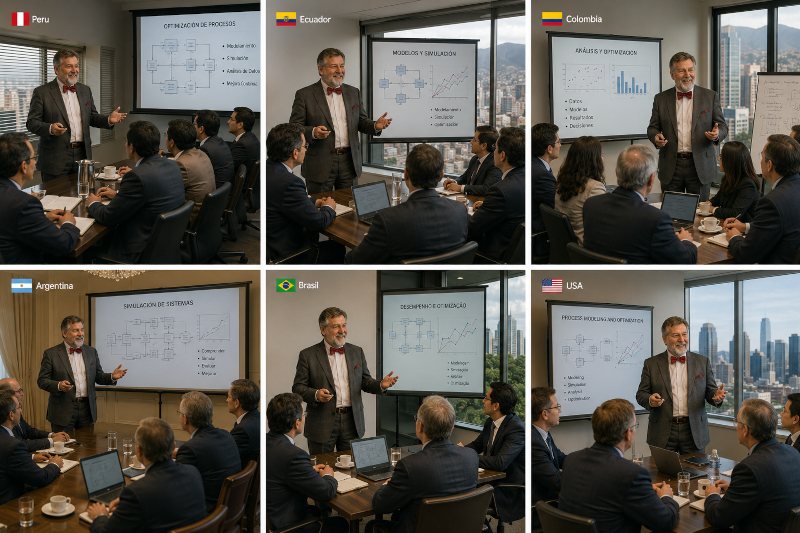
As part of this process I had the opportunity to visit several Price Waterhouse offices, culminating with a stay in the Dallas, United States office. During that visit I presented the work approach based on models and simulations and held numerous meetings with professionals from the firm. The interest generated was such that some partners asked me if I would be willing to join the American organization and develop my professional career there, with the perspective of becoming a partner of Price Waterhouse USA.
Upon returning to Santiago I mentioned this conversation to the management of the firm in Chile. The response was immediate: I was told that there was no intention for me to continue my career in the United States and that Price Waterhouse Chile's interest was for me to remain in the local office, where my work was considered to have significant development potential.
A few days later I observed a change that caught my attention. The intense exchange of communications that I had maintained with the American partner abruptly ceased and my messages stopped receiving a response. I was never given an explanation for what happened, so I cannot say what the cause was. However, I always had the impression that the possibility of an international transfer was rejected through conversations between both offices, favoring my stay at Price Waterhouse Chile. Although this conclusion corresponds to my personal interpretation of the facts, the episode reflected the interest that the developed methodologies had aroused both inside and outside the organization.
ID:('gp', 670)
Entering Alfa: an opportunity that changed my course
Storyboard
The recognition that the methodologies developed during those years had achieved led to him being invited to participate in a workshop held in Paraguay, attended by professionals from different South American countries considered candidates to join the Price Waterhouse company. The name of the program itself, "Entering Alpha," referred to the entry into the group of those who the firm considered its future leaders.
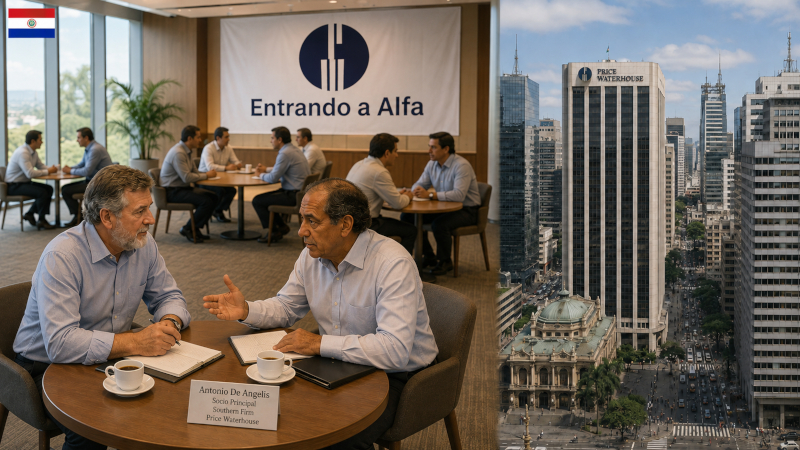
During the meeting, integration, leadership and evaluation activities were developed, along with numerous meetings with partners from the different South American offices. In one of the exercises we were informed that each participant would be interviewed by a partner chosen "at random" from among the attendees. However, the result of that supposed draw was, at least for me, surprising: the partner I had to interview was Antonio De Angelis, main partner of Price Waterhouse South America and one of the firm's top authorities in the region.
The conversation went far beyond a simple evaluation interview. Over time I understood that that meeting had hardly been a product of chance and that there was a specific interest in joining the regional structure of the firm. The proposal implied that my professional development would not continue within Price Waterhouse Chile, but that I would have to move to São Paulo to join the South American organization, from where a future incorporation into the regional society was planned.
From a professional point of view, the proposal was extraordinarily attractive. It represented the possibility of participating in large-scale projects, working alongside some of the firm's main partners and developing the methodologies that it had promoted on an international level. However, the permanent move to Brazil was not well received by my family. After many conversations we understood that this change meant completely modifying our life project.
It was one of the most difficult decisions of my career. I have always been extremely grateful to Price Waterhouse, a company that provided me with exceptional opportunities, allowed me to work with top-level professionals and participate in projects of great relevance to the senior management of numerous organizations. The work environment was intellectually challenging and professionally very stimulating. Precisely for this reason, resigning was a painful decision. Even knowing that I was leaving a career with a very promising future within the firm, I chose to prioritize the well-being of my family and begin a new professional path.
ID:('gp', 671)
Palos Verdes, Costa de Corral, Región de los Rios, Chile