
 User:
User:


Gauss's Theorem
Storyboard

Gauss's law states that electric charges generate electric fields whose total intensity across a closed surface depends directly on the amount of charge contained inside. In this way, it relates the charge distribution to the global behavior of the electric field in space.
This law allows complex electrical systems to be analyzed by considering how field lines cross different surfaces. When there is great symmetry in the charge distribution, as in spheres, cylinders, or extended planes, Gauss's law greatly simplifies the calculation and understanding of electric fields.
Gauss's law is one of the fundamental principles of electromagnetism and is part of the equations that describe the behavior of electric and magnetic fields. Its applications range from basic physics and electrical engineering to the study of materials, plasmas and atmospheric phenomena.
ID:(824, 'ky')

Discrete Gauss's law
Description
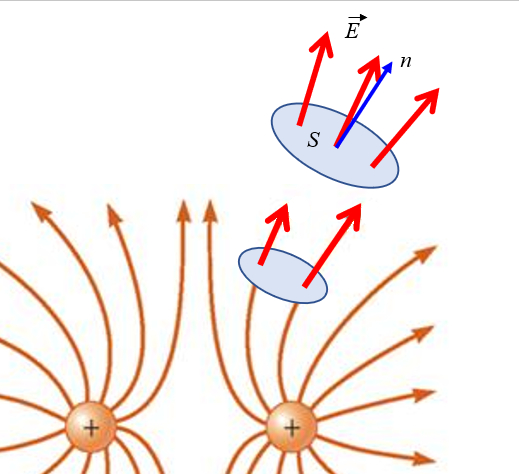
Electric flow ($\Phi$) is defined as the normal component of the electric field, calculated from Surface electric field i ($\vec{E}_i$) and Versor normal to surface i ($\hat{n}_i$), multiplied by Surface element i ($dS_i$) for each element
i, which is then summed over the entire section:
The magnitude of Electric eield ($E$) generated by Charge ($Q$), which are at a distance of Distance ($r$), is calculated using Electric field constant ($\epsilon_0$) and Dielectric constant ($\epsilon$) as follows:
Given that Surface of a sphere ($S$) is with Distance ($r$):
The flux is:
$\Phi = | \vec{E} | S = \displaystyle\frac{1}{4 \pi \epsilon \epsilon_0} \displaystyle\frac{ Q }{ r ^2} 4 \pi r ^2=\displaystyle\frac{ Q }{ \epsilon_0 \epsilon }$
From this, we can infer that the relationship is:
ID:(11377, 'gm')
Gauss's law continuous case
Description
With which it can be inferred that the relationship is:
| $\displaystyle\sum_i \vec{E}_i \cdot \hat{n}_i dS_i = \displaystyle\frac{ Q }{ \epsilon_0 \epsilon }$ |
With Surface element ($dS$) of the dot product of Electric field ($\vec{E}$) and Versor normal to the section ($\hat{n}$), the continuous version of Gauss's law is obtained:
 $\displaystyle\int_S\vec{E}\cdot\hat{n}\,dS=\displaystyle\frac{Q}{\epsilon_0\epsilon}$ $\displaystyle\int_S\vec{E}\cdot\hat{n}\,dS=\displaystyle\frac{Q}{\epsilon_0\epsilon}$
|
This corresponds to the version of the Gauss equation discovered in 1835 that was published posthumously [1]. [1] "Allgemeine Lehrsätze in Beziehung auf die im verkehrten Verhältnisse des Quadrats der Entfernung wirkenden Anziehungs- und Abstossungskräfte" (General theorems relating to the forces of attraction and repulsion acting in the inverted proportion of the square of distance), Carl Friedrich Gauss, Werke, 1867
ID:(15791, 'gm')
Field in the interior of a Conductor
Description
Let us consider a hollow sphere whose Charge ($Q$) are uniformly distributed over its surface. In this situation it is possible to define a Gaussian surface completely contained within the interior of the sphere. Since the total amount of Charge ($Q$) enclosed by said internal surface is zero, Gauss's law implies that the electric field Electric eield ($E$) in the interior must also cancel out:
|
$E =0$
|
ID:(3842, 'gm')
Maxwell's first law
Description
Maxwell's first equation corresponds conceptually to Gauss's law, but expressed in differential form rather than as an integral over a complete Gaussian surface. To obtain this formulation, Gauss's law is applied to an infinitesimally small Volume ($V$), so that the analysis is performed locally at each point in space.
At this limit, the amount of Charge ($Q$) contained within the volume can be approximated using Volume charge density ($\rho_e$) multiplied by the differential volume. At the same time, the flow of Electric field ($\vec{E}$) through the different faces of Volume ($V$) allows us to measure how the electric field diverges locally from said point:
In this way, Gauss's law in its integral form is transformed into a local differential relation, finally obtaining:
|
$\nabla \cdot \vec{E} = \displaystyle\frac{\rho_e}{\epsilon_0\cdot\epsilon}$
|
ID:(3724, 'gm')
Gauss's law for a surface (1)
Description
With Gauss's law
| $\displaystyle\sum_i \vec{E}_i \cdot \hat{n}_i dS_i = \displaystyle\frac{ Q }{ \epsilon_0 \epsilon }$ |
For the case in which the field is normal and constant on a surface, we have
|
$E_1 \cdot S_1 = \displaystyle\frac{ Q }{ \epsilon_0 \cdot \epsilon }$
|
ID:(10389, 'gm')
Gauss's law for two surfaces (2)
Description
With Gauss's law
| $\displaystyle\sum_i \vec{E}_i \cdot \hat{n}_i dS_i = \displaystyle\frac{ Q }{ \epsilon_0 \epsilon }$ |
for the case that the field is normal and constant on two surface we have
| $E_1 S_1 + E_2 S_2 = \displaystyle\frac{ Q }{ \epsilon\epsilon_0 }$ |
ID:(11458, 'gm')
Gauss's law for three surfaces (3)
Description
With Gauss's law
| $\displaystyle\sum_i \vec{E}_i \cdot \hat{n}_i dS_i = \displaystyle\frac{ Q }{ \epsilon_0 \epsilon }$ |
for the case that the field is normal and constant on three surface we have
| $E_1 S_1 + E_2 S_2 + E_3 S_3 = \displaystyle\frac{ Q }{ \epsilon\epsilon_0 }$ |
ID:(11457, 'gm')
Gauss's Theorem
Description

Calculations
to  ,
then, select the variable:
,
then, select the variable:  to
to 
Calculations
Variable
 Given
Calculate
Given
Calculate
 Target :
Equation
To be used
Target :
Equation
To be used

Variables
ID:(824, 0)
Palos Verdes, Costa de Corral, Chile