
 User:
User:


Coulomb Law
Storyboard

Coulomb's law describes the electric force that exists between two electric charges. It establishes that charges of the same sign repel, while charges of opposite signs attract, thus determining the fundamental interaction between charged particles.
The intensity of this force depends on the magnitude of the charges and the distance that separates them. Higher charges produce more intense interactions, while increasing distance forces decrease rapidly. This relationship allows us to understand how charges influence each other even without direct contact.
Coulomb's law constitutes one of the bases of electromagnetism and allows us to explain numerous physical and technological phenomena. From it, concepts such as electric field, electric potential and behavior of conductive and insulating materials are developed, as well as applications in electronics, chemistry and atomic physics.
ID:(1497, 'ky')

Scalar Coulomb's Law
Description
When there are only two charges, the Electric force ($F$) acts in the same direction as the Radius ($r$) that joins Charge ($q$) and Charge ($Q$), so the problem can be analyzed only in that direction and treated as a one-dimensional system.
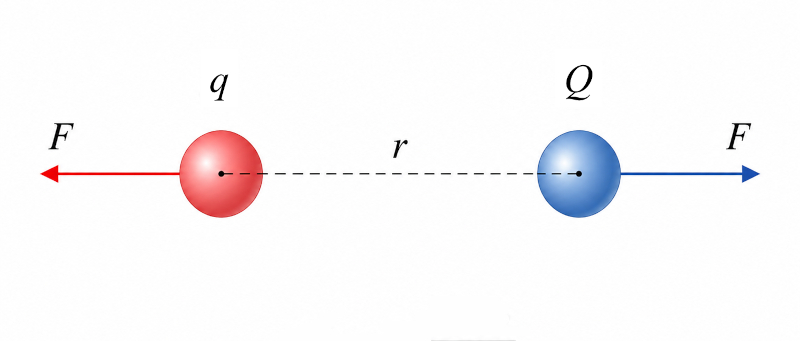
In this way a scalar version of Coulomb's law is obtained:
 $F = \displaystyle\frac{1}{4\pi \cdot \epsilon_0 \cdot \epsilon }\displaystyle\frac{ q \cdot Q }{ r ^2}$ $F = \displaystyle\frac{1}{4\pi \cdot \epsilon_0 \cdot \epsilon }\displaystyle\frac{ q \cdot Q }{ r ^2}$
|
ID:(1697, 'gm')
Vector Coulomb's Law
Description
When one of the charges moves at an angle to the Position ($\vec{r}$) that joins Charge ($q$) and Charge ($Q$), it is no longer sufficient to work with Coulomb's law in scalar form. In this case, Electric force ($\vec{F}$) depends not only on the magnitude of Radius ($r$), but also on its address, which is defined by Versor ($\hat{n}$):
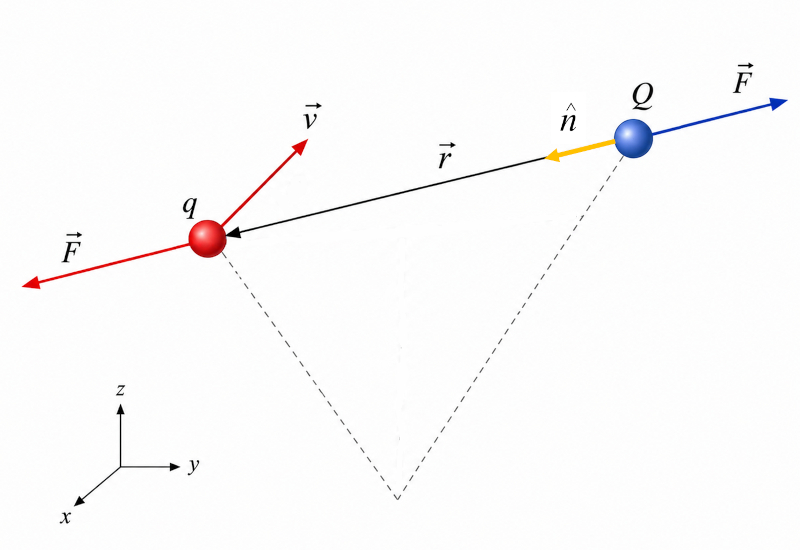
For this reason, Coulomb's law in its general form is expressed as a vector equation, allowing the magnitude and direction of the electric force to be described simultaneously:
|
$\vec{F} =\displaystyle\frac{1}{4 \pi \cdot \epsilon_0 \cdot \epsilon }\displaystyle\frac{ q \cdot Q }{ r ^2} \hat{n}$
|
This expression incorporates Electric field constant ($\epsilon_0$), corresponding to the constant introduced in the original formulation, and also Dielectric constant ($\epsilon$), which allows considering the properties of the medium when the charges are not in a vacuum.
ID:(15773, 'gm')
Distance
Description
Distance ($r$) represents the distance between Position 1 ($\vec{s}_1$) and Position 2 ($\vec{s}_2$), which can be expressed as:
|
$r =| \vec{s}_2 - \vec{s}_1 |$
|
ID:(10390, 'gm')
Versor of Coulomb's law
Description
Versor ($\hat{n}$) along the distance between Position 1 ($\vec{s}_1$) and Position 2 ($\vec{s}_2$) can be calculated using the following formula:
|
$\hat{n} =\displaystyle\frac{( \vec{s}_2 - \vec{s}_1 )}{| \vec{s}_2 - \vec{s}_1 |}$
|
ID:(10391, 'gm')
Coulomb's Law with Position Vectors
Description
The magnitude of Electric force ($F$) generated between two charges, represented by Test charge ($q$) and Charge ($Q$), separated by a distance Distance ($r$) and oriented according to the direction given by Versor radial (versor) ($\hat{r}$), is calculated using Electric field constant ($\epsilon_0$) and Dielectric constant ($\epsilon$) as follows:
Since both Distance ($r$) and Versor radial (versor) ($\hat{r}$) can be expressed as a function of Position 1 ($\vec{s}_1$) and Position 2 ($\vec{s}_2$) using:
and
The electric force can finally be written as:
ID:(15772, 'gm')
Coulomb Law
Description

Calculations
to  ,
then, select the variable:
,
then, select the variable:  to
to 
Calculations
Variable
 Given
Calculate
Given
Calculate
 Target :
Equation
To be used
Target :
Equation
To be used

Variables
ID:(1497, 0)
Palos Verdes, Costa de Corral, Chile