
 User:
User:


Electric Charges
Storyboard

Electric charges are a fundamental property of matter responsible for electrical and magnetic interactions. There are two types of charge, positive and negative, which can attract or repel each other depending on their sign. Everyday matter is made up of charged particles, such as protons and electrons, whose distribution determines many physical and chemical phenomena.
The presence of electric charge modifies the surrounding space, generating electric fields capable of exerting forces on other charges. When charges move, they also produce magnetic effects, establishing the basis of electromagnetism. The transfer and circulation of charges are also the origin of the electric current used in technological systems.
Electrical charges participate in processes that range from the structure of atoms and chemical bonds to the operation of electronic devices, biological systems and atmospheric phenomena such as lightning. Its behavior constitutes one of the fundamental pillars of modern physics.
ID:(822, 'ky')

Electron Charge
Description
The electron was discovered by J.J. Thomson [1,2], who determined his Number of electrons ($n_e$), which is equal to $1.6×10^{19}C$.
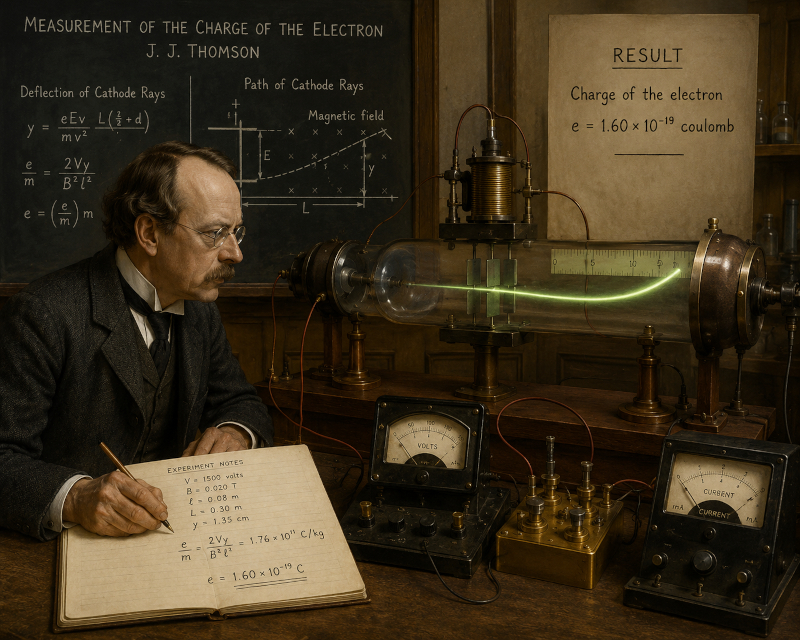
Measurement of the Charge of the Electron by J.J. Thomson
Therefore, Charge of all electrons ($Q_e$) can be determined from Electron Charge ($e$) divided by Number of electrons ($n_e$), resulting in:
 $n_e =\displaystyle\frac{ Q_e }{ e }$ $n_e =\displaystyle\frac{ Q_e }{ e }$
|
[1] "Cathode Rays", J.J. Thomson, Philosophical Magazine, 1897
[2] "On the Charge of Electricity Carried by the Ions Produced by Röntgen Rays", J.J. Thomson, Philosophical Magazine, 1897
ID:(3211, 'gm')
Ion Charge
Description
Svante Arrhenius, in his doctoral thesis [1], postulated that there are particles with multiple electron charges, known as ions.

Therefore, its number depends on the Charge of all ions of one type k ($Q_{i,k}$) and the multiple of the Electron Charge ($e$). Thus, Number of k-type ions ($n_{i,k}$) is calculated from Charge of all ions of one type k ($Q_{i,k}$), divided by the charge of each ion, which is Electron Charge ($e$), multiplied by Valency of the k ion ($z_k$):
|
$n_{i,k} =\displaystyle\frac{ Q_{i,k} }{ z_k e }$
|
[1] "Recherches sur la conductibilité galvanique des électrolytes" (Research on the galvanic conductivity of electrolytes), Svante Arrhenius, Doctoral thesis, 1884
ID:(15774, 'gm')
Total Charge
Description
Charge ($Q$) can be calculated by adding Number of electrons ($n_e$) multiplied by Electron Charge ($e$) and the sum of Number of k-type ions ($n_{i,k}$) multiplied by Valency ($z$), if this number is multiplied by Electron Charge ($e$):
|
$Q = n_e \cdot e + \displaystyle\sum_k n_{i,k} \cdot z_k \cdot e$
|
Since the opposite charges balance each other, it is not possible to determine the total number of charges, nor how many of these are positive or negative.
ID:(15775, 'gm')
Electric Charges
Description

Calculations
to  ,
then, select the variable:
,
then, select the variable:  to
to 
Calculations
Variable
 Given
Calculate
Given
Calculate
 Target :
Equation
To be used
Target :
Equation
To be used

Variables
ID:(822, 0)
Palos Verdes, Costa de Corral, Chile