
 User:
User:


How We Learn: From Speech to Structure to Meaning
Storyboard

Human learning is not a process of memorizing isolated words or sentences. Instead, each new experience is progressively integrated into an increasingly rich internal representation of the world. This representation evolves through several layers: from the first perception of a sentence, to the recognition of structural regularities, and finally to the emergence of concepts that allow us to understand and reason about reality.
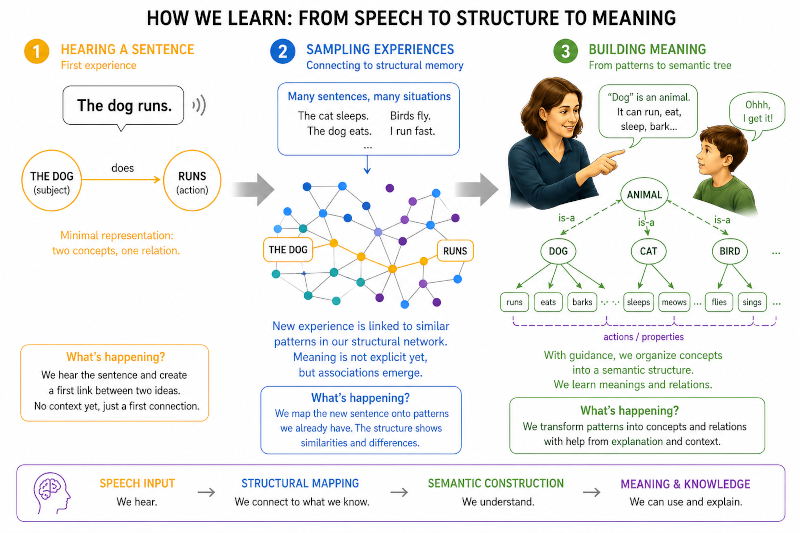
The first stage begins with a single linguistic experience. A sentence such as "The dog runs" already contains a minimal relational structure composed of entities and their interactions. Although this isolated experience has little meaning by itself, it establishes the first connections that can later be reinforced by additional observations.
As more sentences and situations are encountered, the brain no longer processes each one independently. Instead, it connects every new experience with previously stored patterns, creating a large structural network where similarities, differences, and recurring associations naturally emerge. At this stage, knowledge is still primarily structural rather than semantic: the system recognizes recurring configurations before assigning explicit meanings to them.
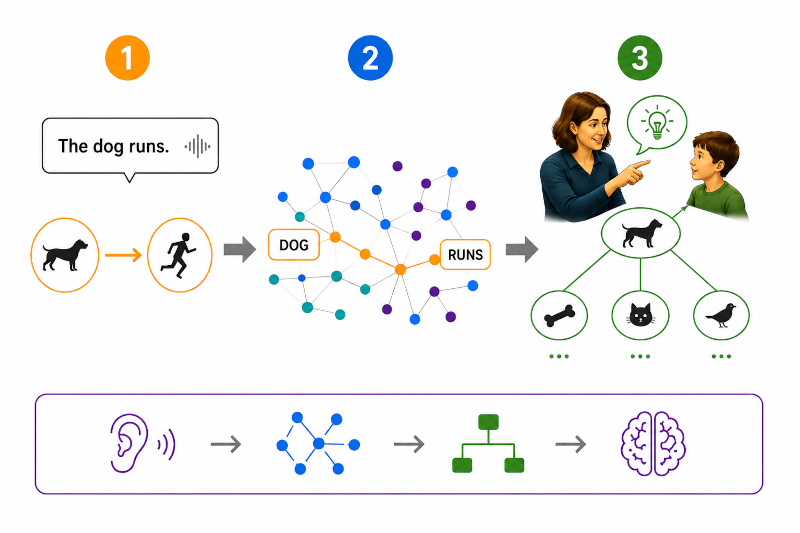
With continued exposure and guided learning, these structural regularities become organized into semantic categories. Similar experiences are grouped together, giving rise to concepts such as dog, animal, or bird. These concepts are not directly observed in the world; rather, they are abstractions that compress many individual experiences into stable mental representations. Once concepts exist, they can be related hierarchically and enriched with properties, enabling communication, reasoning, and knowledge transfer.
The simplified illustration above emphasizes only the essential stages of this process: a sentence generates an initial structural representation, repeated experiences strengthen a structural network, and semantic organization transforms these recurring patterns into concepts. By removing secondary details, the figure highlights the central mechanism through which raw experiences gradually become meaningful knowledge.
The complete figure shown below expands each stage with additional examples, intermediate representations, and explanatory annotations, providing a more detailed view of how structural learning progressively evolves into semantic understanding.
ID:('gp', 556)
From Meaning to Logic: Learning Formal Scientific Models
Storyboard
Human understanding does not end when concepts are formed. Concepts allow us to recognize and classify the world, but science and mathematics require an additional level of representation: formal logical structures. At this stage, qualitative understanding is transformed into variables, equations, and explicit relationships that can be analyzed, calculated, and used to predict the behavior of physical systems.
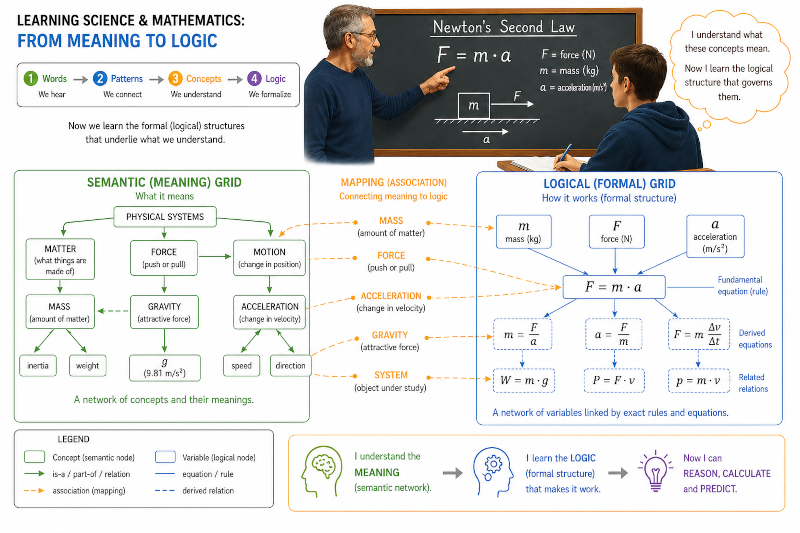
Learning science therefore involves building a bridge between two complementary representations of knowledge. On one side is the semantic network, where concepts such as force, mass, motion, and gravity are organized according to their meanings and relationships. On the other side is the logical network, where these same ideas become variables connected through mathematical rules and equations. The transition between these two representations is achieved by mapping each concept to its corresponding formal variable.
The teacher-student interaction shown in the figure illustrates this process. The student already understands the meaning of concepts such as force and mass, but now learns the logical structure that governs their interaction through Newton's Second Law. Scientific reasoning is therefore not based solely on memorizing equations, but on understanding how formal mathematical relationships represent mechanisms that have already acquired semantic meaning.
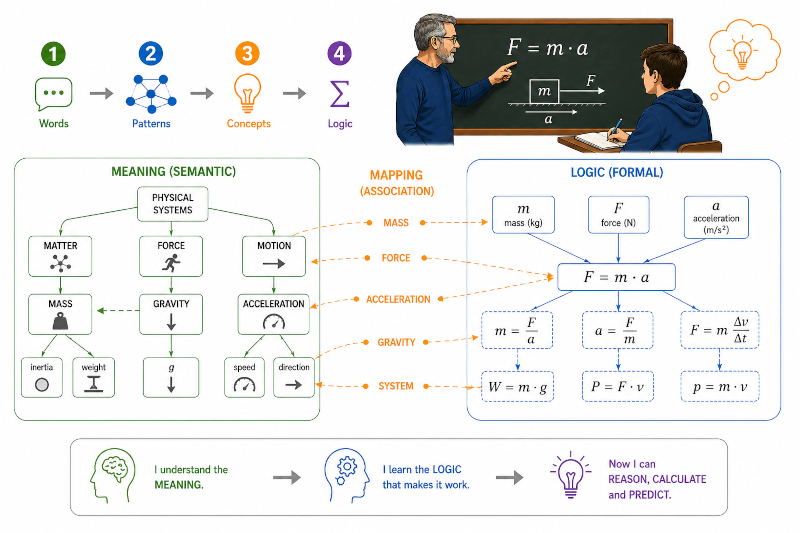
The simplified illustration emphasizes the essential transformation: semantic concepts are associated with formal variables, these variables are connected through equations, and the resulting logical network enables quantitative reasoning, prediction, and calculation. By removing secondary details, the figure highlights the central idea that logical knowledge is built upon previously acquired semantic understanding rather than replacing it.
The complete figure below expands this process by showing richer semantic hierarchies, the detailed mapping between concepts and variables, and the organization of the logical network around fundamental equations and their derived relationships, illustrating how scientific knowledge is progressively formalized.
ID:('gp', 557)
From Discovery to Knowledge: The Scientific Path
Storyboard
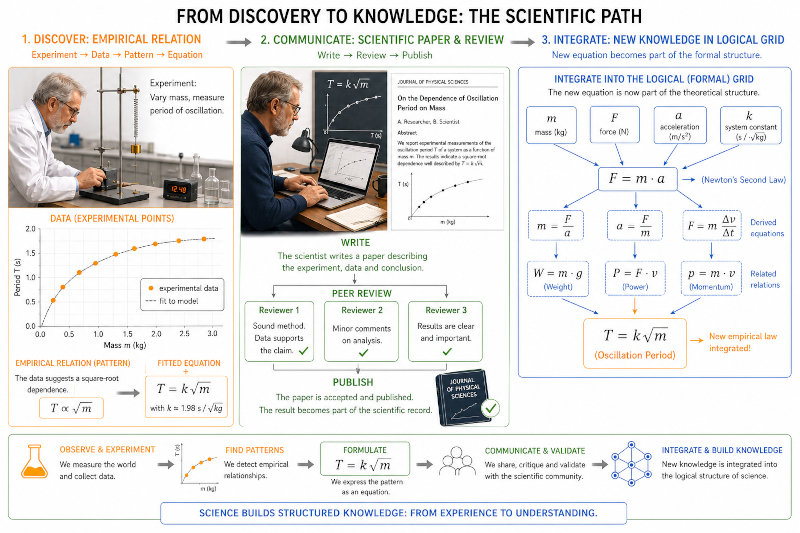
Scientific knowledge is not created by observation alone. It emerges through a structured process in which empirical evidence is transformed into formal knowledge that becomes part of our collective understanding of the world. This process combines experimentation, mathematical modeling, peer evaluation, and integration into the existing body of scientific knowledge.
The first stage begins with observation and experimentation. Measurements collected from the real world often reveal regularities that can be summarized as empirical relationships. These relationships are initially descriptive: they capture recurring patterns in the data and are frequently expressed through equations that reproduce the observed behavior. At this point, the equation represents an empirical model rather than a fully established scientific law.
Once a consistent relationship has been identified, the results are documented and communicated to the scientific community. Preparing a scientific paper makes the methodology, experimental evidence, and proposed interpretation available for independent evaluation. Through peer review, other researchers examine the quality of the experimental design, the analysis, and the conclusions before the work becomes part of the scientific literature.
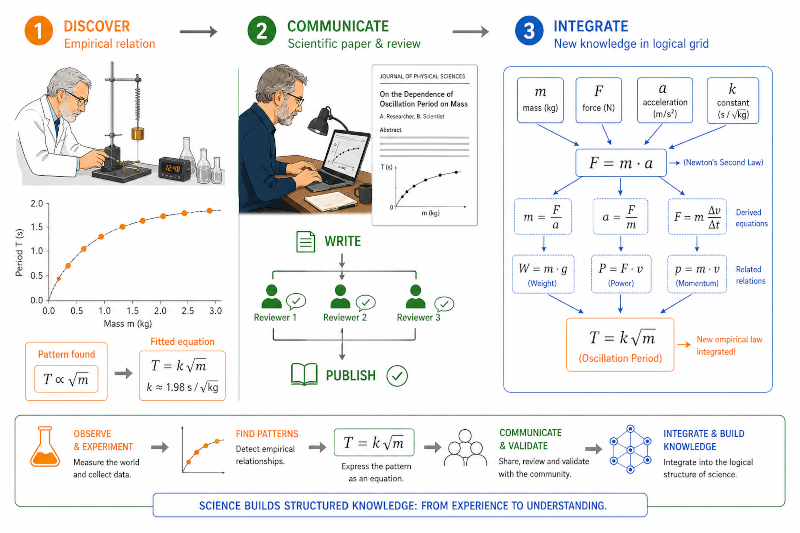
Publication, however, is not the end of the process. New empirical relationships must be integrated into the existing logical structure of science. This means connecting the new equation with previously established variables, models, and theories, allowing it to interact with the broader network of scientific knowledge. As additional evidence accumulates, empirical models may be refined, extended, or eventually incorporated into more comprehensive theoretical frameworks.
The simplified illustration emphasizes the essential scientific workflow: observe the world, discover empirical patterns, communicate the results through scientific publication, and integrate validated knowledge into the growing logical network of science. By removing secondary details, the figure highlights the cumulative nature of scientific progress and the role of validation in transforming observations into reliable knowledge.
The complete figure below expands each of these stages, illustrating the experimental process, scientific communication, peer review, and the integration of new equations into an interconnected logical framework that continuously evolves as new discoveries are made.
ID:('gp', 558)
Lifelong Learning: The Continuous Cycle of Knowledge
Storyboard
Learning is not a process that ends after childhood or formal education. Throughout life, every conversation, observation, experiment, measurement, and interaction with the environment contributes new experiences that continuously reshape our internal representation of the world. Rather than accumulating isolated facts, the brain expands and reorganizes an evolving structural network that becomes progressively richer with each new experience.
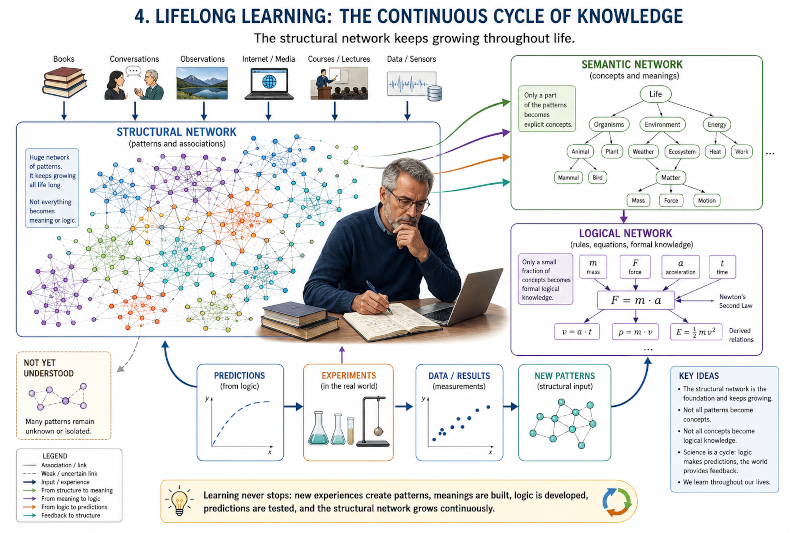
Most of what we learn initially enters this structural network as patterns and associations. Only a fraction of these recurring patterns become explicit concepts within the semantic network, where they acquire names and meaning. An even smaller subset is eventually formalized into logical structuresmathematical models, equations, and scientific theoriesthat allow precise reasoning and prediction. Consequently, the structural network remains by far the largest and fastest-growing component of human knowledge, serving as the foundation upon which semantic understanding and logical reasoning are built.
Scientific knowledge further extends this learning cycle. Logical models generate predictions that are tested through experiments and observations. The resulting measurements produce new data, revealing additional patterns that are reintegrated into the structural network. This continuous feedback allows existing connections to strengthen, weaken, reorganize, or expand as new evidence becomes available, making learning an adaptive and self-correcting process rather than a static accumulation of information.
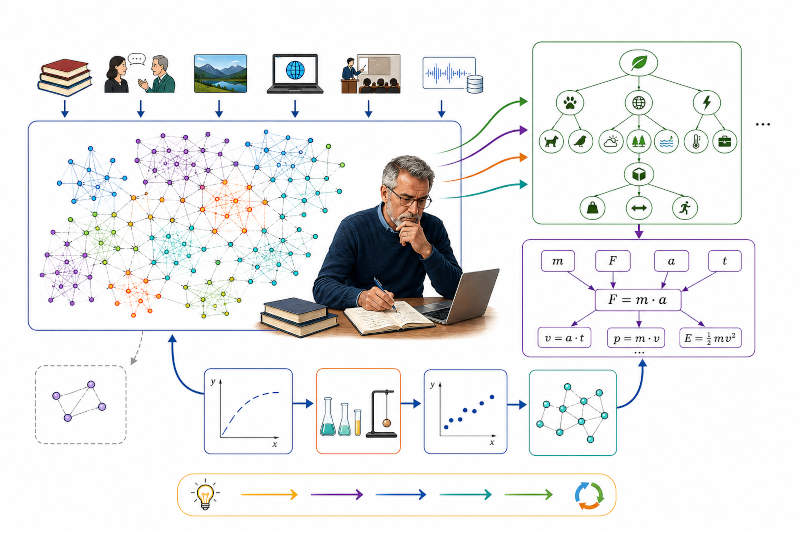
The simplified illustration highlights the essential feedback loop that characterizes lifelong learning. Experiences continuously enlarge the structural network; some patterns evolve into semantic concepts, while a smaller subset becomes formal logical knowledge. Predictions derived from these logical models are tested against reality, generating new observations that feed back into the structural network, allowing it to reorganize and grow indefinitely.
The complete figure presented below expands this process by illustrating the multiple sources of lifelong learning, the interaction between structural, semantic, and logical networks, and the continuous cycle through which prediction, experimentation, and observation progressively refine our understanding of the world throughout life.
ID:('gp', 559)
From Patterns to Concepts
Storyboard
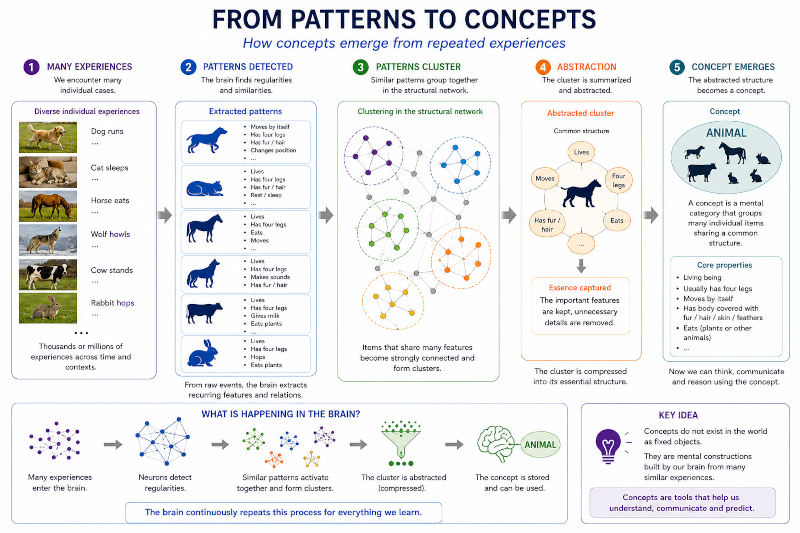
Human understanding does not begin with predefined concepts but with individual experiences. Every interaction with the world contributes observations that are initially stored as patterns of relationships rather than explicit meanings. As similar experiences accumulate, the brain detects regularities and gradually organizes them into clusters within its structural network. These clusters capture recurring combinations of features that repeatedly appear together across many different situations.
With continued exposure, the structural representation becomes progressively more compact. Features that are common across many related experiences are preserved, while details unique to individual examples become less important. This process of abstraction compresses a large collection of experiences into a smaller and more stable internal representation that captures the essential structure shared by the examples.
Once an abstract structural representation becomes sufficiently stable, it can be assigned a semantic label and transformed into a concept. A concept therefore does not correspond to a single observation but to the common structure that emerges from many related experiences. In this way, concepts serve as efficient mental tools that allow us to recognize new situations, communicate ideas, and reason about categories without storing every individual experience independently.
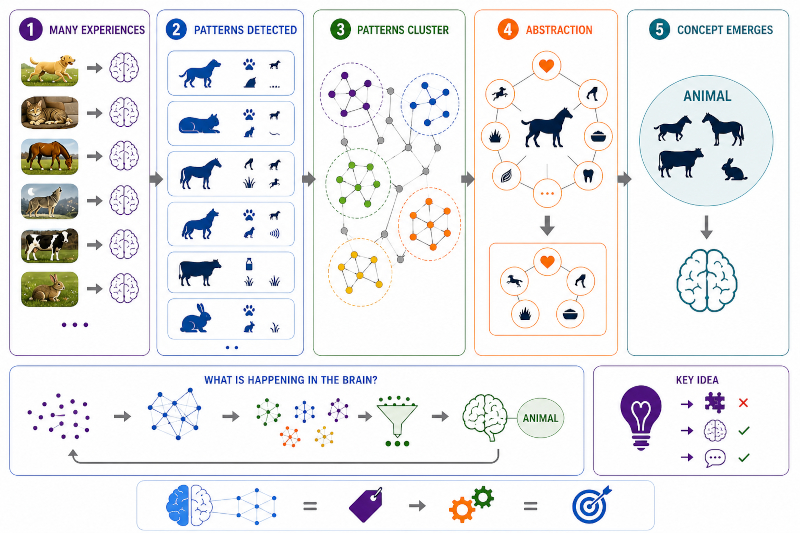
The simplified illustration emphasizes the fundamental progression from repeated experiences to abstract concepts. Individual observations generate recurring patterns, similar patterns organize into structural clusters, abstraction preserves only the common structure, and the resulting compressed representation becomes an explicit concept. This sequence illustrates how semantic knowledge emerges naturally from structural regularities rather than being present from the beginning.
The complete figure shown below expands each stage of this process by illustrating representative examples, the formation of structural clusters, the abstraction of common properties, and the emergence of semantic concepts that can later be used for recognition, communication, reasoning, and further learning.
ID:('gp', 560)
From Concepts to Causal Models
Storyboard
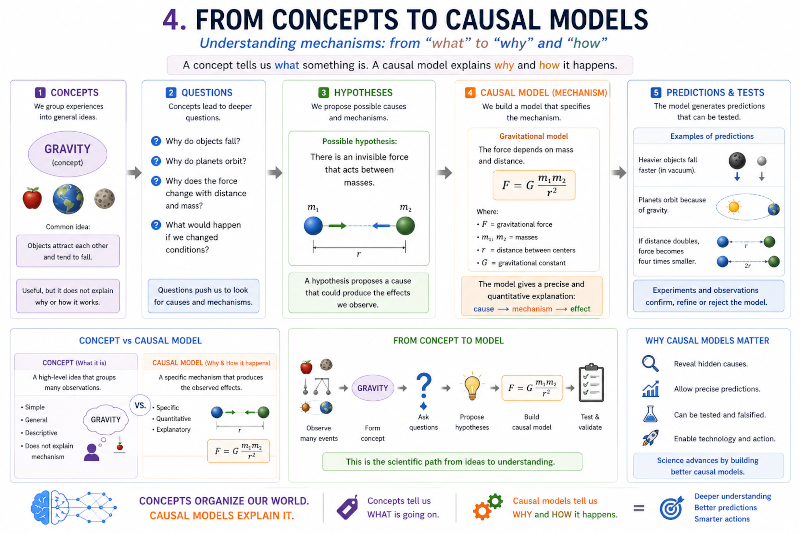
Concepts organize experience by identifying what different observations have in common, but they do not explain the mechanisms that produce those observations. Scientific understanding advances when concepts become the starting point for causal models capable of describing why a phenomenon occurs and how its behavior emerges from the interaction of underlying variables. This transition marks the shift from descriptive knowledge to explanatory knowledge.
Once a concept has been established, it naturally generates new questions about the processes responsible for the observed behavior. These questions motivate the formulation of hypotheses that propose possible causal mechanisms. A hypothesis is not yet an explanation but a candidate mechanism that can be expressed quantitatively and confronted with empirical evidence.
When sufficient evidence supports a hypothesis, it is formalized as a causal model. Such models specify the variables involved, the relationships between them, and the mathematical laws that describe their interactions. Unlike concepts, which classify observations, causal models allow predictions to be derived, experiments to be designed, and competing explanations to be objectively compared. Through repeated testing, refinement, or rejection, these models progressively improve our understanding of reality and provide the foundation for scientific theories.
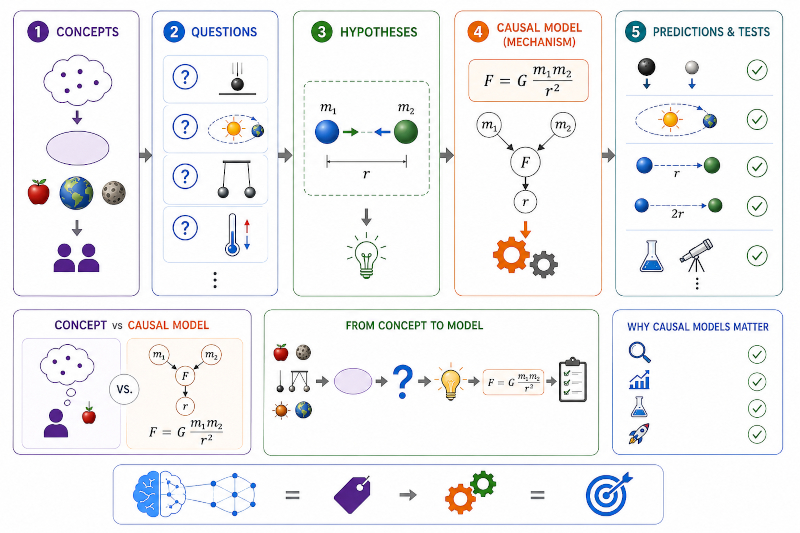
The simplified illustration highlights the essential progression from concepts to scientific explanation. A concept organizes many observations into a common idea, which generates new questions. These questions lead to hypotheses about possible mechanisms, which are formalized into causal models capable of producing quantitative predictions. Experimental observations then validate, refine, or reject these models, making the entire process iterative and self-correcting.
The complete figure shown below expands each stage of this progression by illustrating the transition from conceptual understanding to hypothesis generation, causal modeling, predictive equations, experimental testing, and the continuous refinement of scientific knowledge through empirical validation.
ID:('gp', 561)
Structural NLP: Tokenization
Storyboard
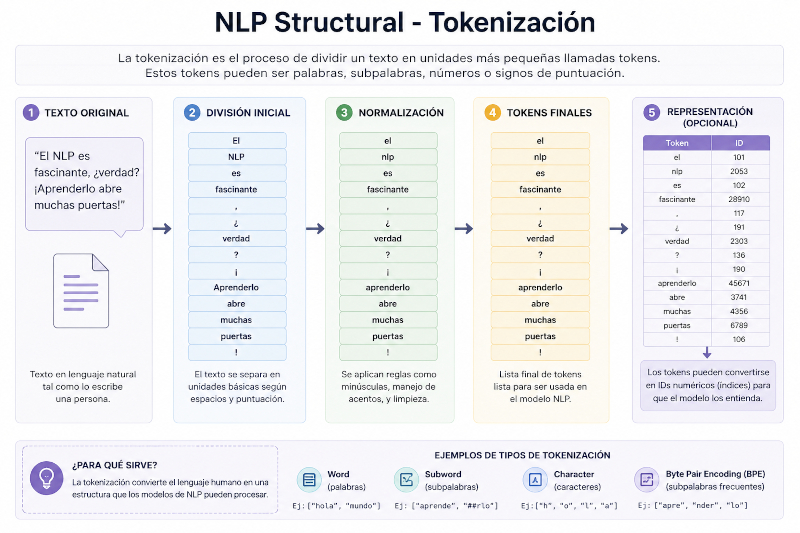
Before an AI model can discover patterns or infer relationships, natural language must first be transformed into a structured representation that the model can process. The first stage of this transformation is tokenization, the process of dividing a continuous text into a sequence of discrete units called tokens. Depending on the tokenizer, these units may correspond to complete words, subwords, individual characters, punctuation marks, or even numerical symbols.
Tokenization is more than simply splitting a sentence at spaces. During this stage, the text is converted into a standardized sequence by applying normalization rules such as lowercase conversion, punctuation handling, accent normalization, or other preprocessing operations. The result is a consistent sequence of tokens that preserves the structure of the original sentence while making it suitable for computational processing.
Once the final token sequence has been created, each token is associated with a unique numerical identifier from the model's vocabulary. These identifiers do not represent meanings themselves; they are simply references that allow the model to retrieve the corresponding vector representations during the embedding stage. From that point onward, the AI operates entirely on numerical representations rather than on the original text.
Tokenization therefore provides the bridge between human language and the structural computations performed by modern language models. Every later stageincluding embeddings, attention mechanisms, structural inference, and response generationdepends on this initial conversion from continuous language into an ordered sequence of discrete symbolic units.
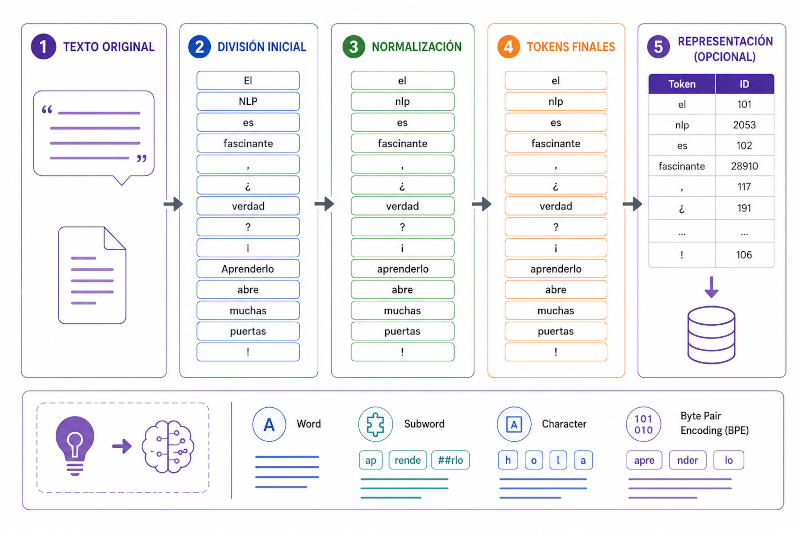
The simplified illustration highlights only the essential processing pipeline. A sentence is transformed into a sequence of tokens, the tokens are normalized into a consistent representation, and each token is optionally mapped to a unique numerical identifier. Although simple, this preprocessing step defines the discrete units on which every subsequent stage of the language model operates.
The complete figure shown below expands each stage of tokenization by illustrating the progression from the original text through token extraction, normalization, the final token sequence, and the optional conversion to vocabulary identifiers, together with examples of the different tokenization strategies commonly used in modern NLP systems.
ID:('gp', 562)
Exploratory AI: Expanding Questions into Structured Understanding
Storyboard
Traditional AI systems are designed to answer questions by selecting the single response with the strongest statistical support. While this approach is highly effective for obtaining concise answers, it naturally compresses the space of possibilities and hides many alternative perspectives. Exploratory AI extends this paradigm by transforming a question into a structured map of related dimensions, allowing users to investigate a problem before committing to a specific conclusion.
Instead of immediately searching for the best answer, Exploratory AI first identifies the major dimensions that define the problem. Each dimension becomes an entry point into a different aspect of the topic, revealing related concepts, hidden relationships, competing viewpoints, and possible causal connections. As exploration continues, new links are discovered between previously independent areas, enabling users to build a progressively richer representation of the problem space.
Once the exploration map has been constructed, the information can be prioritized according to relevance, uncertainty, evidence quality, or expected impact. Weakly supported claims can be identified, missing evidence highlighted, and promising directions refined into more precise research questions. Rather than replacing human reasoning, the system assists it by organizing complexity into a transparent structure that can be examined from multiple perspectives.
The final stage synthesizes the explored information into an evidence-based answer whose assumptions and supporting evidence remain visible. Because every conclusion can be traced back through the exploration process, the resulting answer is not simply a prediction but a structured synthesis that can easily be expanded, questioned, or updated as new information becomes available.
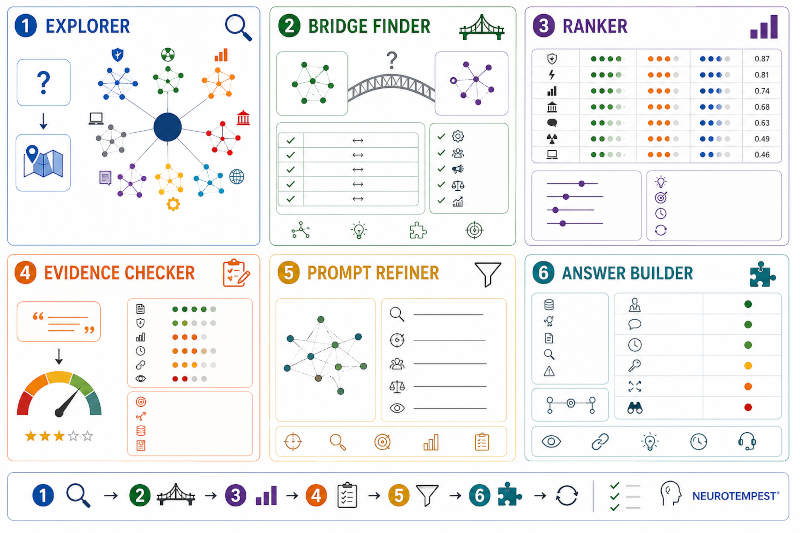
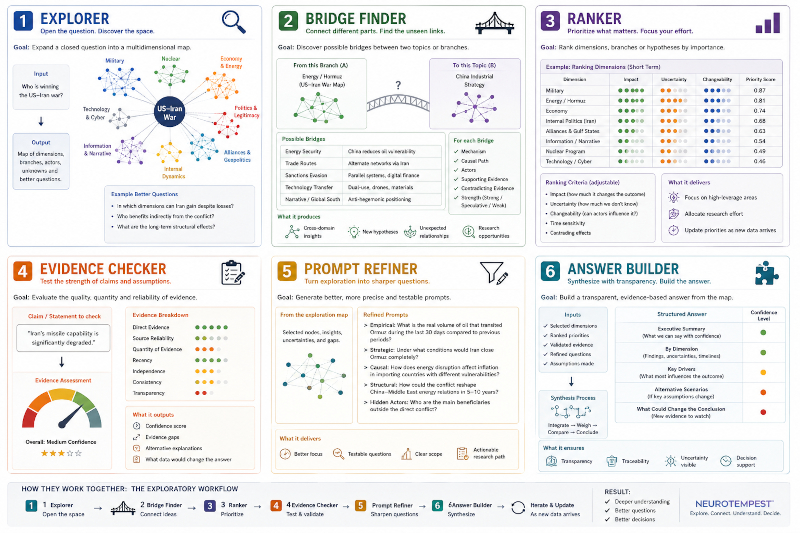
The simplified illustration emphasizes the essential exploratory workflow. A question is first expanded into a multidimensional map, hidden bridges between different areas are identified, important directions are prioritized, evidence is evaluated, the investigation is refined through better questions, and the collected information is finally synthesized into a transparent answer. Unlike traditional AI, exploration remains available throughout the process instead of disappearing behind a single response.
The complete figure shown below expands each component of this workflow by illustrating the Explorer, Bridge Finder, Ranker, Evidence Checker, Prompt Refiner, and Answer Builder, together with the continuous feedback loop that supports iterative knowledge exploration and progressively deeper understanding.
ID:('gp', 563)
From Closed Answers to Open Exploration
Storyboard
Most current AI systems are optimized to answer questions by selecting the single response that receives the highest statistical support. This approach is efficient when a direct answer is required, but it compresses a complex landscape of possibilities into one final output. As a consequence, alternative explanations, hidden relationships, and promising research directions often remain unexplored. An exploratory approach extends the role of AI from answering questions to helping users investigate them.
Exploratory AI begins with a topic or question but, instead of immediately producing a conclusion, expands it into a multidimensional map of related domains. Each branch represents a different perspective, such as scientific, technological, economic, social, or geopolitical aspects, while the links between branches reveal possible interactions that would otherwise remain hidden. This structural representation allows users to navigate the problem space rather than viewing only its final destination.
As exploration progresses, users can expand or collapse branches, search for bridges between different areas, compare competing hypotheses, examine evidence, and identify knowledge gaps. New questions naturally emerge from the structure itself, leading to a deeper and more systematic understanding of the topic. Rather than replacing human reasoning, the AI acts as a guide that organizes information into a navigable knowledge landscape where priorities and uncertainties remain visible.
Only after this exploration phase does the system synthesize the collected information into one or more evidence-based answers. Because the answer is derived from an explicit exploration process, every conclusion can be traced back to its supporting evidence, assumptions, and alternative paths. In this way, AI evolves from a closed-answer machine into an instrument for scientific exploration, critical thinking, and knowledge discovery.
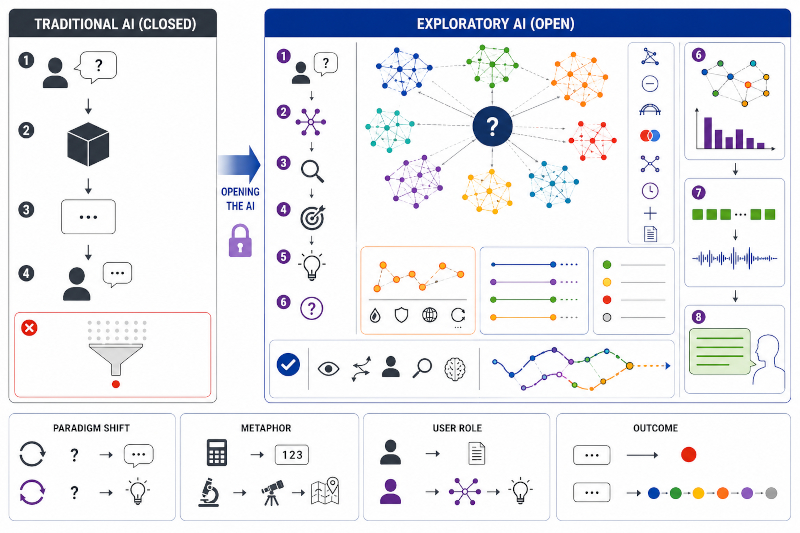
The simplified illustration emphasizes the conceptual transition from traditional AI to exploratory AI. Instead of compressing a question into a single response, the system first expands the topic into a structured map of interconnected dimensions, allowing users to investigate relationships, compare alternatives, and refine their understanding before arriving at a conclusion. The emphasis shifts from obtaining answers quickly to building understanding systematically.
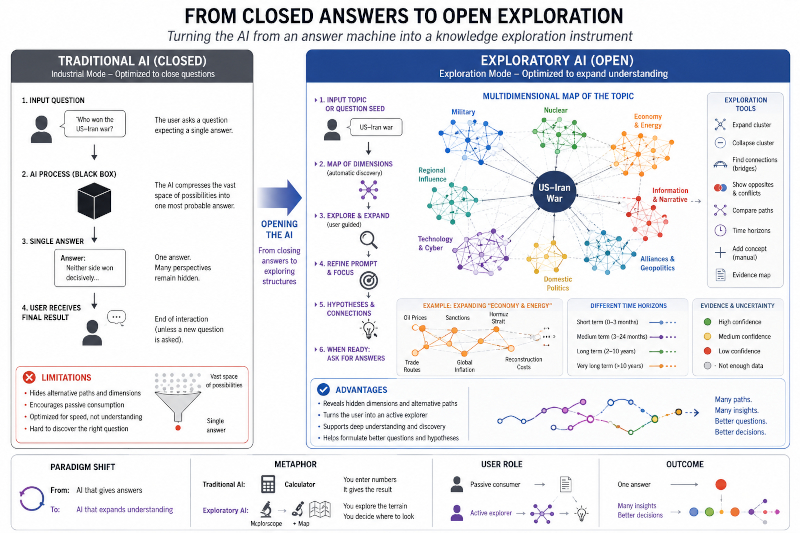
The complete figure shown below illustrates this paradigm in greater detail, contrasting the traditional closed-answer workflow with an open exploratory process that includes multidimensional topic mapping, interactive exploration tools, evidence visualization, multiple time horizons, hypothesis generation, and progressive refinement toward better-informed conclusions.
ID:('gp', 564)
Three Paradigms of Artificial Intelligence
Storyboard
Artificial intelligence can be understood as three complementary paradigms that differ primarily in the way they represent knowledge. Logical AI represents knowledge explicitly through variables, rules, equations, and formal reasoning. Semantic AI represents knowledge as concepts connected by meaningful relationships, such as categories, hierarchies, properties, and causal links. Structural AI, in contrast, represents knowledge as a high-dimensional network of statistical patterns and similarities learned directly from large collections of data, without requiring explicit concepts or symbolic rules.
These three representations are not mutually exclusive but correspond to different levels of abstraction. Logical AI excels when precise rules and mathematical reasoning are available. Semantic AI is well suited for organizing knowledge into meaningful conceptual structures that humans can understand and communicate. Structural AI is particularly effective at discovering regularities in complex data where explicit concepts or formal models are unavailable, allowing modern language models to infer new patterns from enormous amounts of experience.
Although they use different internal representations, the three approaches can complement one another. Structural AI can discover previously unknown regularities, semantic representations can organize these regularities into interpretable concepts, and logical models can transform concepts into precise causal explanations and predictive mathematical frameworks. Together they form a continuum from empirical pattern discovery to scientific understanding.
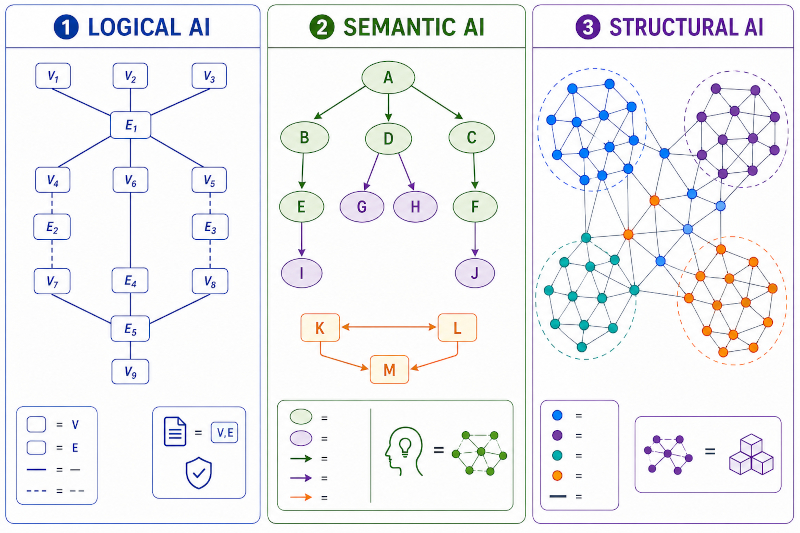
The simplified illustration highlights the essential differences between the three paradigms. Logical AI organizes variables through explicit rules and equations, Semantic AI organizes concepts through meaningful relationships, and Structural AI organizes high-dimensional vectors through similarity patterns and statistical associations. The comparison emphasizes that each paradigm represents knowledge differently while addressing complementary aspects of intelligence.
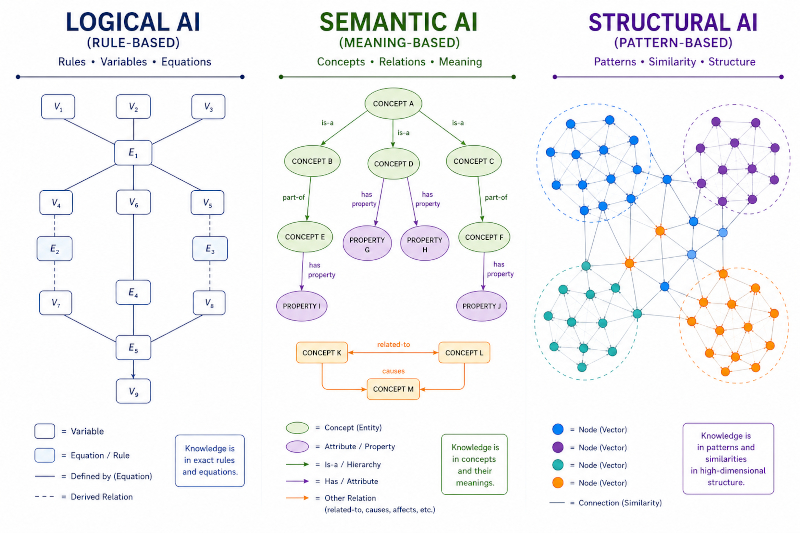
The complete figure shown below expands this comparison by illustrating representative network structures for each paradigm, including symbolic rule networks, semantic concept hierarchies with typed relationships, and the distributed high-dimensional structural networks learned by modern language models through statistical training.
ID:('gp', 565)
Star Trek as a Metaphor for Semantic and Logical Intelligence
Storyboard
One of the reasons Star Trek became such an enduring science fiction series is that its main characters embody complementary ways of thinking. The original crew of the USS Enterprise is not simply a collection of personalities but a representation of different cognitive strategies that, when combined, lead to better decisions.
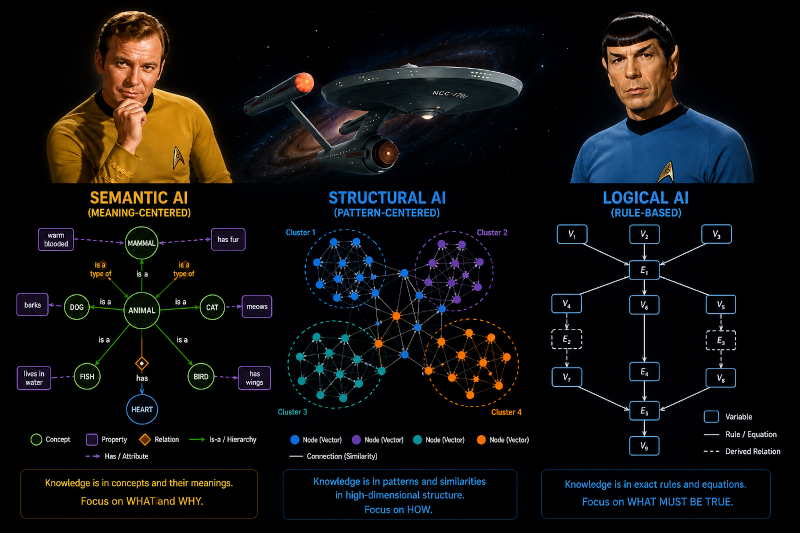
Captain James T. Kirk represents the human semantic approach. His decisions are driven primarily by meanings, context, intuition, emotions, values, and the interpretation of complex situations. He rarely reasons by applying formal rules step by step. Instead, he evaluates intentions, understands social relationships, considers multiple perspectives, and searches for the broader significance of events before deciding. In modern AI terminology, Kirk behaves much like a semantic network, where concepts and their relationships form the basis for understanding. His strength lies in answering questions such as What is happening?, What does it mean?, and What is the best decision for these particular circumstances?
Spock, the Vulcan first officer, represents the complementary logical approach. Educated in Vulcan philosophy, he deliberately suppresses emotion and bases his reasoning on explicit logic, mathematics, consistency, and formal deduction. Given the same information, Spock systematically evaluates alternatives according to logical rules and objective constraints. His way of thinking resembles a logical network, in which variables, equations, and formal relationships determine which conclusions necessarily follow from the available evidence. His strength lies in answering questions such as What must be true?, What follows logically?, and Which conclusion is consistent with the established rules?
The contrast between Kirk and Spock is therefore much deeper than emotion versus reason. Kirk operates primarily in the domain of semantic knowledge, where concepts acquire meaning through context and experience, while Spock operates in the domain of logical knowledge, where conclusions are derived through formal inference. Throughout the series, many of the most memorable episodes arise precisely because each perspective alone is incomplete. Kirk may perceive meanings that pure logic overlooks, whereas Spock may identify logical inconsistencies that intuition fails to detect.
From the perspective developed in this work, a third form of intelligence can be added to this classical pair: Structural AI. Unlike Kirk or Spock, a modern large language model does not begin with meanings or logical rules. Instead, it learns a vast high-dimensional network of statistical patterns from enormous amounts of text. This structural representation can later support semantic interpretations and logical reasoning, but its internal knowledge is fundamentally organized around patterns and similarities rather than concepts or equations.
The three paradigms therefore complement one another. Structural AI discovers patterns in experience, Semantic AI organizes those patterns into meaningful concepts, and Logical AI transforms concepts into formal models capable of rigorous reasoning. Together they provide a useful framework for understanding both modern artificial intelligence and the diverse ways intelligent systemswhether fictional or realcan represent and process knowledge.
ID:('gp', 566)
The human brain: two complementary representations of knowledge.
Storyboard
Although in previous chapters human intelligence has been presented mainly as a semantic system, the reality is more complex. The brain appears to maintain at least two complementary representations of knowledge, each with a different function and supported by different brain regions.
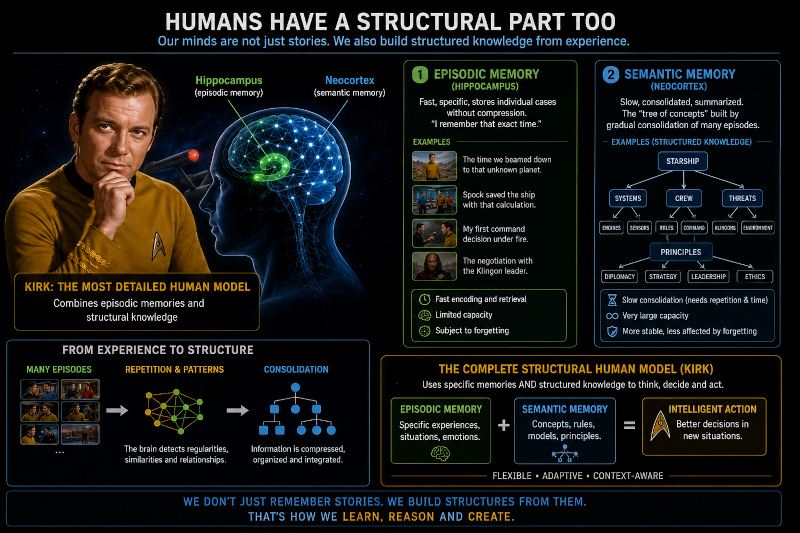
When we live an experience, it is initially stored as an episodic memory, that is, a relatively detailed record of a specific event: what happened, when, where, with whom and under what circumstances. This type of memory depends primarily on the hippocampus, a structure in the medial temporal lobe specialized in forming and retrieving memories of individual episodes. From a structural perspective, these memories can be understood as a large tree or structural network of experiences, where each episode retains much of its original relationships and can be connected to other similar memories.
However, the brain does not only preserve isolated experiences. As the same type of situation is repeated over months or years, a consolidation process begins through which regularities are detected, accidental details are eliminated, and common characteristics are extracted. The result is much more stable and abstract knowledge, organized in a semantic tree of concepts, where categories, properties, relationships and general principles appear. This consolidated knowledge is mainly associated with the neocortex, especially the distributed temporal, parietal, and frontal regions that constitute semantic memory.
In this way, human thought continually combines both systems. The semantic tree provides the concepts, meanings and general knowledge refined throughout life, while the structural network of episodic memories provides concrete examples, contexts and personal experiences that can be retrieved when a situation requires it. Thinking does not consist only of applying concepts nor only of remembering episodes, but of integrating both levels of representation.
This organization also helps understand why humans differ from current models of artificial intelligence. While an LLM directly builds a large structural network of statistical patterns, the human brain appears to progressively transform a portion of its experiences stored in the hippocampus into an increasingly refined semantic system housed in the neocortex. The result is a hybrid architecture in which memories remain specific experiences, while concepts represent abstract knowledge built from miles of those experiences. Both systems constantly cooperate to interpret new situations, reason and make decisions.
ID:('gp', 567)
Knowledge is built in layers.
Storyboard
Understanding the world is not an instantaneous process, but a gradual construction where each level organizes and abstracts the information from the previous level. Direct experience constitutes the starting point, but from it the brain identifies regularities, creates concepts, develops models, formulas, causal explanations and finally builds scientific knowledge and technologies capable of once again transforming reality. Each layer depends on the previous one and, at the same time, provides the necessary tools to build the next one.
The first stage corresponds to experience. We observe, listen, measure, act and accumulate countless interactions with the physical world. These individual experiences do not yet have a specific organization, but they contain all the information from which knowledge can arise.
Patterns and relationships appear from the repetition of similar experiences. The brain connects elements that usually occur together and builds a structural network of associations. This representation does not yet have explicit meaning; it simply reflects similarities, regularities and connections between the observed data.
The semantic network is developed on this structural network. The recurring patterns are grouped under concepts and categories that allow us to answer what each object or phenomenon is. Concepts like "animal", "energy", "force" or "plant" condense miles of particular experiences into much more manageable abstract entities.
The next level corresponds to logical knowledge. The concepts already established allow us to build causal models, rules and equations capable of explaining how phenomena work and predicting their behavior. This is where the physical laws, mathematical models and formal relationships that characterize scientific knowledge appear.
When these models are systematically tested through observations and experiments, they become part of the body of scientific knowledge. The resulting theories provide verifiable explanations, allow accurate predictions, and form the basis for technological development.
Finally, that knowledge re-engages with the world through tools, devices, applications, and decisions. Actions modify reality, generate new experiences and produce new data that restart the entire process, forming a continuous cycle of learning and knowledge construction.
The following figure summarizes this architecture in a simplified way, showing how each level emerges from the previous one and how knowledge finally returns to reality through action.
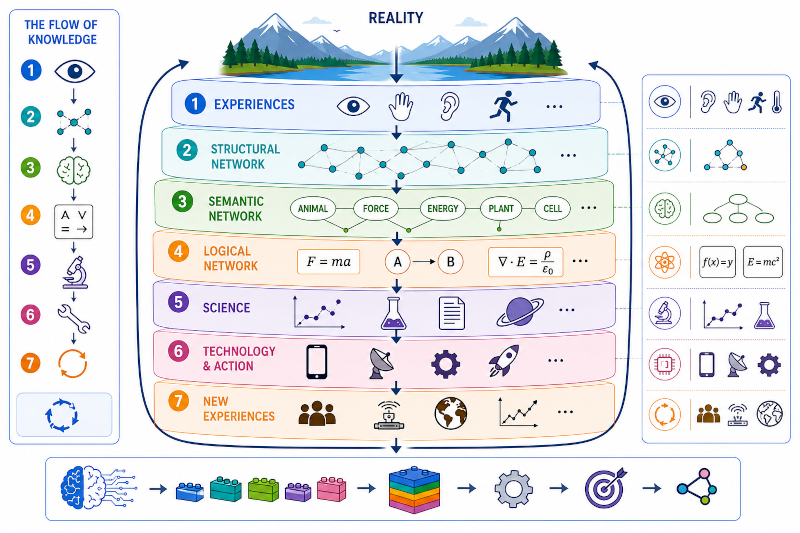
This vision is especially useful for understanding the relationship between the different forms of intelligence studied in this work. Structural intelligence operates primarily at the level of patterns and associations; Semantic intelligence organizes these patterns into meaningful concepts; and logical intelligence builds formal models capable of explaining mechanisms and making predictions. Science integrates these levels through experimental validation, while technology applies the knowledge obtained to once again transform the environment. Knowledge, therefore, should not be understood as a collection of isolated facts, but as a hierarchy of increasingly abstract representations that emerge from and continually return to experience.
The following figure presents the complete diagram, including each of the layers and the complete cycle that connects reality, knowledge and action.
ID:('gp', 568)
How a structural network grows
Storyboard
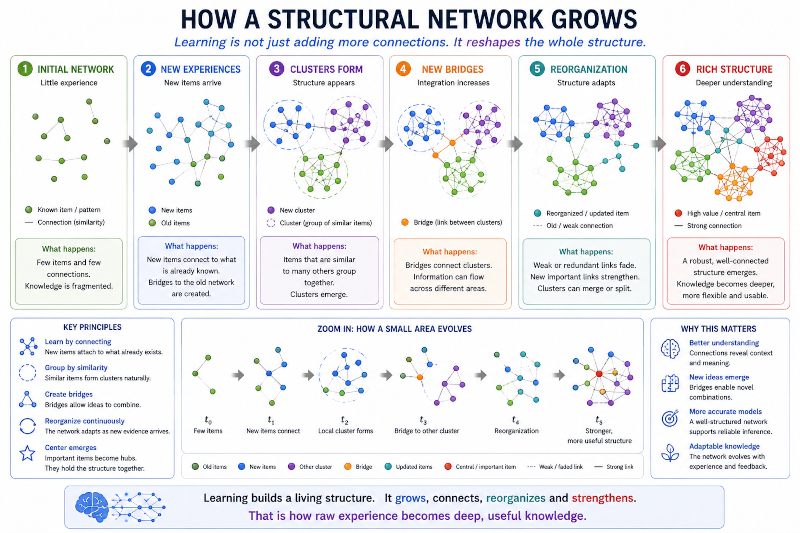
Learning is not simply about storing more information. Each new experience modifies the internal organization of knowledge, strengthens some connections, weakens others and creates new relationships between areas that previously remained separate. Over time, the network stops being a collection of isolated memories and becomes an increasingly integrated, efficient structure capable of making inferences about new situations.
At the beginning of learning the network contains few elements and very few connections. Knowledge is fragmentary and each experience remains relatively isolated. When new observations appear, they are not stored as independent information, but rather seek to connect with what already exists. Similarities with previous experiences allow new elements to be quickly incorporated into the previous structure.
As the number of experiences increases, natural groups of strongly related elements begin to appear. These groups, or clusters, represent specialized regions of the network where similar experiences are concentrated. However, a network made up solely of independent groups would be of little use, as knowledge would remain compartmentalized.
The next step consists of the appearance of bridges between different clusters. These links allow information to flow between different domains and make it possible to discover unexpected relationships between areas that originally seemed independent. Many new ideas arise precisely when a connection is established between two previously disconnected regions of knowledge.
The continuous incorporation of new experiences also forces us to reorganize the entire structure. Some connections lose importance and disappear, while others strengthen and become primary access routes to knowledge. Clusters themselves can split, merge, or redefine as new evidence appears. Consequently, learning also involves forgetting unhelpful relationships and continually reorganizing the internal representation of the world.
Finally, a mature network emerges, characterized by a hierarchical and highly interconnected structure. Some nodes become connection centers that integrate a large amount of information, while bridges between clusters facilitate the transfer of knowledge between different domains. This organization allows deeper inferences to be made, more general models to be built, and knowledge to be quickly adapted to completely new situations.
The following figure summarizes this growth process by showing the evolution of a structural network from a few isolated experiences to a rich, organized and highly connected representation.
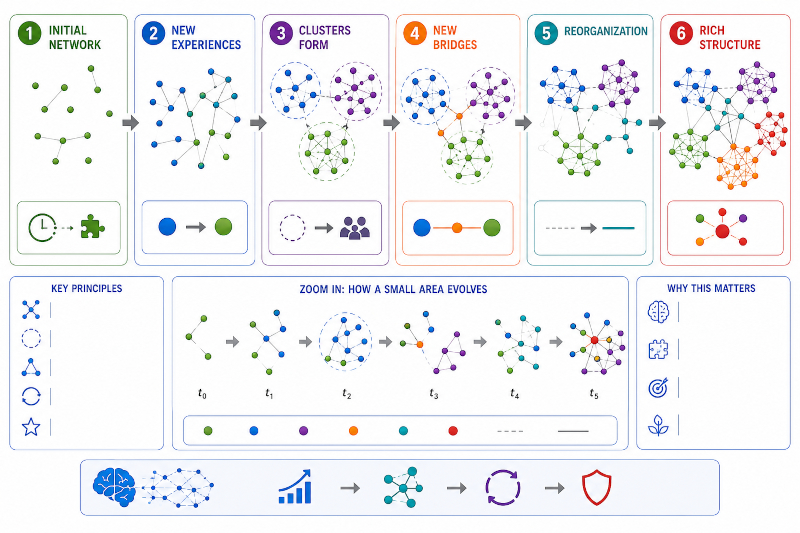
This mechanism explains why human learning and the learning of a structural artificial intelligence present important similarities. In both cases the objective is not only to store more information, but to continually reorganize the internal structure to increasingly better represent the existing relationships between the data. The quality of knowledge depends much more on the organization of the network than on the quantity of stored elements. A structure rich in clusters, bridges and relevant connections allows us to better understand reality, discover hidden relationships and generate more robust inferences.
The following figure presents the complete diagram of the growth process of a structural network, including the evolution of clusters, the formation of bridges and the progressive reorganization of the entire structure.
ID:('gp', 569)
From many models to a scientific theory
Storyboard
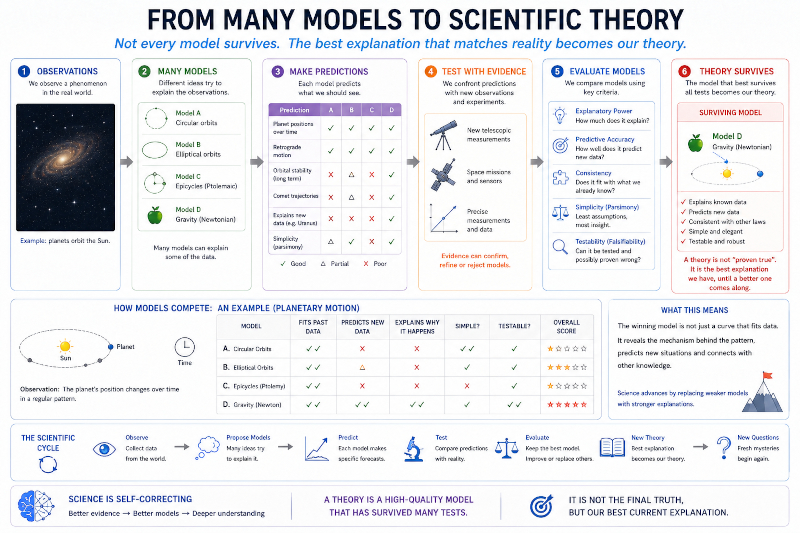
Science does not advance because a researcher has a good idea, but because multiple models continually compete to explain reality. An observation rarely determines a single possible explanation; On the contrary, different models can correctly describe the same known data. Scientific progress consists precisely in comparing these explanations, testing them and preserving only those that survive the most demanding evidence.
Every process begins with the observation of a phenomenon. Various hypotheses and models capable of reproducing, at least partially, the available observations arise from experimental data. Some models are simple empirical descriptions, while others propose causal mechanisms capable of explaining why the observed phenomenon occurs.
Each model generates different predictions about situations that have not yet been observed. These predictions constitute the true criterion of scientific evaluation, since they allow the design of experiments or observations capable of distinguishing between alternative models. A model that only fits existing data has little scientific value; a valuable model must correctly anticipate new facts.
New evidence obtained through experiments, measurements or observations allows each proposal to be confirmed, refined or discarded. No model is accepted by authority or by consensus, but only by its ability to withstand confrontation with reality. This process is continuous: each new evidence can strengthen an existing model or reveal its limitations.
The evaluation does not depend exclusively on the numerical adjustment. Criteria such as explanatory power, predictive capacity, coherence with other consolidated knowledge, simplicity and the possibility of being falsified by new observations are also considered. The models that best balance these aspects become the strongest candidates to describe the phenomenon.
When a model repeatedly passes experimental tests and continues to correctly explain both known data and new observations, it becomes part of scientific knowledge as a theory. However, a theory does not represent an absolute or definitive truth. It is simply the best model available at a given time, always open to being replaced by another that explains more phenomena, with greater precision or through deeper mechanisms.
The following figure summarizes this process of competition between models, showing how initial observations generate multiple explanations that are subjected to successive predictions, experiments and evaluations until one of them emerges as the current scientific theory.
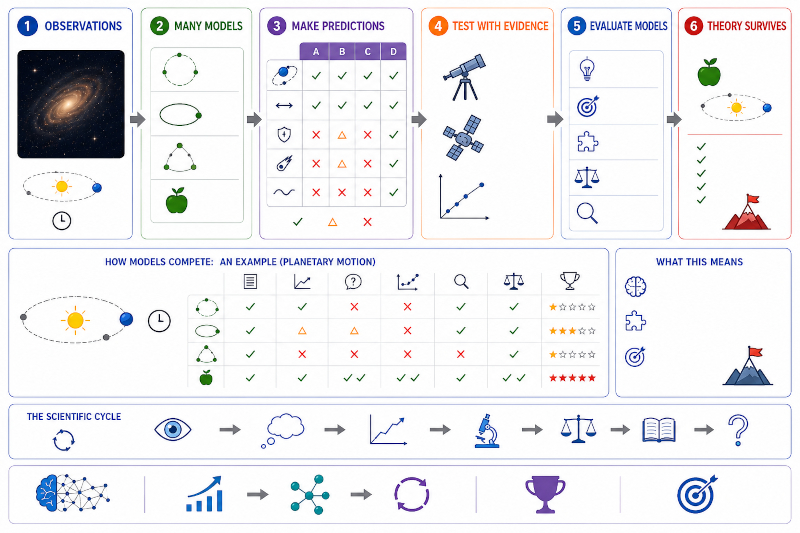
This selection mechanism explains why science has an extraordinary capacity for self-correction. Theories survive not by tradition or authority, but because they continue to be the explanations that best withstand the available evidence. Each new observation constitutes an opportunity to improve existing models or replace them with more complete ones. Consequently, the objective of science is not to achieve an immutable truth, but to build increasingly precise, general and predictive models of reality.
The following figure presents the complete diagram of the process by which multiple models compete, are experimentally contrasted and, finally, one of them is consolidated as a scientific theory.
ID:('gp', 570)
From pattern recognition to scientific discovery
Storyboard
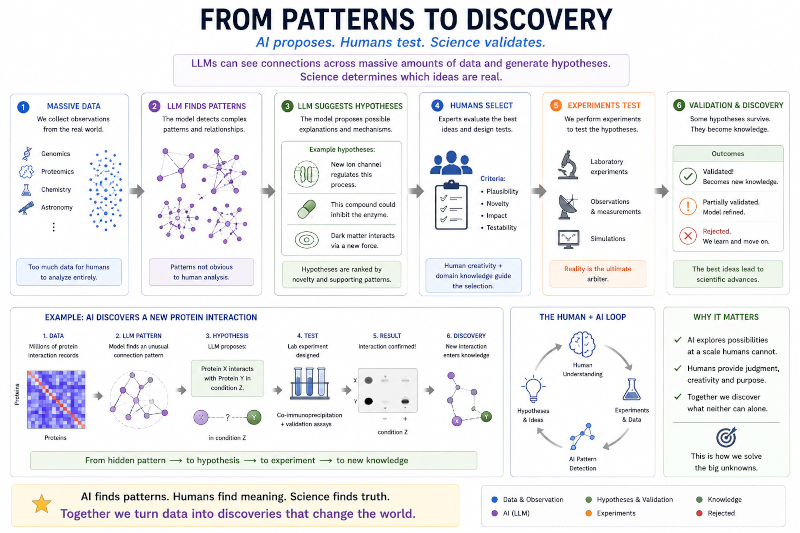
Modern artificial intelligence models can analyze amounts of information far greater than a person could examine in a lifetime. Thanks to this, they are able to detect patterns, associations and hidden relationships between millions of data from very different disciplines. However, discovering a pattern is not the same as making a scientific discovery. Artificial intelligence only proposes possibilities; It is up to researchers to interpret these proposals, design experiments and determine which ones represent real phenomena.
The process begins with the massive collection of experimental, observational or historical data. Based on this enormous base of information, a structural model identifies regularities that would normally remain hidden from conventional human analysis. These relationships can connect elements belonging to completely different domains and reveal unexpected associations that suggest new mechanisms or explanations.
From these patterns, artificial intelligence generates hypotheses. Each hypothesis represents a possible causal explanation, an unknown interaction, or a mechanism that could exist in nature. These proposals do not constitute validated knowledge; They are simply candidates whose plausibility depends on the structural support found in the data.
Human specialists then select the most promising hypotheses using their domain knowledge, scientific intuition, and criteria such as originality, consistency with existing knowledge, potential impact, and experimental verification. The objective is to concentrate experimental resources on those ideas that offer the greatest probability of producing a significant advance.
The selected hypotheses are tested through experiments, observations, simulations or new measurements. It is at this stage where reality acts as the definitive arbiter. Some hypotheses are confirmed, others require modifications and many are completely discarded. Even negative results provide valuable information, allowing us to refine models and guide new research.
The hypotheses that survive the experimental testing become integrated into the available scientific knowledge. From that moment on, they can become the basis for new theories, more complete models or technological developments. The entire process forms a continuous cycle in which artificial intelligence proposes possibilities, researchers evaluate them, and science determines which ones represent genuine discoveries.
The following figure summarizes this workflow, showing how a pattern detected by an artificial intelligence can be transformed, through experimental validation, into new scientific knowledge.
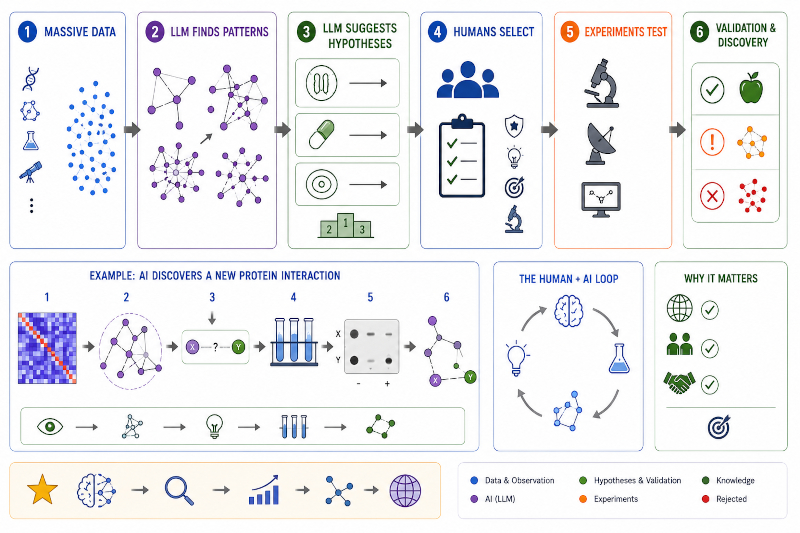
This approach highlights the complementary role of artificial intelligence and the scientific method. Structural models stand out for their extraordinary ability to explore immense spaces of possibilities and discover relationships that would be practically invisible to an individual researcher. However, the interpretation of these relationships, the design of appropriate experiments and validation against reality continue to be tasks specific to scientific research. Consequently, artificial intelligence does not replace the scientist, but rather greatly expands his ability to generate promising hypotheses and accelerate the discovery process.
The figure below presents the complete diagram of the process, from pattern recognition in large volumes of data to experimental validation and incorporation of new knowledge into the body of science.
ID:('gp', 571)
The pyramid of knowledge: from data to theory
Storyboard
All knowledge arises from observation of the world, but not all forms of knowledge have the same level of organization or explanatory capacity. As we accumulate experiences, the brain and science build increasingly abstract representations, where each level organizes and gives meaning to the previous one. The pyramid of knowledge summarizes this process of progressive abstraction, showing how data end up becoming theories capable of explaining and predicting the behavior of reality.
The base of the pyramid is made up of data. They correspond to individual observations, measurements, images, signals, words or any other information obtained directly from the world. On its own, data describes isolated events, but does not yet reveal relationships or meaning.
When the number of data increases, patterns begin to appear. The brain, and also modern artificial intelligence models, detect regularities, similarities and associations between different observations. At this stage there is still no conceptual interpretation; structures that are repeated more frequently than expected by chance are simply identified.
The next level corresponds to concepts. Similar patterns are grouped together and given a common meaning, allowing us to answer what each set of observations represents. A concept summarizes thousands of particular experiences under the same abstract idea, greatly facilitating reasoning and communication.
Models are built on concepts, whose purpose is to explain the mechanisms responsible for the observed phenomena. A model proposes causal relationships between concepts and allows us to understand why a certain behavior occurs, in addition to generating predictions that can be contrasted with new observations.
The models subsequently give rise to higher level structures represented by logic, where general rules, equations and formal systems appear capable of connecting multiple models together. This level allows rigorous deductions to be made, knowledge to be extended to new situations, and a coherent representation of an entire domain to be constructed.
Finally, at the top of the pyramid are scientific theories. A theory integrates numerous compatible models within a unified framework that has been repeatedly validated through observations and experiments. Theories represent the highest level of understanding achieved up to a given point in time, although they always remain open to being refined or replaced by more complete explanations when new evidence appears.
The figure below presents a simplified version of this hierarchy, highlighting only the fundamental levels of the process by which data is progressively transformed into deep understanding.
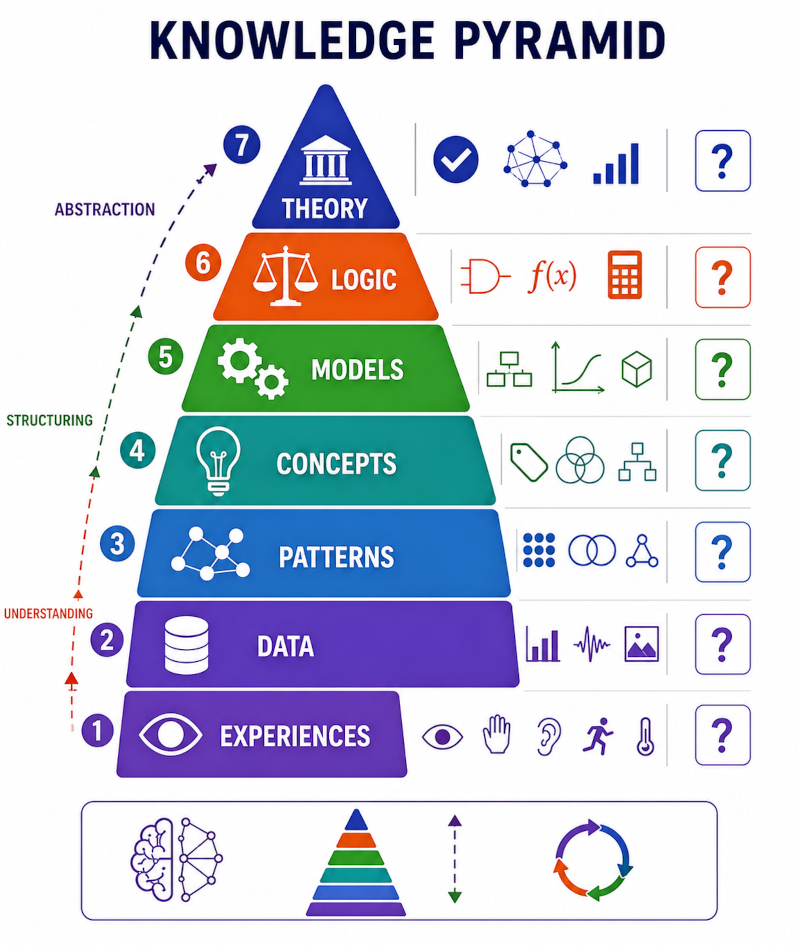
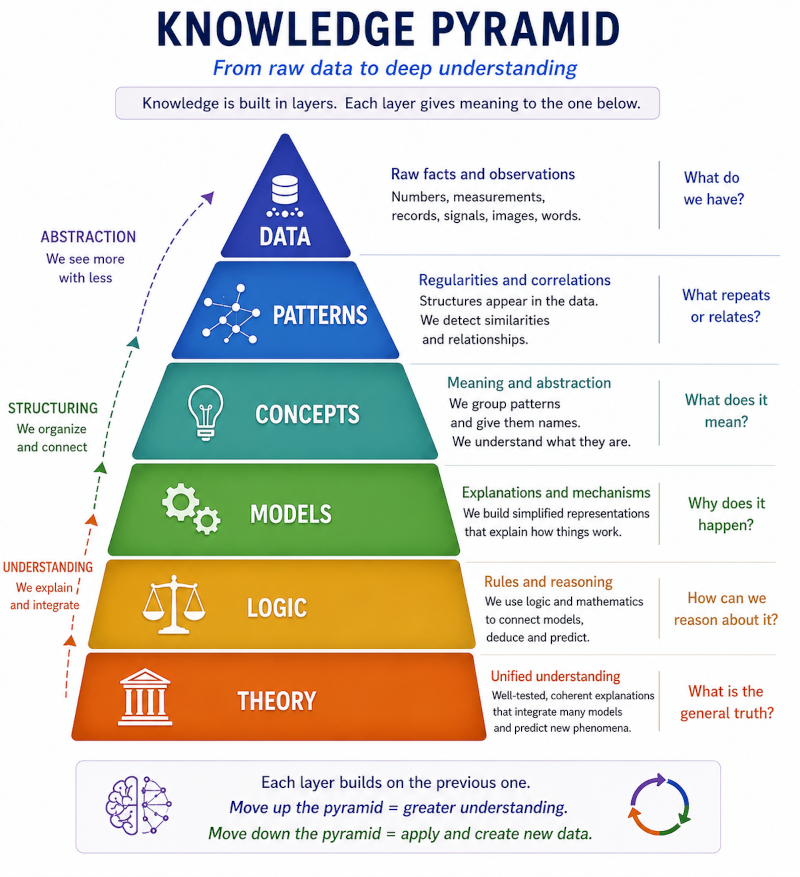
This pyramid also allows us to understand the relationship between the different intelligence architectures described in this work. Structural intelligence operates primarily at the level of patterns; Semantic intelligence organizes these patterns into meaningful concepts; while logical intelligence develops formal models and structures capable of explaining mechanisms and making predictions. Science completes the process by validating these models against reality and consolidating them, when they repeatedly survive evidence, as scientific theories. The upward path represents a continuous increase in the level of abstraction and understanding, while the downward path corresponds to the application of knowledge to generate new observations and restart the learning cycle.
The following figure shows the complete diagram of the pyramid of knowledge, including the characteristic questions answered by each level and the relationship between abstraction, understanding and progressive construction of knowledge.
ID:('gp', 572)
Training structural artificial intelligence
Storyboard
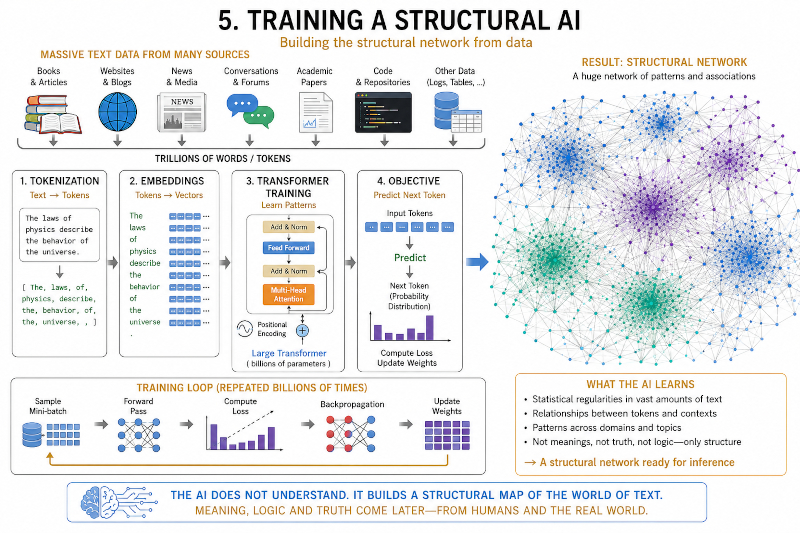
Modern artificial intelligence models are not born with prior knowledge about the world. Everything they learn comes from analyzing enormous amounts of information written by human beings. During training, the goal is not to teach concepts, rules or theories, but to allow the system to discover for itself the statistical regularities present in billions of texts. The result is a gigantic structural network where words, expressions and contexts are organized according to the relationships that repeatedly appear in the data.
The process begins by collecting information from numerous sources, such as books, scientific articles, web pages, conversations, news, software repositories, and other data sets. All this content represents an immense sample of the knowledge produced by humanity and constitutes the raw material on which the model will be trained.
The first step is tokenization, where the text is divided into small units called tokens. Depending on the algorithm used, a token can correspond to an entire word, a part of it, a punctuation mark, or even an individual character. This representation allows natural language to be transformed into a sequence that can be processed computationally.
Subsequently, each token is converted into a numerical vector through the process known as embedding. These vectors represent the relative position of each token within a very high-dimensional space. Tokens that appear in similar contexts end up being located close to each other, while those used in different contexts are separated. At this stage there is still no explicit meaning; we only begin to build a structural representation based on statistical similarities.
The vector information is then processed by the Transformer architecture, whose attention mechanism identifies which parts of the context are relevant to predict the next token. Over billions of iterations, the model adjusts its billions of internal parameters to minimize prediction error. Each new correction slightly modifies the entire internal structure, strengthening some connections and weakening others.
At the end of training, the system has built a huge network of associations between linguistic patterns. This network contains relationships between words, expressions, writing styles and thematic domains, allowing extremely complex inferences to be made during the text generation process. However, it is important to highlight that this structure does not in itself constitute a semantic or logical representation of knowledge. The model has learned only regularities present in the data, without directly distinguishing between truth, meaning or causality.
The following figure summarizes in a simplified manner the main stages through which a structural artificial intelligence builds its internal network of patterns from large volumes of text.
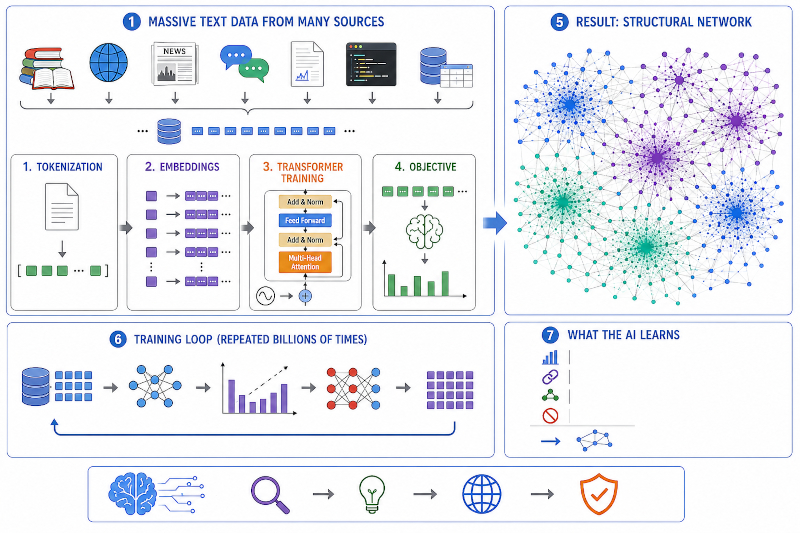
From the perspective developed in this work, the result of training can be interpreted as the construction of a gigantic structural network, analogous to the structural memory that the human brain also develops from experience. This network constitutes the foundation on which semantic layers, causal models and logical reasoning can later be incorporated. Training does not produce understanding; produces an extremely rich structure of statistical relationships that will serve as the basis for all subsequent inferences made by the model.
The following figure presents the complete diagram of the training process of a structural artificial intelligence, from massive data collection to the formation of the pattern network later used during inference.
ID:('gp', 573)
Structural validation: how an AI chooses the best answer
Storyboard
Once training is completed, a structural artificial intelligence has a huge network of patterns, associations and similarities built from billions of examples. When the user asks a question, the model does not look up a stored answer or check whether a statement is true. Its task is to generate multiple possible continuations and select the one that receives the greatest support from the internal structure learned during training.
The process begins with the activation of the relevant regions of the structural network based on the received prompt. The words of the query stimulate different groups of connections distributed throughout the network, recovering information related to the context of the question. This initial activation determines which areas of structural knowledge will participate in the generation of possible responses.
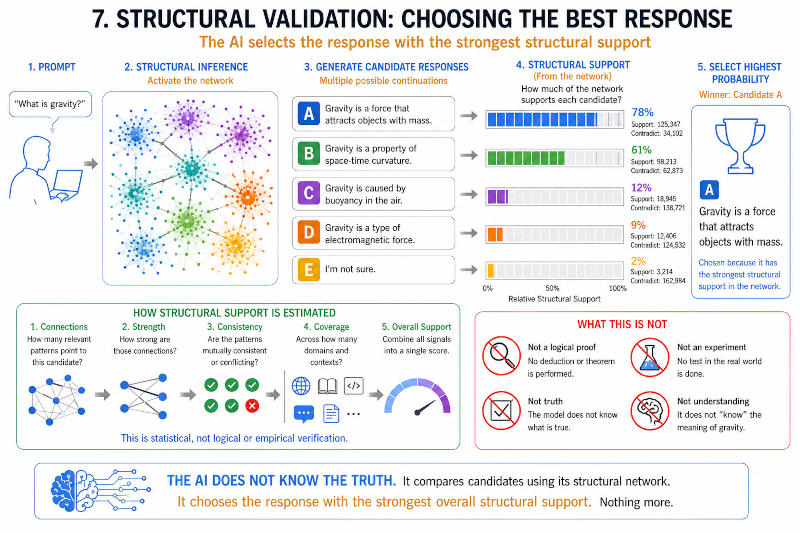
The model then simultaneously constructs numerous candidates. Each represents a possible continuation of the text and may differ both in content and formulation. These candidates do not appear because the system "knows" which one is correct, but because they all have some degree of compatibility with the patterns learned during training.
The decisive step is to estimate the structural support of each candidate. To do this, the model evaluates how many relevant connections support the proposed answer, how strong these connections are, how consistent they are with each other, and in how many independent contexts similar relationships appear. The combination of these factors produces an overall score that reflects the degree of structural coherence of each alternative within the internal network.
The following figure summarizes this selection mechanism in a simplified way, showing how several candidate responses compete with each other until the model chooses the one with the greatest structural support.
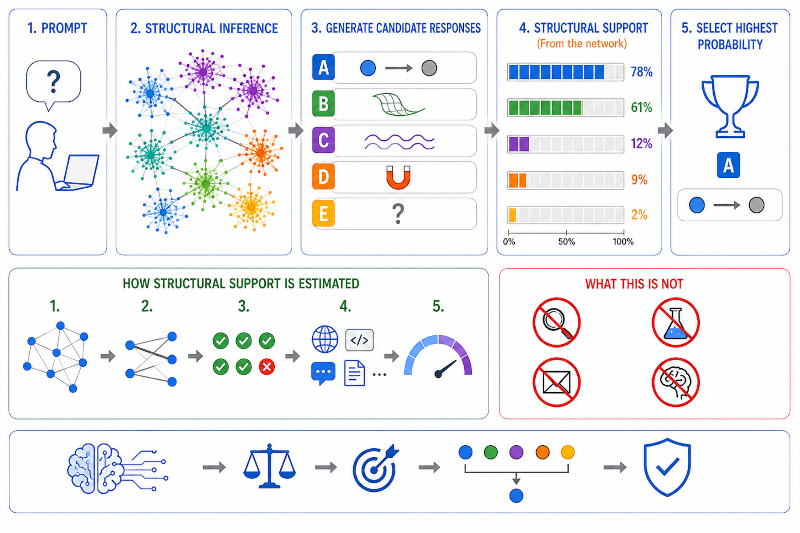
It is important to understand that this procedure does not constitute a logical demonstration, nor does it represent experimental validation nor does it imply that the model knows the truth of the generated statement. The artificial intelligence only estimates which of the responses is the most consistent with the enormous statistical structure it built during training. For this reason, a response can be structurally highly probable and still be incorrect if the training data contains errors, biases, or insufficient information.
From this perspective, the inference made by an LLM can be understood as a process of competition between hypotheses, where each possible answer receives a different level of support depending on the quantity and quality of the relationships that support it within the network. The system finally selects the alternative with the highest overall score, even though it never has an internal criterion to distinguish between probability, meaning, logic or truth.
The following figure presents the complete structural validation process used by an artificial intelligence to select the final answer from multiple candidates generated during inference.
ID:('gp', 574)
From prompt to response: the inference process in structural AI
Storyboard
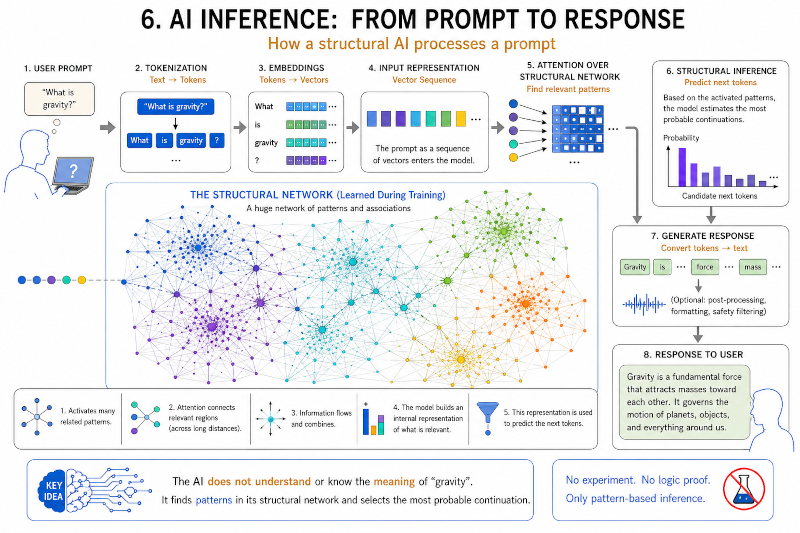
Once the structural network is trained, the artificial intelligence is ready to answer queries. In this stage, called inference, the model no longer modifies its internal knowledge, but rather uses the structure learned during training to generate a response consistent with the information received. The entire process occurs in fractions of a second and consists of a sequence of transformations that convert a question written by the user into a new sequence of words.
The process begins when the user enters a prompt. This text represents the only information that the model receives to start the inference. As during training, the first stage consists of tokenization, where the text is divided into a sequence of tokens that can correspond to whole words, fragments of words or punctuation marks.
Each token is subsequently converted into a numerical vector (embedding), allowing the entire sequence to be represented as a set of points within the vector space learned during training. These vectors constitute the actual input to the model and contain only structural information, not explicit meaning.
The Transformer architecture then uses the attention mechanism to identify which regions of the structural network are most relevant to interpreting the context of the prompt. Attention does not look for defined concepts or logical rules, but rather for statistical patterns similar to those observed during training. As a consequence, different areas of the internal network are activated simultaneously and information begins to spread between them.
The following figure summarizes in a simplified way the path followed by a query from when it is entered by the user until the activation of the structural network responsible for generating the response.
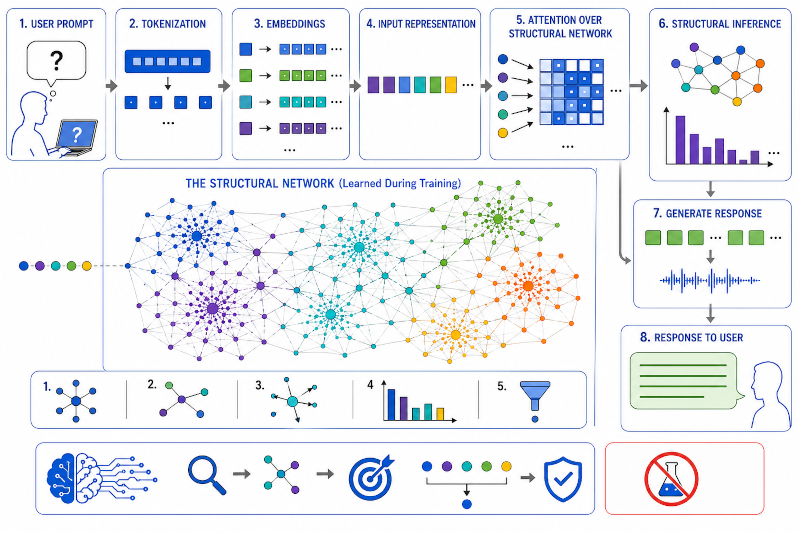
The joint activation of these regions produces an internal representation of the current context. Based on this representation, the model estimates a probability distribution for all possible tokens that could appear as a continuation of the text. The token with the highest probability is selected, incorporated into the sequence and the process is repeated to predict the next one. In this way, the complete response is constructed word by word through a succession of predictions conditioned by the previously generated context.
It is important to note that throughout the inference, the artificial intelligence does not understand the meaning of the words, perform logical demonstrations, or experimentally verify its statements. Its operation consists exclusively of activating relevant regions of the structural network and selecting, at each step, the continuation with the greatest statistical support according to the structure learned during training.
From this perspective, inference can be interpreted as a process of navigation within a gigantic network of patterns, where each new token modifies the context and causes new activations that determine the next prediction. The quality of the response will therefore depend on the richness of the internal structure built during training and the statistical support available for each possible continuation.
The following figure presents the complete inference process of a structural artificial intelligence, from receiving the prompt to generating the final response delivered to the user.
ID:('gp', 575)
Collaborative intelligence: combining the structural capacity of AI with the human scientific method
Storyboard
Up to this point we have analyzed how a structural artificial intelligence learns large networks of patterns and how it uses those structures to generate responses. However, the greatest strength of these systems is not in replacing the human researcher, but in becoming a tool capable of enormously expanding the space for knowledge exploration. Artificial intelligence and human beings have profoundly different capabilities and, precisely for this reason, highly complementary.
AI excels at simultaneously analyzing enormous amounts of information. You can discover obscure relationships, generate summaries, propose hypotheses, find analogies between distant disciplines, and explore thousands of alternatives that would be impossible to review manually. This entire process occurs using exclusively the structural network built during training, without understanding the meaning of the concepts or distinguishing between truth and falsehood.
On the contrary, the human scientist provides capabilities that currently remain outside the reach of structural artificial intelligence. He is the one who interprets the meaning of observations, builds causal models, applies logical reasoning, designs experiments and uses the scientific method to validate or reject the proposed hypotheses. The final decision about what constitutes new knowledge always depends on evidence obtained in the real world.
The following figure summarizes in a simplified way how both capabilities complement each other. Artificial intelligence explores the space of possibilities and generates new ideas, while the human researcher selects the most promising ones, interprets them within a scientific context and subjects them to experimental verification.
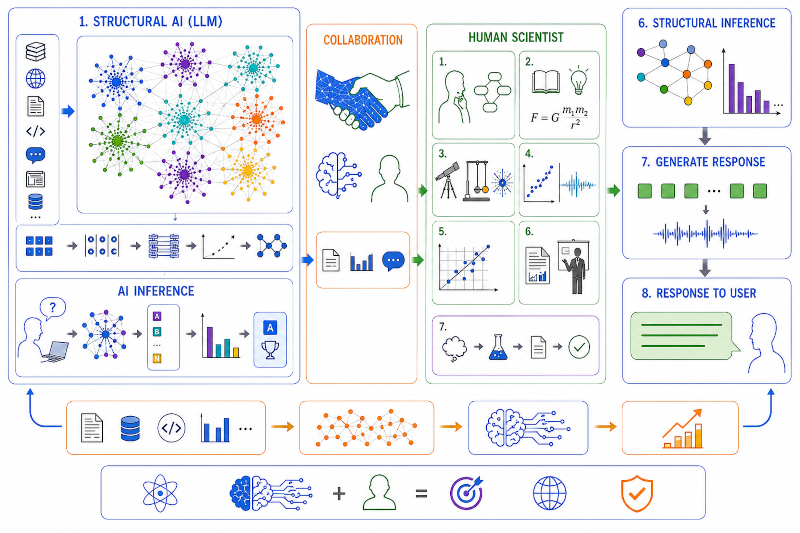
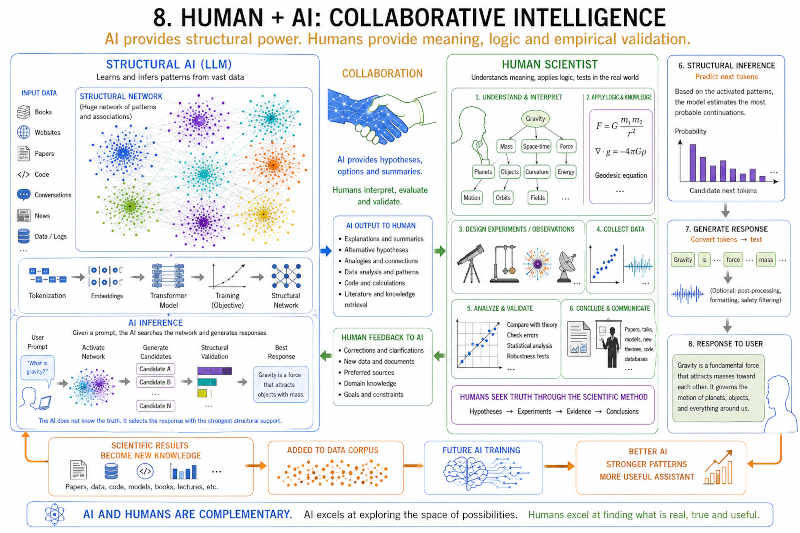
This collaboration establishes a continuous feedback loop. AI produces hypotheses, connections and possible explanations; The researcher evaluates them, performs experiments, obtains new data and communicates the results through scientific publications, databases, software or new models. This information subsequently becomes part of the data set available for future generations of artificial intelligence systems, allowing increasingly richer and more precise models to be trained.
From this perspective, artificial intelligence ceases to be a simple machine that answers questions and becomes an accelerator of the scientific process. Its main function is to expand the search space, reveal hidden patterns and suggest research paths that must subsequently be analyzed using expert knowledge and empirical evidence. Scientific discovery remains a human process, but now you have a tool capable of exploring possibilities on an unprecedented scale.
Consequently, the greatest revolution lies not only in having increasingly powerful linguistic models, but in learning to integrate them into the scientific method as specialized assistants in structural exploration. The combination between the statistical capacity of AI and the interpretation, creativity and experimental validation of the human researcher allows us to address problems whose complexity far exceeds the capabilities of either of them working in isolation.
The figure below presents the complete flow of this collaborative intelligence, showing how AI generates structural hypotheses, how the researcher transforms them into validated scientific knowledge, and how that new knowledge subsequently feeds back into the training of future generations of models.
ID:('gp', 576)
Palos Verdes, Costa de Corral, Región de los Rios, Chile