
 User:
User:



Deep water mixing process
Storyboard 
In the case of greater depths, the energy dissipation mechanisms of vortices are related to viscosity and buoyancy. Which one dominates depends on the situation and can be determined using characteristic numbers associated with both phenomena.[1] Marine Physics, Jerzy Dera, Elsevier, 1992 (6.2 The Turbulent Exchange of Mass, Heat and Momentum in the Sea)
ID:(1628, 0)

Kinetic energy dissipated by the vortex
Concept
In general, energy dissipation occurs over the considered time period, so the kinetic energy ($\epsilon_v$) should be compared with a characteristic time ($\tau$) such that
$\displaystyle\frac{d\epsilon}{dt}\sim\displaystyle\frac{\epsilon_v}{\tau}$
There are two types of processes that reduce the energy of vortices until they become thermal fluctuations. On one hand, there's momentum diffusion or viscosity, while on the other hand, there's flotation.
The loss of the kinetic energy ($\epsilon_v$) varies depending on the energy dissipated by viscosity ($\epsilon_{\eta}$) and the energy dissipated by flotation ($\epsilon_{\rho}$) in the characteristic time ($\tau$) as
| $ \displaystyle\frac{ \epsilon_v }{ \tau } = \displaystyle\frac{ \epsilon_{\eta} }{ \tau } + \displaystyle\frac{ \epsilon_{ \rho } }{ \tau } $ |
ID:(15621, 0)
Variation of kinetic energy
Concept
As the kinetic energy ($\epsilon_v$), where for simplicity we neglect the factor of 1/2 and it depends on the medium density ($\rho$) and the vortex speed ($v_l$),
$\epsilon =\displaystyle\frac{1}{2}\rho v_l^2\sim \rho v_l^2$
the energy loss will be this energy by the characteristic time ($\tau$), which with the mixing length ($l$) is
| $ \tau = \displaystyle\frac{ l }{ v_l }$ |
and thus, the variation is
| $ \displaystyle\frac{ \epsilon_v }{ \tau } = \displaystyle\frac{ \rho v_l ^3 }{ l }$ |
ID:(15608, 0)
Loss of energy due to viscosity
Concept
As the energy dissipated by viscosity ($\epsilon_{\eta}$) is with the viscosity of ocean water ($\eta$), the vortex speed ($v_l$), and the mixing length ($l$),
$\epsilon_{\eta} =\eta\displaystyle\frac{v_l}{l}$
the energy loss will be this energy by the characteristic time ($\tau$), which with the mixing length ($l$) is
| $ \tau = \displaystyle\frac{ l }{ v_l }$ |
and thus, the variation is
| $ \displaystyle\frac{ \epsilon_{\eta} }{ \tau } = \eta \displaystyle\frac{ v_l ^2 }{ l ^2 }$ |
ID:(15609, 0)
Loss of energy due to flotation
Concept
As the energy dissipated by flotation ($\epsilon_{\rho}$) is with ERROR:9484, the gravitational acceleration ($g$), and the mixing length ($l$):
$\epsilon_{\rho} =\Delta\rho g l$
the energy loss will be this energy by the characteristic time ($\tau$), which is
| $ \tau = \displaystyle\frac{ l }{ v_l }$ |
and thus, the variation is
| $ \displaystyle\frac{ \epsilon_{\rho} }{ \tau } = \Delta\rho g v_l $ |
ID:(15610, 0)
Viscosity damping
Concept
In the case where diffusive processes are more relevant than flotation ones, it is observed that with the kinetic energy ($\epsilon_v$), the energy dissipated by flotation ($\epsilon_{\rho}$), and the energy dissipated by viscosity ($\epsilon_{\eta}$),
$\epsilon_v > \epsilon_{\eta} \gg \epsilon_{\rho}$
Given that with the characteristic time ($\tau$), the kinetic energy ($\epsilon_v$) is
| $ \displaystyle\frac{ \epsilon_v }{ \tau } = \displaystyle\frac{ \rho v_l ^3 }{ l }$ |
and the energy dissipated by viscosity ($\epsilon_{\eta}$) is
| $ \displaystyle\frac{ \epsilon_{\eta} }{ \tau } = \eta \displaystyle\frac{ v_l ^2 }{ l ^2 }$ |
the existence of the vortex implies that its kinetic energy is greater than the loss, so with
$\rho\displaystyle\frac{v_l^3}{l}>\eta\displaystyle\frac{v_l^2}{l^2}$
it results in the requirement that it must be the case that
| $ Re = \displaystyle\frac{ \rho l v_l }{ \eta } > 1$ |
ID:(15612, 0)
Flotation damping
Concept
In the event that with the kinetic energy ($\epsilon_v$), the energy dissipated by viscosity ($\epsilon_{\eta}$), and the energy dissipated by flotation ($\epsilon_{\rho}$) are such that
$\epsilon_v > \epsilon_{\rho} \gg \epsilon_{\eta}$
Given that the kinetic energy ($\epsilon_v$) is with the density ($\rho$), the mixing length ($l$), and the vortex speed ($v_l$) in the characteristic time ($\tau$),
| $ \displaystyle\frac{ \epsilon_v }{ \tau } = \displaystyle\frac{ \rho v_l ^3 }{ l }$ |
and the energy dissipated by flotation ($\epsilon_{\rho}$) is with ERROR:9484, the gravitational Acceleration ($g$), and the vortex speed ($v_l$) in the characteristic time ($\tau$),
| $ \displaystyle\frac{ \epsilon_{\rho} }{ \tau } = \Delta\rho g v_l $ |
the existence of the vortex implies that its kinetic energy is greater than the loss, so with
$\rho\displaystyle\frac{v_l^3}{l}>\Delta\rho g v_l$
the requirement arises that with it must be the case that the richardson number ($R_i$) satisfies
| $ R_i = \displaystyle\frac{\Delta \rho}{\rho}\displaystyle\frac{ g l }{ v_l^2}<1$ |
ID:(15611, 0)

Richardson and Reynolds number relationship
Description
The relationship between ERROR:8614 with the density ($\rho$), the vortex speed ($v_l$), the viscosity of ocean water ($\eta$), and the tamaño característico ($l$) is given by
| $ Re = \displaystyle\frac{ \rho l v_l }{ \eta } > 1$ |
and the richardson number ($R_i$) with ERROR:9484 and the gravitational Acceleration ($g$) is represented by
| $ R_i = \displaystyle\frac{\Delta \rho}{\rho}\displaystyle\frac{ g l }{ v_l^2}<1$ |
as shown in the graph below, where both boundary cases mark the stability limit situations:
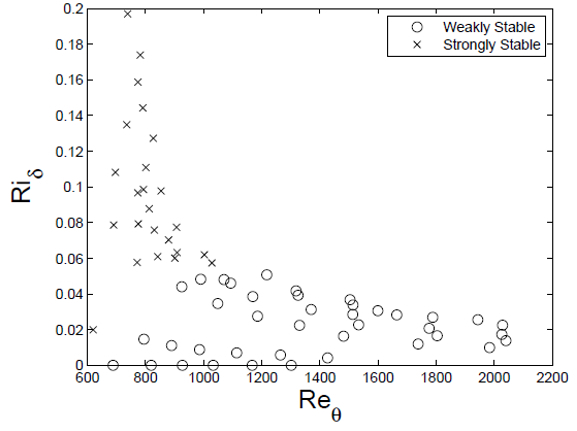
Turbulent Coherent Structures in a Thermally stable Boundary Layer, Owen Williams and Alexander J. Smits, https://www.researchgate.net/publication/228761589_Turbulent_Coherent_Structures_in_a_Thermally_Stable_Boundary_Layer
ID:(12211, 0)

Deep water mixing process
Model
In the case of greater depths, the energy dissipation mechanisms of vortices are related to viscosity and buoyancy. Which one dominates depends on the situation and can be determined using characteristic numbers associated with both phenomena. [1] Marine Physics, Jerzy Dera, Elsevier, 1992 (6.2 The Turbulent Exchange of Mass, Heat and Momentum in the Sea)

Variables

Calculations
 to
to  ,
then, select the variable:
,
then, select the variable:  to
to 
Calculations
Variable
 Given
Calculate
Given
Calculate
 Target :
Equation
To be used
Target :
Equation
To be used

Equations
The loss from the vortices involves the energy dissipated by viscosity ($\epsilon_{\eta}$) with the viscosity of ocean water ($\eta$), the vortex speed ($v_l$), and the mixing length ($l$).
$\epsilon_{\eta} =\eta\displaystyle\frac{v_l}{l}$
The energy loss due to the characteristic time ($\tau$), which is
| $ \tau = \displaystyle\frac{ l }{ v_l }$ |
is described by
| $ \displaystyle\frac{ \epsilon_{\eta} }{ \tau } = \eta \displaystyle\frac{ v_l ^2 }{ l ^2 }$ |
(ID 12207)
Since the energy dissipated by flotation ($\epsilon_{\rho}$) equals ERROR:9484, the gravitational Acceleration ($g$), and the distance traveled ($\Delta z$),
$\epsilon_{\rho} =\Delta\rho g \Delta z$
the energy loss will be this energy per the characteristic time ($\tau$), which, with the mixing length ($l$), is
| $ \tau = \displaystyle\frac{ l }{ v_l }$ |
so with the vortex speed ($v_l$), it is
| $ \displaystyle\frac{ \epsilon_{\rho} }{ \tau } = \Delta\rho g v_l $ |
(ID 12208)
In the case where diffusive processes are more relevant than buoyancy, we have that with the kinetic energy ($\epsilon_v$), the energy dissipated by flotation ($\epsilon_{\rho}$) and the energy dissipated by viscosity ($\epsilon_{\eta}$),
$\epsilon_v > \epsilon_{\eta} \gg \epsilon_{\rho}$
Given that with the characteristic time ($\tau$), the kinetic energy ($\epsilon_v$) and the medium density ($\rho$) is
| $ \displaystyle\frac{ \epsilon_v }{ \tau } = \displaystyle\frac{ \rho v_l ^3 }{ l }$ |
and the energy dissipated by viscosity ($\epsilon_{\eta}$) is
| $ \displaystyle\frac{ \epsilon_{\eta} }{ \tau } = \eta \displaystyle\frac{ v_l ^2 }{ l ^2 }$ |
the existence of the vortex implies that its kinetic energy is greater than the loss, so with
$\rho\displaystyle\frac{v_l^3}{l}>\eta\displaystyle\frac{v_l^2}{l^2}$
the requirement that the reynolds number ($Re$) must be
| $ Re = \displaystyle\frac{ \rho l v_l }{ \eta } > 1$ |
(ID 12209)
In the event that with the kinetic energy ($\epsilon_v$), the energy dissipated by viscosity ($\epsilon_{\eta}$), and the energy dissipated by flotation ($\epsilon_{\rho}$) are such that
$\epsilon_v > \epsilon_{\rho} \gg \epsilon_{\eta}$
Given that the kinetic energy ($\epsilon_v$) is with the medium density ($\rho$), the mixing length ($l$), and the vortex speed ($v_l$) in the characteristic time ($\tau$),
| $ \displaystyle\frac{ \epsilon_v }{ \tau } = \displaystyle\frac{ \rho v_l ^3 }{ l }$ |
and the energy dissipated by flotation ($\epsilon_{\rho}$) is with ERROR:9484, the gravitational Acceleration ($g$), and the vortex speed ($v_l$) in the characteristic time ($\tau$),
| $ \displaystyle\frac{ \epsilon_{\rho} }{ \tau } = \Delta\rho g v_l $ |
the existence of the vortex implies that its kinetic energy is greater than the loss, so with
$\rho\displaystyle\frac{v_l^3}{l}>\Delta\rho g v_l$
the requirement arises that with, the richardson number ($R_i$) must satisfy
| $ R_i = \displaystyle\frac{\Delta \rho}{\rho}\displaystyle\frac{ g l }{ v_l^2}<1$ |
(ID 12210)
Como the kinetic energy ($\epsilon_v$) of the vortices depends on the medium density ($\rho$) and the vortex speed ($v_l$) according to
$\epsilon_v =\displaystyle\frac{1}{2}\rho v_l^2\sim \rho v_l^2$
Como the characteristic time ($\tau$) with the mixing length ($l$) is
| $ \tau = \displaystyle\frac{ l }{ v_l }$ |
we have that
$\displaystyle\frac{\epsilon_v}{\tau} =\rho \displaystyle\frac{v_l^3}{l}$
which means
| $ \displaystyle\frac{ \epsilon_v }{ \tau } = \displaystyle\frac{ \rho v_l ^3 }{ l }$ |
(ID 12212)

Examples
(ID 15616)
In general, energy dissipation occurs over the considered time period, so the kinetic energy ($\epsilon_v$) should be compared with a characteristic time ($\tau$) such that
$\displaystyle\frac{d\epsilon}{dt}\sim\displaystyle\frac{\epsilon_v}{\tau}$
There are two types of processes that reduce the energy of vortices until they become thermal fluctuations. On one hand, there's momentum diffusion or viscosity, while on the other hand, there's flotation.
The loss of the kinetic energy ($\epsilon_v$) varies depending on the energy dissipated by viscosity ($\epsilon_{\eta}$) and the energy dissipated by flotation ($\epsilon_{\rho}$) in the characteristic time ($\tau$) as
| $ \displaystyle\frac{ \epsilon_v }{ \tau } = \displaystyle\frac{ \epsilon_{\eta} }{ \tau } + \displaystyle\frac{ \epsilon_{ \rho } }{ \tau } $ |
(ID 15621)
As the kinetic energy ($\epsilon_v$), where for simplicity we neglect the factor of 1/2 and it depends on the medium density ($\rho$) and the vortex speed ($v_l$),
$\epsilon =\displaystyle\frac{1}{2}\rho v_l^2\sim \rho v_l^2$
the energy loss will be this energy by the characteristic time ($\tau$), which with the mixing length ($l$) is
| $ \tau = \displaystyle\frac{ l }{ v_l }$ |
and thus, the variation is
| $ \displaystyle\frac{ \epsilon_v }{ \tau } = \displaystyle\frac{ \rho v_l ^3 }{ l }$ |
(ID 15608)
As the energy dissipated by viscosity ($\epsilon_{\eta}$) is with the viscosity of ocean water ($\eta$), the vortex speed ($v_l$), and the mixing length ($l$),
$\epsilon_{\eta} =\eta\displaystyle\frac{v_l}{l}$
the energy loss will be this energy by the characteristic time ($\tau$), which with the mixing length ($l$) is
| $ \tau = \displaystyle\frac{ l }{ v_l }$ |
and thus, the variation is
| $ \displaystyle\frac{ \epsilon_{\eta} }{ \tau } = \eta \displaystyle\frac{ v_l ^2 }{ l ^2 }$ |
(ID 15609)
As the energy dissipated by flotation ($\epsilon_{\rho}$) is with ERROR:9484, the gravitational acceleration ($g$), and the mixing length ($l$):
$\epsilon_{\rho} =\Delta\rho g l$
the energy loss will be this energy by the characteristic time ($\tau$), which is
| $ \tau = \displaystyle\frac{ l }{ v_l }$ |
and thus, the variation is
| $ \displaystyle\frac{ \epsilon_{\rho} }{ \tau } = \Delta\rho g v_l $ |
(ID 15610)
In the case where diffusive processes are more relevant than flotation ones, it is observed that with the kinetic energy ($\epsilon_v$), the energy dissipated by flotation ($\epsilon_{\rho}$), and the energy dissipated by viscosity ($\epsilon_{\eta}$),
$\epsilon_v > \epsilon_{\eta} \gg \epsilon_{\rho}$
Given that with the characteristic time ($\tau$), the kinetic energy ($\epsilon_v$) is
| $ \displaystyle\frac{ \epsilon_v }{ \tau } = \displaystyle\frac{ \rho v_l ^3 }{ l }$ |
and the energy dissipated by viscosity ($\epsilon_{\eta}$) is
| $ \displaystyle\frac{ \epsilon_{\eta} }{ \tau } = \eta \displaystyle\frac{ v_l ^2 }{ l ^2 }$ |
the existence of the vortex implies that its kinetic energy is greater than the loss, so with
$\rho\displaystyle\frac{v_l^3}{l}>\eta\displaystyle\frac{v_l^2}{l^2}$
it results in the requirement that it must be the case that
| $ Re = \displaystyle\frac{ \rho l v_l }{ \eta } > 1$ |
(ID 15612)
In the event that with the kinetic energy ($\epsilon_v$), the energy dissipated by viscosity ($\epsilon_{\eta}$), and the energy dissipated by flotation ($\epsilon_{\rho}$) are such that
$\epsilon_v > \epsilon_{\rho} \gg \epsilon_{\eta}$
Given that the kinetic energy ($\epsilon_v$) is with the density ($\rho$), the mixing length ($l$), and the vortex speed ($v_l$) in the characteristic time ($\tau$),
| $ \displaystyle\frac{ \epsilon_v }{ \tau } = \displaystyle\frac{ \rho v_l ^3 }{ l }$ |
and the energy dissipated by flotation ($\epsilon_{\rho}$) is with ERROR:9484, the gravitational Acceleration ($g$), and the vortex speed ($v_l$) in the characteristic time ($\tau$),
| $ \displaystyle\frac{ \epsilon_{\rho} }{ \tau } = \Delta\rho g v_l $ |
the existence of the vortex implies that its kinetic energy is greater than the loss, so with
$\rho\displaystyle\frac{v_l^3}{l}>\Delta\rho g v_l$
the requirement arises that with it must be the case that the richardson number ($R_i$) satisfies
| $ R_i = \displaystyle\frac{\Delta \rho}{\rho}\displaystyle\frac{ g l }{ v_l^2}<1$ |
(ID 15611)
The relationship between ERROR:8614 with the density ($\rho$), the vortex speed ($v_l$), the viscosity of ocean water ($\eta$), and the tamaño característico ($l$) is given by
| $ Re = \displaystyle\frac{ \rho l v_l }{ \eta } > 1$ |
and the richardson number ($R_i$) with ERROR:9484 and the gravitational Acceleration ($g$) is represented by
| $ R_i = \displaystyle\frac{\Delta \rho}{\rho}\displaystyle\frac{ g l }{ v_l^2}<1$ |
as shown in the graph below, where both boundary cases mark the stability limit situations:
Turbulent Coherent Structures in a Thermally stable Boundary Layer, Owen Williams and Alexander J. Smits, https://www.researchgate.net/publication/228761589_Turbulent_Coherent_Structures_in_a_Thermally_Stable_Boundary_Layer
(ID 12211)
(ID 15620)
ID:(1628, 0)