
 User:
User:


Thermal diffusion and molecular transport
Storyboard

Particles immersed in a fluid are in continuous motion due to thermal agitation produced by microscopic collisions with molecules in the environment. This random movement generates a progressive dispersion of the particles from regions of higher concentration to regions of lower concentration. The diffusion process constitutes one of the fundamental macroscopic manifestations of statistical physics and reflects the natural tendency of systems to evolve towards more homogeneous states and higher entropy.
ID:(1311, 'ky')

Distance between two Points
Description
Two points and a volume associated with each of them are defined, within which the concentration of particles is determined.

Distance between two points.
Subsequently, Distancia de Posiciones ($\Delta x$) is calculated as the difference between Position 2 ($x_2$) and Position 1 ($x_1$):
 $\Delta x = x_2 - x_1$ $\Delta x = x_2 - x_1$
|
ID:(15300, 'gm')
Concentration Difference
Description
The concentration of particles at each point is estimated and the difference between both concentrations is subsequently determined:

Difference in concentration between two points.
Concentration difference ($\Delta C$) is obtained by subtracting Concentration on point 1 ($C_1$) from Concentration on point 2 ($C_2$):
|
$\Delta C = C_2 - C_1$
|
ID:(3882, 'gm')
Fick's First Law
Description
From statistical physics, diffusion can be understood as the macroscopic consequence of the Brownian movement of enormous quantities of particles.

The fundamental relationship that describes the diffusive flow is Fick's first law:
|
$J_d = - D \displaystyle\frac{ dC }{ dx }$
|
with Particle Flow by Diffusion ($J_x$), Diffusion Constant ($D$), Concentration Variation ($dC$) and Distance Variation ($dx$).
ID:(15301, 'gm')
Stocks Law
Description
Stokes' law describes the viscous friction force experienced by a spherical particle as it moves slowly through a fluid. When a sphere advances in a liquid or gas, the layers of the fluid close to its surface are dragged due to viscosity, generating a resistance force that opposes the movement.
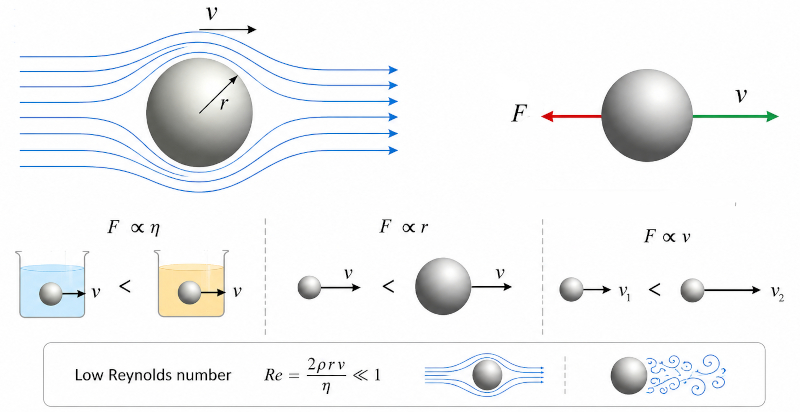
For low velocities and laminar flow, this force can be expressed as:
|
$F_x = 6 \pi \cdot \eta \cdot a \cdot v_x$
|
is Force ($F_x$), Viscosity ($\eta$), Radio of the molecule ($a$) and Relative velocity between the particle and the medium ($v_x$). The equation shows that resistance increases when the fluid is more viscous, when the particle is larger, or when the speed of travel increases. The linear dependence on velocity indicates that the law is valid in the slow laminar regime, corresponding to small Reynolds numbers, where viscous forces dominate over inertia and significant turbulence does not appear.
Conceptually, the fluid acts as a dissipative medium that continually dampens movement and transforms mechanical energy into heat. On a microscopic scale this has very important consequences, since small particles immersed in liquids experience such dominant viscous resistance that inertia practically disappears. The movement is then controlled mainly by the balance between external forces, viscosity and thermal fluctuations.
ID:(16279, 'gm')
Mechanical mobility
Description
Mechanical mobility describes how easily a particle can move through a medium when acted upon by an external force. It represents the ability of the particle to respond to a force while simultaneously considering the viscous resistance of the environment.
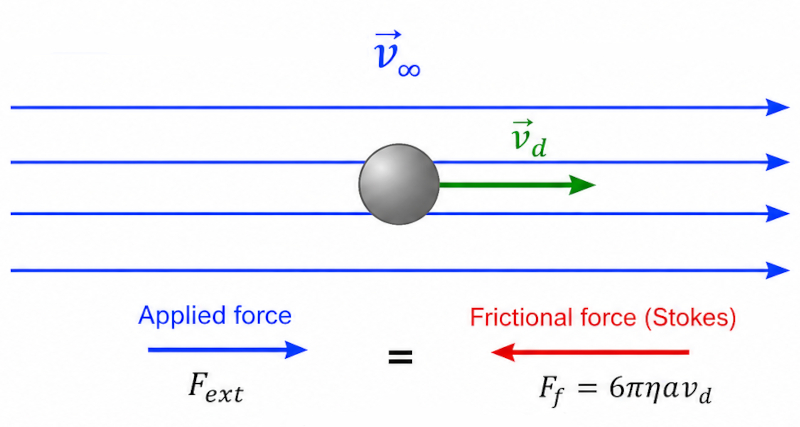
Conceptually, a particle immersed in a fluid experiences two opposite effects. The applied force tries to accelerate it, while the viscosity of the medium generates a friction force that opposes the movement. After a short interval, both forces balance and the particle reaches a constant average velocity called the drift velocity.
Mobility indicates precisely how much speed the particle acquires for each unit of force applied.
|
$v_x = \mu_m \cdot F_x$
|
where Relative velocity between the particle and the medium ($v_x$), Mechanical mobility ($\mu_m$) and Force ($F_x$). The equation shows that if the force increases, the particle moves faster. Likewise, particles with greater mobility respond more efficiently to force and reach higher speeds.
ID:(16287, 'gm')
Boltzmann distribution
Description
The Boltzmann distribution describes how particles are distributed between different energy states when a system is in thermal equilibrium. Conceptually, it expresses the balance between two opposing tendencies. On the one hand, physical systems statistically tend to occupy many possible states due to thermal agitation and the disorder associated with entropy. On the other hand, higher energy states are less probable because they require more energy to occupy.
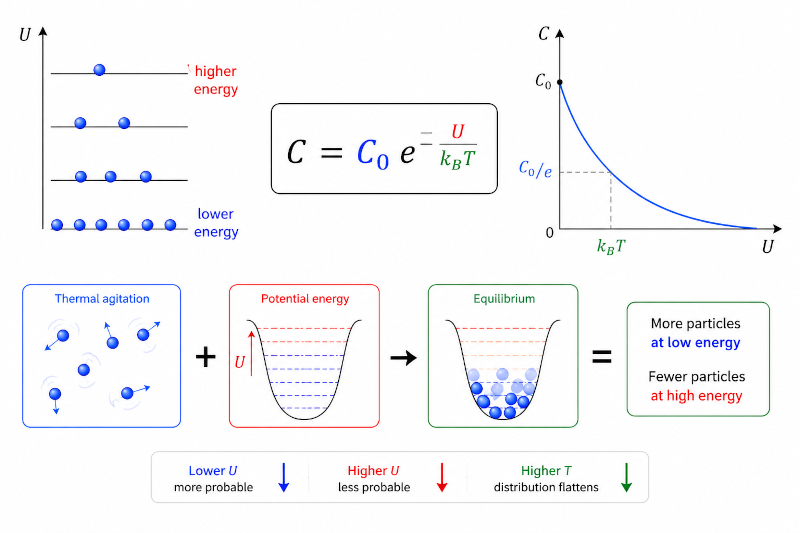
As a consequence, particles tend to accumulate preferentially in regions or states of lower potential energy, while the presence of temperature allows a fraction of them to also reach higher energy states. The higher the temperature, the more important thermal agitation becomes and the more easily particles can occupy high-energy states.
The Boltzmann distribution exactly quantifies this competition between energy and thermal agitation. It can be expressed as:
|
$C = C_0 e^{- U / k_B \cdot T }$
|
with Concentration ($C$), Reference concentration ($C_0$), Potential energy of particles ($U$), Boltzmann Constant ($k_B$) and Absolute temperature ($T$).
The exponential term shows that the concentration decreases exponentially with increasing potential energy. High energy states are much less likely than low energy states. However, as the temperature increases, the factor $k_B \cdot T$ grows and the decrease becomes less pronounced, allowing more particles to reach high energy levels.
ID:(16288, 'gm')
Strength and Potential Energy
Description
Potential energy represents the stored energy associated with the position of a particle within a force field. While potential energy describes how energy is distributed in space, force describes how a particle responds locally to that distribution.
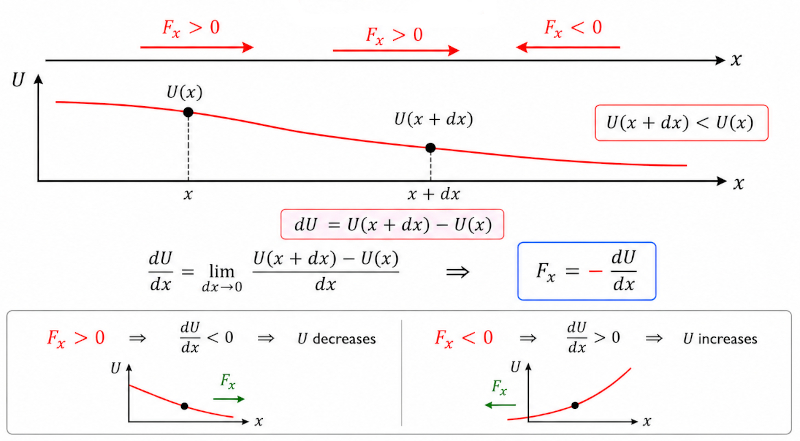
Force appears precisely when potential energy changes from one point to another. If there is a spatial variation of energy, the particles will tend to move spontaneously towards regions of lower potential energy.
Mathematically, force corresponds to the speed with which potential energy changes in space, that is, to its spatial derivative:
|
$F_x = - \displaystyle\frac{ dU }{ dx }$
|
with Force ($F_x$), Variation of potential energy ($dU$) and Distance Variation ($dx$).
The negative sign indicates that the force points toward where the potential energy decreases most rapidly. In other words, particles are spontaneously accelerated downhill in the potential energy landscape.
ID:(16289, 'gm')
Particle Flow
Description
The particle flux corresponds to the number of particles that cross a surface perpendicular to the direction of movement per unit of time and per unit of area. To calculate it, it is considered that Concentration ($C$) represents the number of particles per unit of volume. If the particles move with a Relative velocity between the particle and the medium ($v_x$), then during a time interval $\Delta t$ they will travel a distance $v \Delta t$.
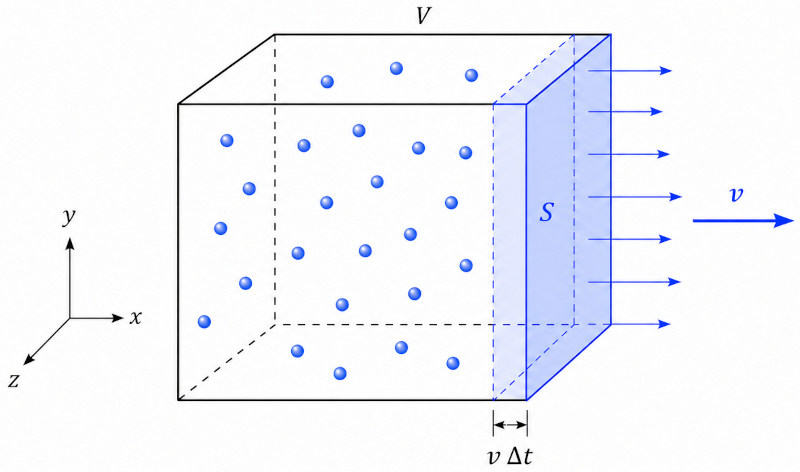
If a surface $S$ is considered perpendicular to the movement, the swept volume during that interval will be $S \cdot v \cdot \Delta t$. Since each unit volume contains $C$ particles, the total number of particles that will cross the surface will be:
$\Delta N = C \cdot S \cdot v \cdot \Delta t$
Therefore, the particle flux can be expressed as:
|
$J_x = C \cdot v_x$
|
with Particle Flow by Diffusion ($J_x$), Concentration ($C$) and Relative velocity between the particle and the medium ($v_x$).
ID:(16290, 'gm')
Diffusion Constant
Description
Electrochemical equilibrium occurs when the flux associated with diffusion is exactly compensated by the flux produced by Electric field ($E_x$). In this situation there is no net flow of particles through the membrane, since both mechanisms have equal magnitude and opposite directions.
The Particle Flow by Diffusion ($J_x$) is described by Fick's first law:
where Diffusion Constant ($D$), Concentration Variation ($dC$) and Distance Variation ($dx$). The negative sign indicates that diffusion occurs spontaneously from regions of higher concentration to regions of lower concentration.
To relate both mechanisms, it is considered that the particles are thermally distributed according to the Boltzmann distribution:
where Potential energy of particles ($U$) associated with the position of the particles, Boltzmann Constant ($k_B$) and Absolute temperature ($T$). This expression shows that regions with higher potential energy have lower concentrations of particles.
Deriving this distribution with respect to x:
$\displaystyle\frac{dC}{dx}=-\displaystyle\frac{C}{k_B\cdot T}\displaystyle\frac{dU}{dx}$
The Force ($F_x$) is related to the potential through:
while the viscous friction force that opposes the movement is given by Stokes' law:
where Viscosity ($\eta$), Radio of the molecule ($a$) and Relative velocity between the particle and the medium ($v_x$).
Since the particle flux can be expressed as:
you get:
$C\cdot v_x=J_x=-D\displaystyle\frac{dC}{dx}=D\displaystyle\frac{C}{k_B\cdot T}6\pi \cdot \eta \cdot a \cdot v_x$
In this expression it can be seen that thermal diffusion, described by the Boltzmann distribution, tends to disperse the particles, while the viscosity of the medium, represented by Stokes' law, opposes the movement. The diffusion constant arises precisely from the balance between both effects.
ID:(16277, 'gm')
Thermal diffusion and molecular transport
Description

Calculations
to  ,
then, select the variable:
,
then, select the variable:  to
to 
Calculations
Variable
 Given
Calculate
Given
Calculate
 Target :
Equation
To be used
Target :
Equation
To be used

Variables
ID:(1311, 0)
Palos Verdes, Costa de Corral, Chile