
 User:
User:


Electrochemical balance in membranes
Storyboard

In membranes permeable to charged particles, diffusion and electrical transport act simultaneously. While diffusion tends to equalize the concentrations on both sides of the membrane, the displacement of charges generates electric potential differences that oppose the diffusive movement. Electrochemical equilibrium is reached when both effects are exactly compensated and the net flow of particles disappears. This balance constitutes the physical basis of fundamental phenomena such as membrane potential, cellular ion transport and the Nernst equation.
ID:(2061, 'ky')

Fick's First Law
Description
From statistical physics, diffusion can be understood as the macroscopic consequence of the Brownian movement of enormous quantities of particles.

The fundamental relationship that describes the diffusive flow is Fick's first law:
 $J_d = - D \displaystyle\frac{ dC }{ dx }$ $J_d = - D \displaystyle\frac{ dC }{ dx }$
|
with Particle Flow by Diffusion ($J_x$), Diffusion Constant ($D$), Concentration Variation ($dC$) and Distance Variation ($dx$).
ID:(15301, 'gm')
Diffusion Constant
Description
Electrochemical equilibrium occurs when the flux associated with diffusion is exactly compensated by the flux produced by Electric field ($E_x$). In this situation there is no net flow of particles through the membrane, since both mechanisms have equal magnitude and opposite directions.
The Particle Flow by Diffusion ($J_x$) is described by Fick's first law:
where Diffusion Constant ($D$), Concentration Variation ($dC$) and Distance Variation ($dx$). The negative sign indicates that diffusion occurs spontaneously from regions of higher concentration to regions of lower concentration.
To relate both mechanisms, it is considered that the particles are thermally distributed according to the Boltzmann distribution:
where Potential energy of particles ($U$) associated with the position of the particles, Boltzmann Constant ($k_B$) and Absolute temperature ($T$). This expression shows that regions with higher potential energy have lower concentrations of particles.
Deriving this distribution with respect to x:
$\displaystyle\frac{dC}{dx}=-\displaystyle\frac{C}{k_B\cdot T}\displaystyle\frac{dU}{dx}$
The Force ($F_x$) is related to the potential through:
while the viscous friction force that opposes the movement is given by Stokes' law:
where Viscosity ($\eta$), Radio of the molecule ($a$) and Relative velocity between the particle and the medium ($v_x$).
Since the particle flux can be expressed as:
you get:
$C\cdot v_x=J_x=-D\displaystyle\frac{dC}{dx}=D\displaystyle\frac{C}{k_B\cdot T}6\pi \cdot \eta \cdot a \cdot v_x$
In this expression it can be seen that thermal diffusion, described by the Boltzmann distribution, tends to disperse the particles, while the viscosity of the medium, represented by Stokes' law, opposes the movement. The diffusion constant arises precisely from the balance between both effects.
ID:(16277, 'gm')
Electrical mobility and Viscosity relationship
Description
The Force ($F_x$) that acts on a Electric charge of the particle ($q$) immersed in a Electric field ($E_x$) can be expressed as:
This force tends to accelerate the particle in the direction of the field if the charge is positive, or in the opposite direction if it is negative.
However, when the particle moves within a viscous fluid, a friction force appears that opposes the movement. For small particles in the laminar regime, this force is given by Stokes' law:
with Force ($F_x$), Viscosity ($\eta$), Radio of the molecule ($a$) and Relative velocity between the particle and the medium ($v_x$). As the particle accelerates, the viscous force increases until it exactly balances the electrical force. At that moment a constant speed called drift speed is reached. Equating both forces we obtain:
$q \cdot E_x= 6\pi \eta \cdot a \cdot v_x$
Solving for speed:
$v_x = \displaystyle\frac{ q }{6\pi \cdot \eta \cdot a } E_x$
On the other hand, the Electric mobility ($\mu_q$) is defined by the relationship:
Comparing both expressions for the speed we directly obtain:
ID:(16286, 'gm')
Electric Potential Difference
Description
The electric potential is measured at each point and the difference between both potentials is subsequently determined:

Electric potential difference between two points.
Electric Potential Difference ($\Delta V$) is obtained by subtracting Electric potential in 1 ($V_1$) from Electric potential in 2 ($V_2$):
|
$\Delta V = V_2 - V_1$
|
ID:(15359, 'gm')
Particle Flow by Electric Field
Description
If the particles have a Electric charge of the particle ($q$) and are in the presence of a Electric field ($E_x$) they experience a Force ($F_x$).
This force accelerates the particles in the direction of the field if the charge is positive, or in the opposite direction if it is negative. However, due to collisions and the effective viscosity of the medium, the particles do not continue to accelerate indefinitely, but instead reach Relative velocity between the particle and the medium ($v_x$).
If Concentration ($C$), then Particle Flow by Electric Field ($\vec{J}$) corresponds to the number of particles that cross a surface perpendicular to the movement per unit of time and per unit of area. This flow can be expressed as:
The drift speed depends on how easily the particles respond to Electric field ($E_x$). This property is described by Electric mobility ($\mu_q$), defined by:
The equation shows that particles with greater mobility reach higher speeds under the same electric field.
On the other hand, the electric field can be interpreted as the spatial variation of the electric potential. In one dimension:
where the negative sign indicates that the field points towards where the potential decreases most rapidly.
Substituting these relations we finally obtain:
ID:(16276, 'gm')
Valencia
Description
The Valencia ($z$) represents the number of elementary charges that a particle or ion has. Indicates both the magnitude and the sign of the electric charge in units of the fundamental charge of the electron. Conceptually, valence expresses how many electrons an atom has lost or gained when becoming an ion.
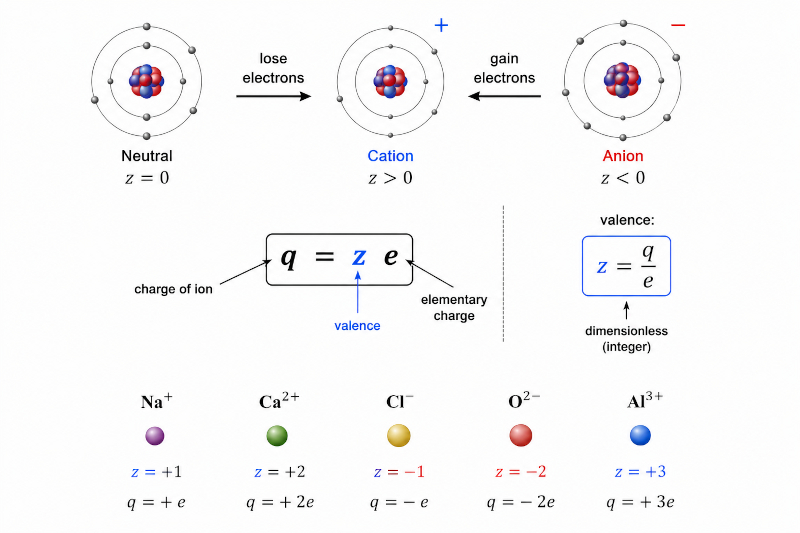
Valence can be expressed as:
|
$z = \displaystyle\frac{ q }{ e }$
|
where Valencia ($z$), Electric charge of the particle ($q$) and Electric charge of the electron ($e$).
ID:(16283, 'gm')
Faraday constant
Description
The Faraday constant ($F$) represents the total electric charge contained in one mole of elementary charges. Conceptually, it connects the microscopic world of individual electrons and ions with the macroscopic world of molar quantities used in chemistry and thermodynamics.
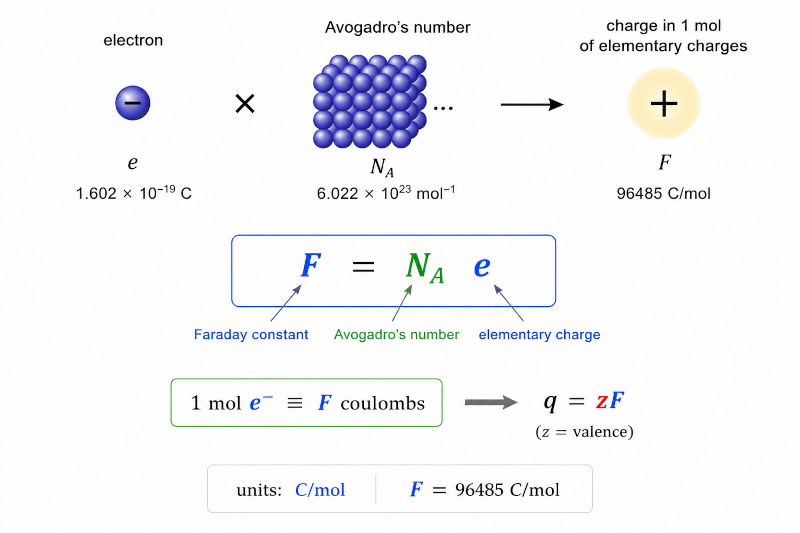
Therefore, the total charge contained in one mole of electrons can be calculated by multiplying both quantities:
|
$F = e N_A$
|
where Faraday constant ($F$), Electric charge of the particle ($q$) and Electric charge of the electron ($e$).
ID:(16284, 'gm')
Universal Constant of Ideal Gases
Description
The Gas constant ($R$) expresses how much thermal energy is associated with one mole of particles per unit of temperature.
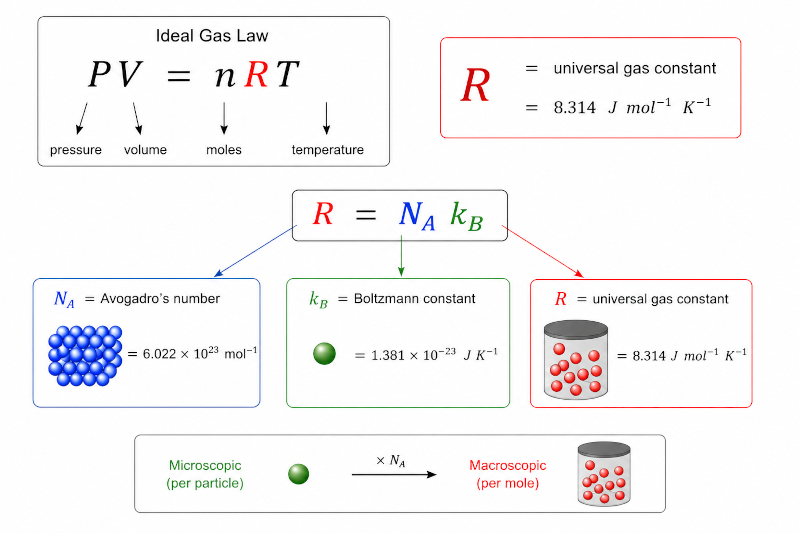
Since one mole contains Avogadro's number of particles, the universal gas constant can be calculated by multiplying both quantities:
|
$R = N_A \cdot k_B$
|
where Gas constant ($R$), Avogadro's number ($N_A$) and Boltzmann Constant ($k_B$).
ID:(16285, 'gm')
Nernst equation
Description
The Particle Flow by Diffusion ($J_x$) is described by Fick's first law:
where Diffusion Constant ($D$), Concentration Variation ($dC$) and Distance Variation ($dx$). The negative sign indicates that diffusion occurs spontaneously from regions of higher concentration to regions of lower concentration.
On the other hand, a difference in electric potential generates an electric field that produces the displacement of charged particles. The Particle Flow by Diffusion ($J_x$) associated with this mechanism can be expressed as:
where Electric mobility ($\mu_q$), Concentration ($C$), Electric Potential Variation ($dV$) and Distance Variation ($dx$).
In equilibrium both flows are equal:
$D\displaystyle\frac{dC}{dx}=\mu_q \cdot C \displaystyle\frac{dV}{dx}$
Solving for the variation of electric potential:
$dV=\displaystyle\frac{D}{\mu_q}\displaystyle\frac{dC}{C}$
This expression shows that a relative change in concentration produces a change in electrical potential. Integrating between side 1 and side 2 of the membrane we obtain:
$V_2-V_1=\displaystyle\frac{D}{\mu_q}\log\left(\displaystyle\frac{C_2}{C_1}\right)$
To continue, the microscopic expressions of the diffusion constant and electrical mobility are used. The Diffusion Constant ($D$) is given by the StokesEinstein relation:
with Boltzmann Constant ($k_B$), Absolute temperature ($T$), Viscosity ($\eta$) and Radio of the molecule ($a$), while the Electric mobility ($\mu_q$) can be expressed as:
with Electric charge of the particle ($q$).
Since the charge of an ion can be written as:
and
with Valencia ($z$), Electric charge of the electron ($e$), Avogadro's number ($N_A$), Gas constant ($R$) and Faraday constant ($F$) finally in the integrated expression of the potential:
ID:(16278, 'gm')
Electrochemical balance in membranes
Description

Calculations
to  ,
then, select the variable:
,
then, select the variable:  to
to 
Calculations
Variable
 Given
Calculate
Given
Calculate
 Target :
Equation
To be used
Target :
Equation
To be used

Variables
ID:(2061, 0)
Palos Verdes, Costa de Corral, Chile