
 User:
User:


Resistances
Storyboard

Resistances are elements that allow the generation of defined currents avoiding direct discharges.
ID:(1585, 'ky')

Resistance Mechanism
Description
When an electric field exists, the free electrons in the material experience a force that propels them in the opposite direction to the field due to their negative charge.
Microscopically, electrons do not move freely in straight lines. As they move, atoms of the crystalline lattice, thermal vibrations, defects, impurities, microscopic boundaries between regions of the material continually interact with the internal structure of the material.
These interactions produce constant collisions and deflections in the path of the electrons. As a consequence, global movement results from a combination of acceleration caused by the electric field and braking produced by the material structure.
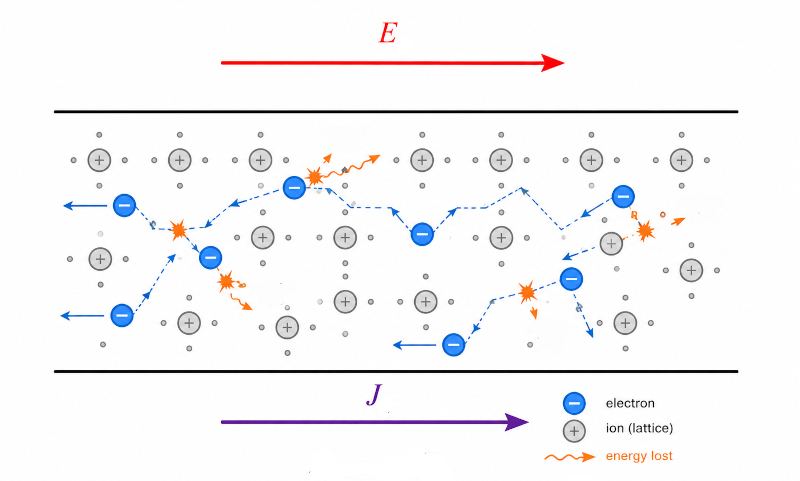
The end result is a slow, orderly average motion called drift velocity. Although each individual electron can move rapidly chaotically due to its thermal agitation, the electric field introduces a small collective tendency to move in a preferred direction.
 $\vec{J} = \sigma \cdot \vec{E}$ $\vec{J} = \sigma \cdot \vec{E}$
|
The Driving current density ($\vec{J}$) represents precisely that net macroscopic flow of charge through the material. The greater the Electric eield ($E$) applied, the greater the average force on the electrons and the greater the current flow generated.
The proportionality constant corresponds to the Electrical conductivity ($\sigma$) of the material, which measures how easily loads can move within the structure. A material with high conductivity has electrons capable of traveling relatively long distances between collisions, while a material with low conductivity greatly hinders charge transport.
During collisions, part of the energy acquired by electrons from the electric field is transferred to the atomic lattice of the material. This energy is transformed mainly into microscopic vibrations of atoms, increasing the internal thermal energy of the body. Macroscopically this is observed as resistive heating or Joule effect.
Therefore, electrical conduction in real materials does not correspond to a free movement without losses, but to a dynamic process where the electric field continuously delivers energy to the charges and they progressively dissipate it in the microscopic structure of the material.
ID:(11763, 'gm')
Resistances
Description
The electrical resistance of a body depends on both the material it is made of and its geometry. Even if two objects are made of the same material, they can have different resistances depending on their length and cross-sectional area.
The intrinsic property of the material that characterizes how easily it allows the movement of electrical charges is called resistivity.
For an approximately uniform conductor, the Resistance ($R$) is calculated by:
|
$R = \rho_e \displaystyle\frac{ L }{ S }$
|
with Resistivity ($\rho_e$), Section of Conductors ($S$) and Conductor length ($L$).
ID:(11762, 'gm')
Resistances
Description

Calculations
to  ,
then, select the variable:
,
then, select the variable:  to
to 
Calculations
Variable
 Given
Calculate
Given
Calculate
 Target :
Equation
To be used
Target :
Equation
To be used

Variables
ID:(1585, 0)
Palos Verdes, Costa de Corral, Chile