
 User:
User:


Models
Storyboard

Following the guideline presented at the end of this section, a descriptive text of the system is written without including equations or the symbology of the variables, although the physical concepts that they represent are specified. From this text, the first prompt allows the artificial intelligence to identify the thematic groups and the concepts, processes and actions associated with each of them. With this information it generates a semantic network that describes the operation of the model. This network constitutes the first validation of the modeling process, since it allows us to verify that the artificial intelligence has correctly understood the hypothesis and the conceptual structure of the model before proceeding to formulate the equations.
ID:('ky', 1791)
Model Example: Hydraulic Transport
Storyboard
Let's consider the model of water transport in a plant as an example. This can be represented by the following image.
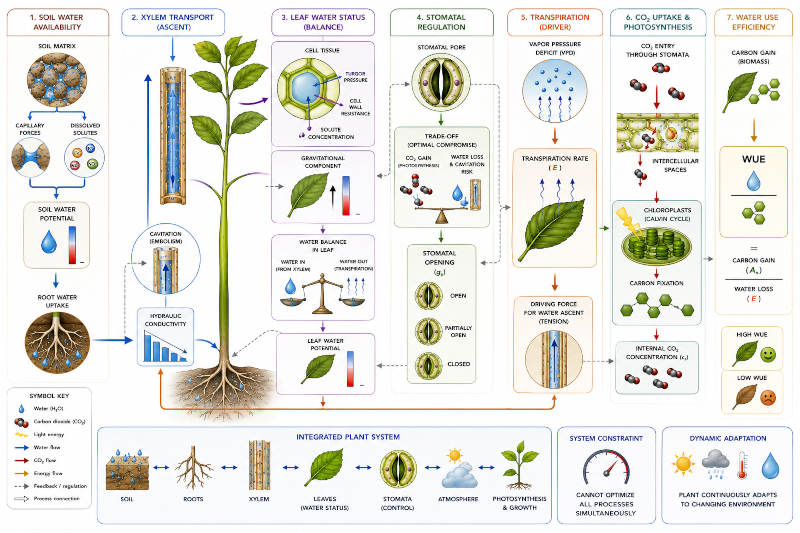
The figure summarizes:
"Let us now consider an integrated physical model of water transport in plants. The following images show how water, carbon dioxide, and light energy are coupled through a continuous chain of processes that connects the soil to the atmosphere. Each stage represents a specific physical phenomenon, but all interact to form a single system whose purpose is to maintain photosynthesis and plant growth by using water as efficiently as possible. The process begins in the soil, where water is held between mineral particles and organic matter. Its availability depends not only on the amount present but also on the energy with which it is held. On the one hand, capillary forces in the soil matrix keep water bound to the pores and mineral surfaces; on the other hand, dissolved solutes further reduce its energy. Together, both mechanisms determine the soil water potential, establishing the starting point from which roots can extract water.
Once absorbed by the roots, Water enters the plant's vascular system and ascends through the xylem. The conducting vessels function as a continuous network of microscopic tubes capable of transmitting the tension generated by evaporation in the leaves. As long as the water column remains continuous, transport is highly efficient. However, when the tension increases excessively, air bubbles can form, partially or completely blocking some vessels. This phenomenon, known as cavitation or embolism, progressively reduces the plant's hydraulic capacity and limits the water supply to the leaves.
The water that reaches the leaves determines the water status of the plant tissues. Inside each cell, there is a dynamic equilibrium between the concentration of solutes, the turgor pressure exerted by the vacuole on the cell wall, and the leaf's position within the plant. Simultaneously, water continues to enter from the xylem while some is lost through transpiration. The balance between these two processes determines the leaf's water potential, considered one of the most important indicators of the level of water stress experienced by the plant.
The main regulation Transpiration occurs in the stomata, small pores present in the epidermis of the leaves. Their opening is a response to the constant balance between two opposing objectives. On the one hand, the plant needs to keep the stomata open to allow the entry of carbon dioxide necessary for photosynthesis. On the other hand, excessive opening increases water loss and raises the risk of cavitation in the hydraulic system. Consequently, the degree of stomatal opening constitutes a control mechanism that balances carbon acquisition with water conservation.
The intensity of transpiration depends on both stomatal opening and the difference in humidity between the inside of the leaf and the atmosphere. When the air is drier, water evaporation increases, and with it, the water demand on the entire plant. This evaporation is the physical engine that maintains the continuous ascent of water from the roots.
The same stomata that allow the exit of water vapor also serve as the entry point for atmospheric carbon dioxide. Once inside the leaf, CO diffuses through the intercellular spaces until it reaches the chloroplasts of the cells. mesophyll. There, using energy captured from sunlight, carbon is incorporated into organic compounds through photosynthesis. The internal concentration of CO is continuously adjusted according to the balance between the rate at which the gas enters from the atmosphere and the rate at which it is consumed by the photosynthetic process.
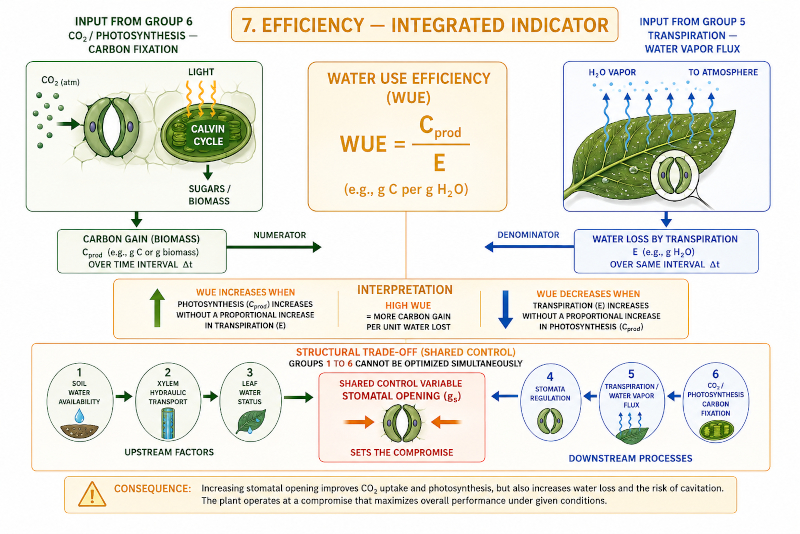
All these processes ultimately converge on a single integrated indicator: water use efficiency. This parameter expresses how much biomass or carbon the plant manages to produce for each unit of water it loses through transpiration. High efficiency means the plant can maintain high photosynthetic activity with relatively low water consumption, while low efficiency indicates that much of the absorbed water is lost without resulting in equivalent carbon production.
The complete model shows that the plant cannot optimize each process independently. Increasing stomatal opening promotes CO uptake but also increases water loss and the risk of cavitation. Reducing transpiration protects the hydraulic system, but simultaneously limits photosynthesis and growth. Thus, plant physiology arises from the dynamic balance between soil water availability, water transport, leaf water status, stomatal regulation, carbon fixation, and transpiration.
This integrated representation allows us to understand that the functioning of a plant corresponds to a highly coupled physical system, where hydraulic, osmotic, diffusive, and biochemical processes act simultaneously to maximize growth, maintain survival during periods of stress, and continuously adapt the functioning of the organism to changing environmental conditions.
ID:('gp', 614)
Promp for semantic network
Storyboard
Once you have a text that describes the operation of the system, it is possible to generate a semantic tree that identifies the main concepts and the relationships between them. From this structure, the different thematic groups can be recognized and, subsequently, the equations that describe each of these processes can be located.
To do this, an artificial intelligence model can be used by executing the following prompt (replace [paste storyboards/narrative, NOT the equations] with the text):
ID:('gp', 615)
Semantic network of water transport
Storyboard
When executing the prompt in an AI, one should obtain, on the one hand, the semantic network of the text, which shows the concepts (elements, objects) identified and the way in which they interact with each other. The diagram can be scrolled and scaled as a whole, while each node can be moved independently. Below is a non-interactive image for reference:
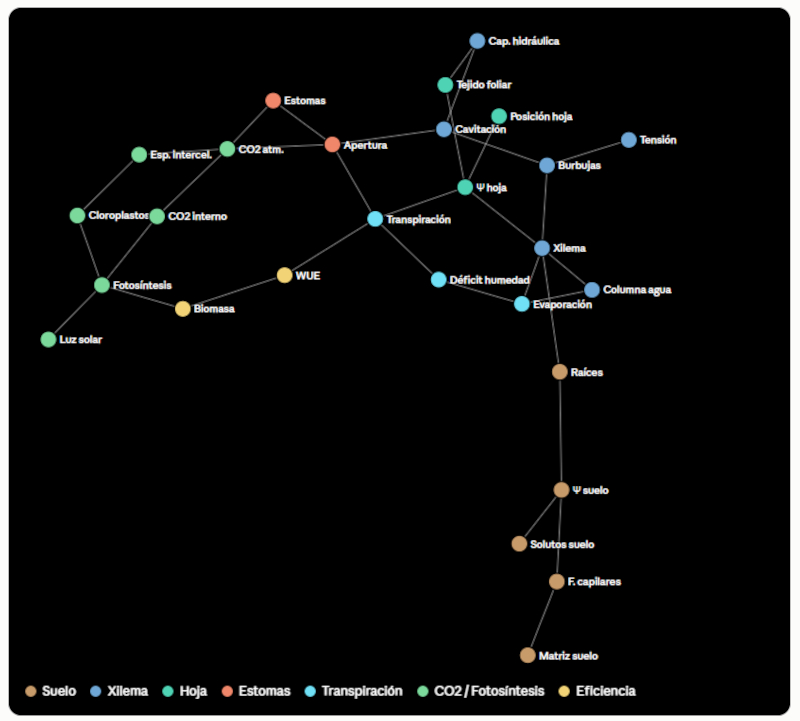
The system also provides the list of identified thematic groups and the color associated with each one:
ERROR btable: expected table_name#column_definition
It also generates the list of nodes (concepts) and the list of links (verbs or relationships between concepts.
Additionally, a detailed description of the meaning of each thematic group is presented. This information is essential to subsequently build the logical network and, therefore, must be available within the same chat in which the prompt that generates the model equations is executed.
In this example, the following pages describe the meaning of each group through explanatory text accompanied by an image that facilitates understanding of the process represented.
ID:('gp', 616)
Group 1: Soil, water availability
Storyboard
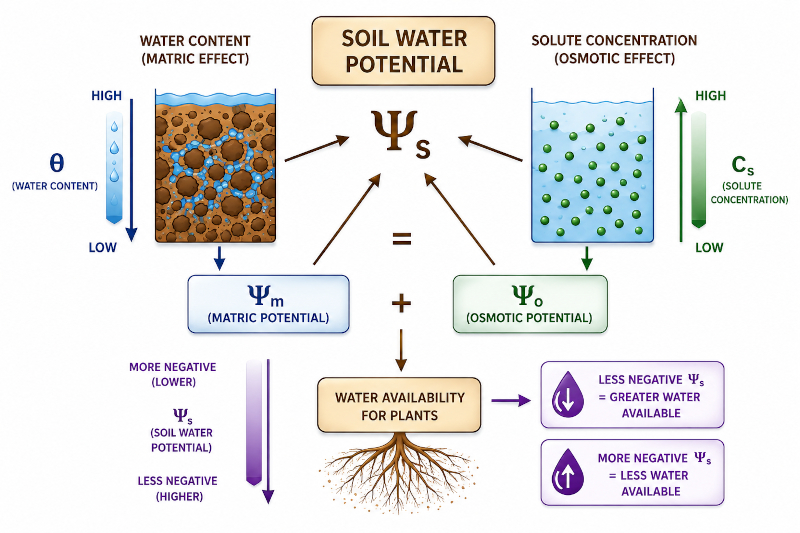
Soil water is not a free reservoir: it is retained by capillary forces in the network of pores formed by mineral particles and organic matter. The smaller the pore size and the larger the mineral-organic contact surface, the greater the energy with which water is retained (inverse relationship between extractable water and retention energy). The root must generate a more negative water potential than the surrounding soil to extract water; As the soil dries, this retention potential becomes more negative and extraction becomes progressively more difficult, with a threshold (withering point) existing below which root extraction is cancelled.
ID:('gp', 617)
Group 2: Xylem, hydraulic transport and cavitation
Storyboard
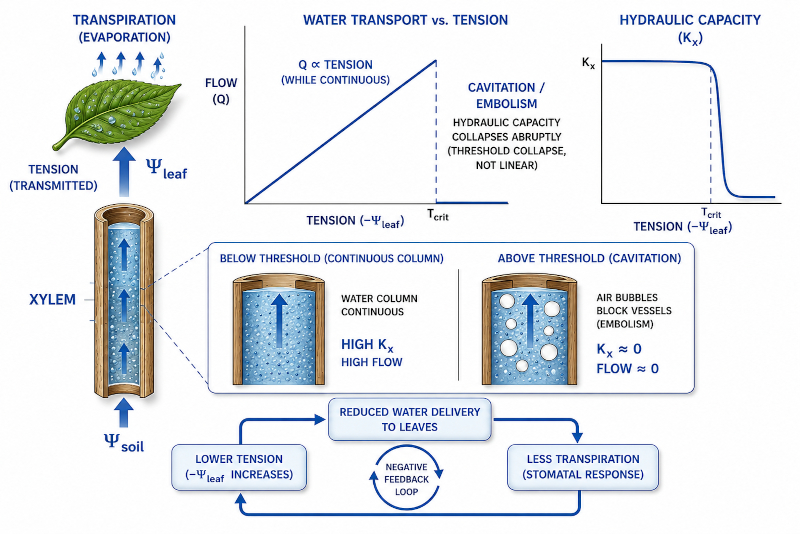
The transport of water depends on the tension generated by foliar evaporation: the greater the tension, the greater the upward flow, in a relationship that the text presents as proportional while the water column remains continuous. There is, however, a critical tension threshold above which air bubbles appear that block conductive vessels (cavitation/embolism); Once that threshold is exceeded, the plant's hydraulic capacity drops abruptly, not gradually it is a threshold-type collapse, not a linear degradation. The reduced hydraulic capacity in turn limits the water that reaches the leaves, closing a negative feedback loop towards Group 3.
ID:('gp', 618)
Group 3: Leaf, cellular water state
Storyboard
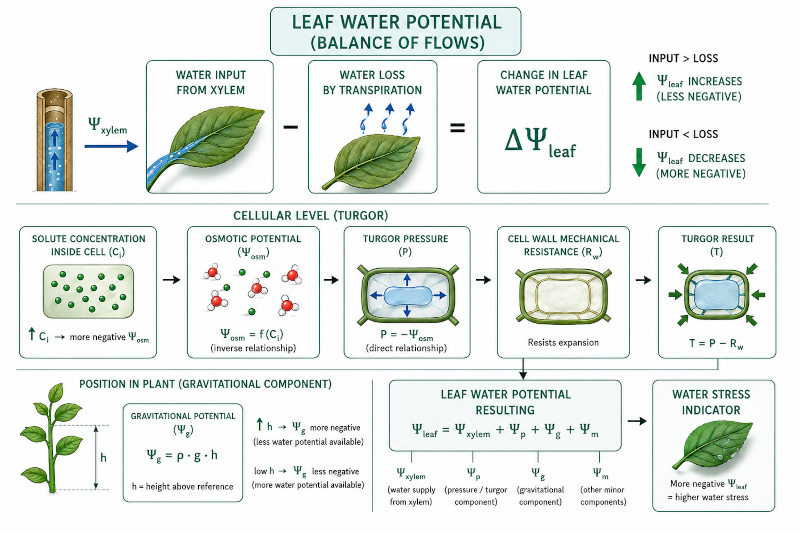
The water potential of the leaf results from a balance of flows: water enters from the xylem and leaves through transpiration, so that the potential rises or falls depending on which of the two terms dominates (balance relationship, input minus output). At the cellular level, turgor pressure depends on the concentration of internal solutes (inverse relationship via osmotic potential) and is opposed to the mechanical resistance of the cell wall; The position of the leaf on the plant adds an additional component (more height, less available potential, due to gravitational effect). The resulting leaf water potential is the indicator that the text uses to express the level of water stress.
ID:('gp', 619)
Group 4. Stomata, regulation
Storyboard
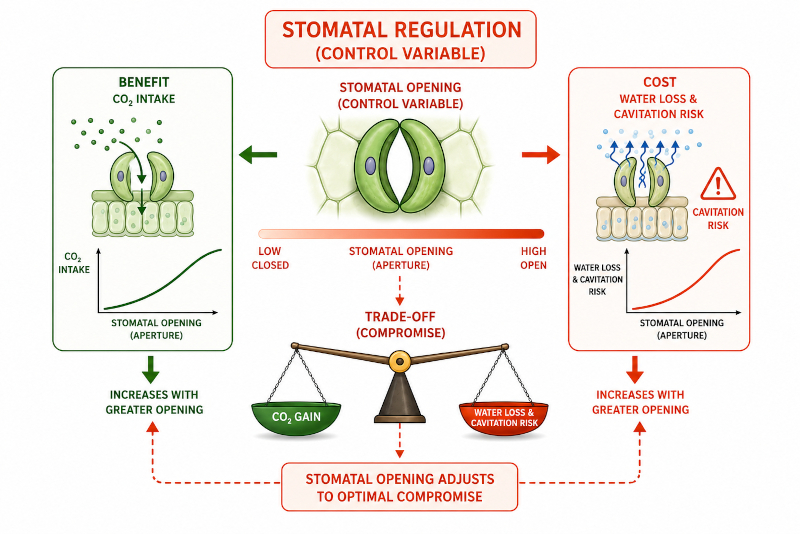
Stomatal opening is the control variable of the system and arises from a compromise between two effects that both grow, and in the same sense, with the degree of opening: the greater the opening, the greater the CO intake (benefit) as well as the loss of water and the risk of cavitation (cost), so that the text suggests a growing and simultaneous relationship on both sides of the compromise. It is not specified in the text what exact physiological signal sets the balance point, only that the aperture is adjusted seeking that optimal compromise.
ID:('gp', 620)
Group 5: Perspiration, vapor flow
Storyboard
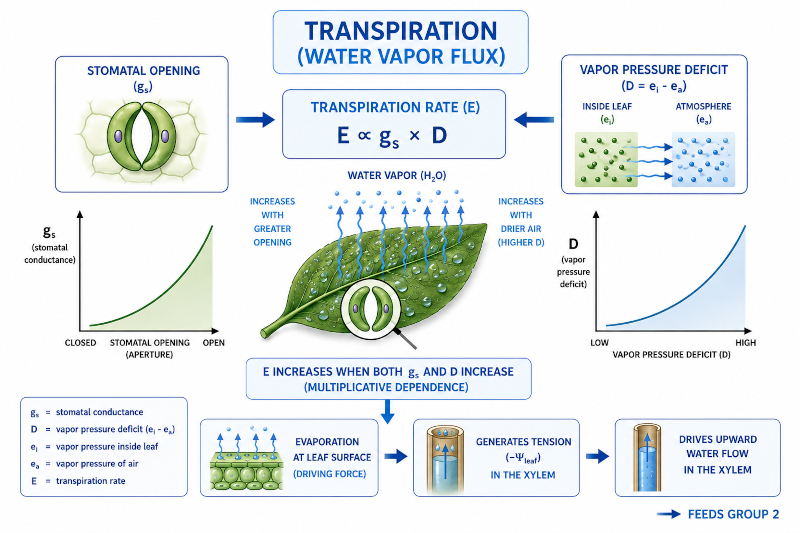
The transpiration rate depends jointly on the stomatal opening and the humidity deficit between the interior of the leaf and the atmosphere; The text describes both dependencies as increasing, suggesting a multiplicative relationship (two resistances/drivers acting together, not in mutual exclusion). Drier air (greater deficit) proportionally increases evaporation, and this evaporation is explicitly pointed out as the physical engine that sustains the tension and continuous rise of water in the xylem that is, it directly feeds Group 2.
ID:('gp', 622)
Group 6: CO2 / photosynthesis, carbon fixation
Storyboard
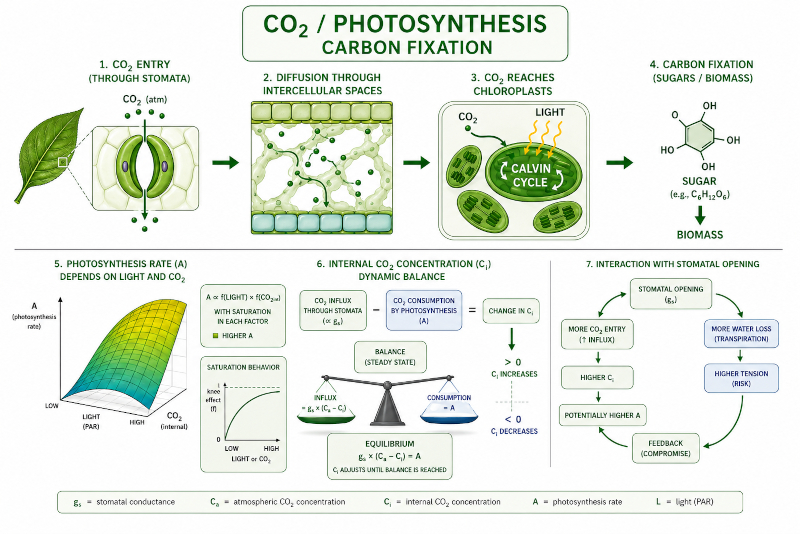
Atmospheric CO2 enters through the same stomata that regulate water loss, diffuses through the intercellular spaces and reaches the chloroplasts, where light energy drives its fixation; The text suggests a joint dependence between light availability and CO2 availability (expected of a multiplicative type with possible saturation in each factor separately). The internal concentration of CO2 is not fixed: it results from a dynamic balance between the rate of entry (linked to stomatal opening) and the rate of photosynthetic consumption if consumption increases faster than entry, the internal concentration falls until a new equilibrium is reached.
ID:('gp', 621)
Group 7: Efficiency, integrated indicator
Storyboard
Water use efficiency is defined as a ratio between the biomass/carbon produced (numerator, from Group 6) and the water lost through transpiration (denominator, from Group 5) in the same interval. It is not its own physical mechanism but rather an emerging indicator: it rises when photosynthesis grows without transpiration growing in the same proportion, and falls in the opposite case. The text is explicit that groups 1 to 6 cannot be optimized simultaneously because they share the same control variable (stomatal aperture), which imposes a structural restriction on this ratio.
ID:('gp', 624)
Guidelines for writing appropriate texts for the promp
Storyboard
The quality of the model depends on the analyzed text being as clear and precise as possible. To do this, the following guideline can be used, designed to facilitate analysis and reduce the possibility of the AI incorrectly interpreting the situation and building a model with errors. Remember that AI does not correct the content of the text: if it interprets it wrongly, it will generate an equally wrong model. Therefore, it is advisable to review the semantic network obtained before continuing with the construction of the logical model.
Guideline:
1. A block of text = a physical question, with a protagonist. Each paragraph or section must answer a single question ("where does it come from?", "how does it spread?", "what limits it?") and have an identifiable central noun: the entity, quantity or process that paragraph is about and no other. If a paragraph mixes two different mechanisms, the model has to guess where to cut the group.
2. Order the paragraphs according to the real causal chain. Origin > propagation > regulation/output > mechanism that connects everything > consequences. The order of appearance in the text ends up being the order of the groups, so it is advisable that it already appears that way in the storyboard, not reordered later.
3. Name entities consistently.If an entity appears with one name in one paragraph and a different synonym in the next, the extractor can create multiple nodes where there should be only one. Choose a name per entity and repeat it the same throughout the text, even if it sounds repetitive.
4. Use active and specific verbs, not generic filler verbs. "Retains", "drives", "releases", "conditions", "generates" are extractable as a relation. "It is related to", "it has to do with", "it is linked to" do not say what happens to what, and are lost as meaningless edges.
5. Explain what quantity changes, what it depends on and in what sense, without writing the equation. This is the key for the equations stage to work. "The quantity increases" is not enough; You have to say "it increases when [another quantity] increases" (direct relationship) or "it decreases when [another quantity] is greater" (inverse relationship). Also mention if there is a threshold (something is canceled or triggered suddenly) or saturation (it stops responding proportionally).
6. Close the causal loop explicitly if the system is cyclical. If the mechanism feeds back (the output of a stage affects a previous stage back), this closure must be named in an explicit phrase such as "this maintains/replaces [the initial condition], closing the cycle." If it is not said, the graph remains a linear chain instead of a coupled system.
7. Provide information at different scales when applicable (macro + detail). Going down a level of detail at each stage (the subcomponent, the internal mechanism, the relevant sub-unit) multiplies the useful entities without inventing anything. A text that only describes the phenomenon in macro gives few nodes; the "extensions" at each stage function as anchors for sub-entities.
8. Finish with a "what is it for" / consequences section. This naturally generates the output group (result, function, product) that closes the causal sequence and gives destination to the intermediate nodes, instead of leaving them dangling.
9. Avoid mathematical notation or variable names in the narrative body. If the text already includes symbols, the extractor tends to copy the structure of the equation as if it were the semantic structure, which is exactly what the logical network step should avoid. Better to describe the phenomenon in prose and leave the variables for the separate equations document.
10. One paragraph, at least one explicit cause-effect relationship. "X causes Y" at some point in the paragraph ensures at least one extractable verb per thematic block; Purely descriptive paragraphs (lists of parts without action between them) generate isolated nodes without edges.
ID:('gp', 623)
Palos Verdes, Costa de Corral, Región de los Rios, Chile