
 User:
User:




Visible coverage (clouds)
Description 
On average, clouds cover more than 40% of the Earth\'s surface:

As they are visible, clouds reflect light, resulting in visible radiation and are associated with atmospheric albedo.
ID:(3071, 0)

Radiation flow from the atmosphere to the ocean
Model

Variables

Calculations
 to
to  ,
then, select the variable:
,
then, select the variable:  to
to 
Calculations
Variable
 Given
Calculate
Given
Calculate
 Target :
Equation
To be used
Target :
Equation
To be used

Equations
The value of ERROR:6523 is calculated from the temperature of the lower atmosphere ($T_b$), using the values of the stefan Boltzmann constant ($\sigma$) and the emissivity ($\epsilon$) as follows:
| $ I_b = \epsilon \sigma T_b ^4 $ |
However, given the high humidity over the ocean, it is crucial to include a correction factor that depends on ERROR:9923, ERROR:9924, and the relative humidity ($RH$). In this context, the intensidad NIR emitida por atmósfera con humedad (despejado) ($I_{bl}$) can be modeled as:
| $ I_{bl} = I_b ( t_0 + t_{RH} \sqrt{ RH })$ |
(ID 13498)
The intensidad NIR emitida por atmósfera con humedad (despejado) ($I_{bl}$) is a function of ERROR:6523, ERROR:9923, ERROR:9924, and the relative humidity ($RH$):
| $ I_{bl} = I_b ( t_0 + t_{RH} \sqrt{ RH })$ |
in which the effect of cloud cover, modeled by a constante de cobertura ($c$) and the atmosphere coverage for VIS radiation ($\gamma_v$), is not considered. Therefore, a correction to the intensidad NIR emitida por atmósfera con humedad (cubierto) ($I_{bc}$) results in the intensidad NIR emitida por atmósfera con humedad (despejado) ($I_{bl}$) being defined as:
| $ I_{bc} = I_{bl} (1 + c \gamma_v )$ |
(ID 13499)
The intensidad NIR emitida por atmósfera con humedad (despejado) ($I_{bl}$) is related to ERROR:6523 along with ERROR:9923, ERROR:9924, and the relative humidity ($RH$) as follows:
| $ I_{bl} = I_b ( t_0 + t_{RH} \sqrt{ RH })$ |
This allows for the calculation of the intensidad NIR emitida por atmósfera con humedad (cubierto) ($I_{bc}$) using the constante de cobertura ($c$) and the atmosphere coverage for VIS radiation ($\gamma_v$) through the equation:
| $ I_{bc} = I_{bl} (1 + c \gamma_v )$ |
Thus, we derive an integrated equation for the atmospheric flux towards the ocean as follows:
| $ I_{bc} = I_b ( t_0 + t_{RH} \sqrt{ RH }) (1 + c \gamma_v )$ |
(ID 13500)

Examples
On average, clouds cover more than 40% of the Earth\'s surface:
As they are visible, clouds reflect light, resulting in visible radiation and are associated with atmospheric albedo.
(ID 3071)
Clouds interact with visible light, while the water vapor present in the cloud also interacts with infrared radiation. However, the greatest impact on infrared radiation is caused by greenhouse gases, particularly CO2. Therefore, the atmospheric coverage included in the models exhibits significant variability, as a portion of it must be attributed to greenhouse gases, which have a different distribution from that of visible clouds. Specifically, the estimated coverages are as follows:
- For visible radiation: 42%.
- For infrared radiation: 89%.
The distribution of atmospheric coverage for infrared radiation can be inferred from the presence of CO2 in the atmosphere.
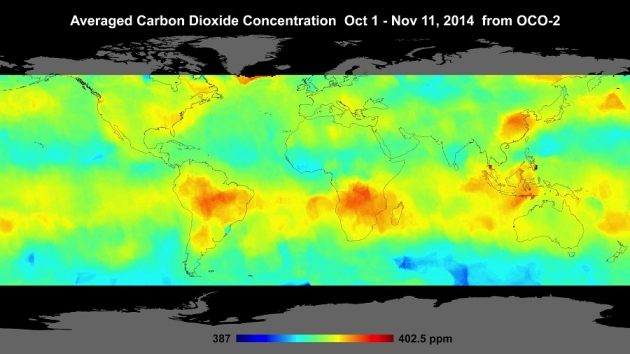
(ID 13501)
ID:(1754, 0)