
 User:
User:



Moment exchange
Storyboard 
The exchange of momentum between the atmosphere and the ocean refers to the process by which the atmosphere drives the ocean, generating corresponding ocean currents.Ocean-Atmosphere Interactions of Gases and Particles, Peter S. Liss, Martin T. Johnson (eds.). Springer, 2014Chapter: Transfer Across the Air-Sea Interface
ID:(1631, 0)


Surface tension
Description
The wind over the ocean surface is composed of a large number of molecules that periodically collide with water molecules at the surface.
In this way, the kinetic energy of the air molecules is partially transferred to the water molecules, which can be represented as a stress exerted by the air onto the water.
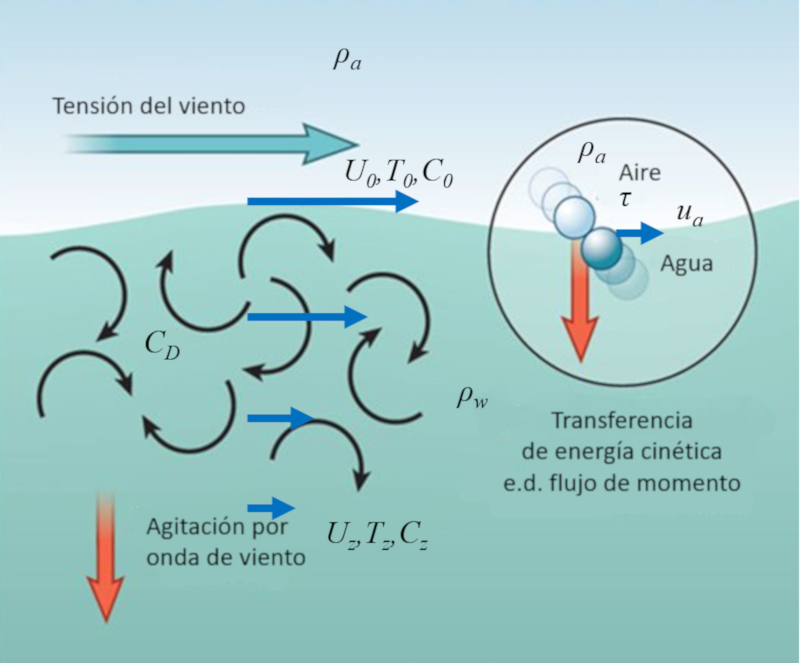
The resulting effect is the creation of surface eddies, which in turn affect deeper layers, transferring the velocity of the wind to a shallow layer of the ocean. This process allows the energy of the wind to be transferred to the near-surface layer of the ocean, increasing the speed of the water in that area.
ID:(12303, 0)

General scheme of types of disturbances
Image
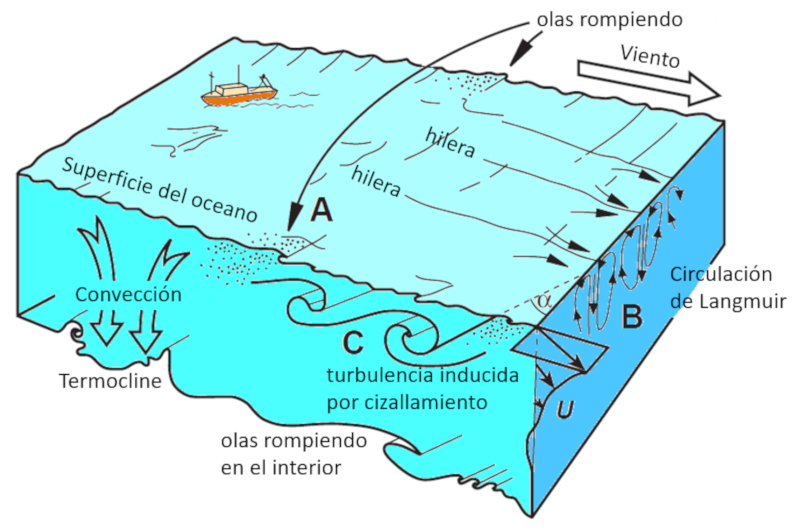
Generally, when observing the ocean, various mechanisms generating vortices and turbulence are evident, contributing to mixing processes.
Within the surface layer, notable features include:
• Surface waves generated by winds.
• Langmuir circulation, forming visible streaks from the air.
• Breaking of surface waves.
Meanwhile, between the lower boundary of the mixing layer and the thermocline, prominent factors include:
• Turbulence due to shear at the upper boundary.
• Internal waves breaking at the lower boundary.
• Convection.
• Vertical instabilities.
These phenomena are depicted in the following diagram:
ID:(12180, 0)
Langmuir stable waves
Description
One of the phenomena originating from wind-induced surface currents is called the Langmuir circulation:
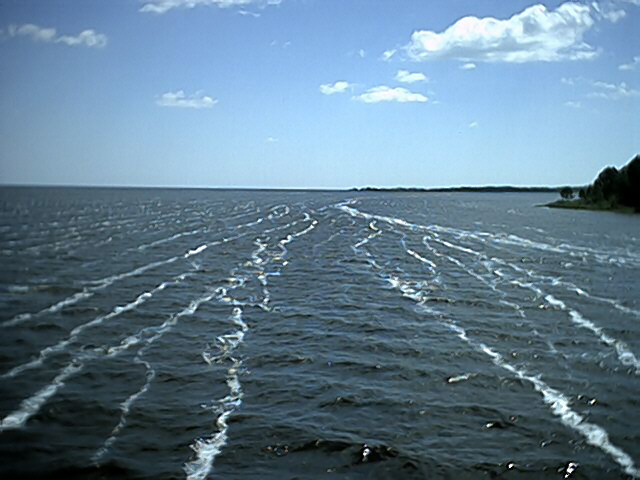
The instability of the ocean to Langmuir circulations, S. Leibovich and S. Paoluccit, J. Fluid Mech. (1981). vol. 102, pp. 141-167
It originates similarly to Ekman transport, where due to the Coriolis force, there are areas of downwelling that generate upwelling eddies. The circulation closes with the formation of an upwelling zone:

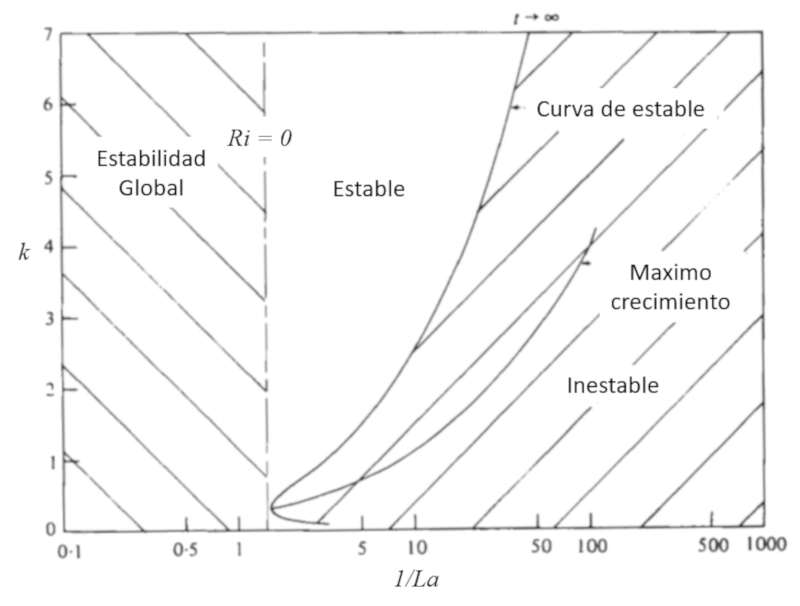
In the article cited in the next image, it is concluded that there are specific conditions for the formation of Langmuir circulation, which depend on various conditions and the oscillation itself:
ID:(12221, 0)

Moment exchange
Model
The exchange of momentum between the atmosphere and the ocean refers to the process by which the atmosphere drives the ocean, generating corresponding ocean currents. Ocean-Atmosphere Interactions of Gases and Particles, Peter S. Liss, Martin T. Johnson (eds.). Springer, 2014 Chapter: Transfer Across the Air-Sea Interface

Variables

Calculations
 to
to  ,
then, select the variable:
,
then, select the variable:  to
to 
Calculations
Variable
 Given
Calculate
Given
Calculate
 Target :
Equation
To be used
Target :
Equation
To be used

Equations

Examples
(ID 15638)
The wind over the ocean surface is composed of a large number of molecules that periodically collide with water molecules at the surface.
In this way, the kinetic energy of the air molecules is partially transferred to the water molecules, which can be represented as a stress exerted by the air onto the water.
The resulting effect is the creation of surface eddies, which in turn affect deeper layers, transferring the velocity of the wind to a shallow layer of the ocean. This process allows the energy of the wind to be transferred to the near-surface layer of the ocean, increasing the speed of the water in that area.
(ID 12303)
Generally, when observing the ocean, various mechanisms generating vortices and turbulence are evident, contributing to mixing processes.
Within the surface layer, notable features include:
• Surface waves generated by winds.
• Langmuir circulation, forming visible streaks from the air.
• Breaking of surface waves.
Meanwhile, between the lower boundary of the mixing layer and the thermocline, prominent factors include:
• Turbulence due to shear at the upper boundary.
• Internal waves breaking at the lower boundary.
• Convection.
• Vertical instabilities.
These phenomena are depicted in the following diagram:
(ID 12180)
One of the phenomena originating from wind-induced surface currents is called the Langmuir circulation:
The instability of the ocean to Langmuir circulations, S. Leibovich and S. Paoluccit, J. Fluid Mech. (1981). vol. 102, pp. 141-167
It originates similarly to Ekman transport, where due to the Coriolis force, there are areas of downwelling that generate upwelling eddies. The circulation closes with the formation of an upwelling zone:
In the article cited in the next image, it is concluded that there are specific conditions for the formation of Langmuir circulation, which depend on various conditions and the oscillation itself:
(ID 12221)
(ID 15643)
ID:(1631, 0)