
 User:
User:


Eye
Definition 
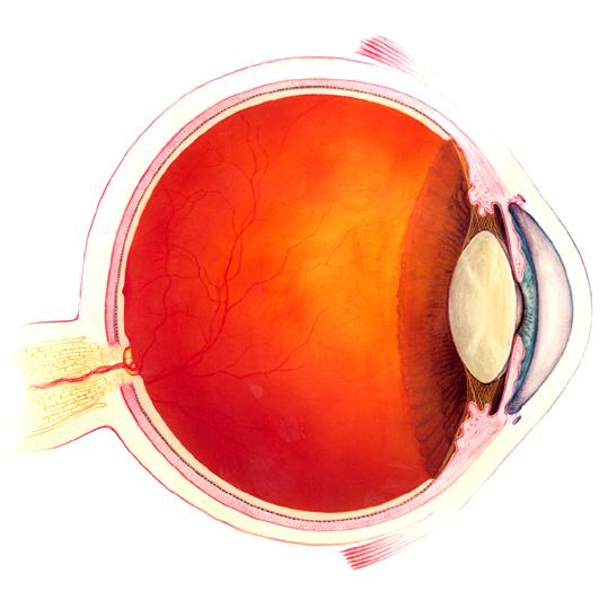
The eye is constituted by three key elements to be able to take advantage of the light:
- the lens adjusting light, about it more in the section on lenses
- the system that registers light and the nervous system that carries information to the brain
- the brain that processes the information received
In this section we will dedicate ourselves to the last point, since it is the point that defines what our eye captures.
ID:(218, 0)


See
Note
There are two key aspects in the way we see.
On the one hand is the mechanism as we segment what we see in multiple sub-fields that we analyze individually. This analysis then focuses on recognizing known patterns.
Secondly, there is our ability to recognize the objects in each of these subfields. This requires being able to recognize an object and its spatial position.
ID:(488, 0)

Eye Lenses
Quote
Our eye is able to adjust the focal length of the lens and thereby focus on objects in a very wide range of distances.
In case the lens is not able to adapt the focus in said range, optical lenses can be used that modify the range that is able to focus it.
ID:(490, 0)

Funcionamiento del Ojo
Storyboard
Variables

Calculations
 to
to  ,
then, select the variable:
,
then, select the variable:  to
to 
Calculations
Variable
 Given
Calculate
Given
Calculate
 Target :
Equation
To be used
Target :
Equation
To be used

Equations
Una relaci n se puede armar con los tri ngulos del lado del objeto. En este caso la similitud nos permite escribir que el tama o del objeto
$\displaystyle\frac{a_o}{s_o-f}=\displaystyle\frac{a_i}{f}$
Con la relaci n de similitud de los tri ngulos
se puede mostrar que se cumple:

Examples
The eye is constituted by three key elements to be able to take advantage of the light:
- the lens adjusting light, about it more in the section on lenses
- the system that registers light and the nervous system that carries information to the brain
- the brain that processes the information received
In this section we will dedicate ourselves to the last point, since it is the point that defines what our eye captures.
Below is the structure of the eye:
There are two key aspects in the way we see.
On the one hand is the mechanism as we segment what we see in multiple sub-fields that we analyze individually. This analysis then focuses on recognizing known patterns.
Secondly, there is our ability to recognize the objects in each of these subfields. This requires being able to recognize an object and its spatial position.
Our eye is able to adjust the focal length of the lens and thereby focus on objects in a very wide range of distances.
In case the lens is not able to adapt the focus in said range, optical lenses can be used that modify the range that is able to focus it.
Por similitud de los tri ngulos de los tama os del objeto y la imagen y las posiciones del objeto y foco permite por similitud de tri ngulos mostrar que:
For any lens you can draw characteristic beams with which you can similarly show that the sizes of the object and the image are in the same proportion as their distances to the optical element (lens or mirror).
If the object has a size
ID:(290, 0)