
 User:
User:


Pressure and curvature mechanics
Storyboard

Pressure and curvature mechanics studies how pressure differences generate forces and stresses on curved surfaces and how the geometry of these surfaces determines their mechanical equilibrium. When a membrane, interface or wall curves, the internal and external pressure stop compensating locally and a stress appears that depends on both the curvature and the mechanical properties of the system.
Laplace's law constitutes the central principle of this behavior and relates pressure, radius of curvature and tension. In liquid interfaces, tension appears as surface tension, while in thick material walls it manifests as mechanical stress distributed in the tissue or structure.
These principles allow us to describe very diverse physical and biological phenomena, including droplets, bubbles, menisci, capillarity, liquid films, lung alveoli, blood vessels, cardiac ventricles and biological membranes. In all these systems, a decrease in the radius of curvature increases the pressure necessary to maintain the structure, while an increase in wall thickness reduces the internal mechanical stress.
Pressure-curvature mechanics thus connects geometry, pressure, and stress into a common framework that explains the stability, deformation, and mechanical behavior of curved surfaces and cavities in both physics and biology.
ID:(2108, 'ky')

Laplace's Law for Curved Surfaces in General
Description
Laplace's law for a curved surface describes how surface tension is generated by a pressure difference between the inner side of the liquid and the outer side. When the surface is curved, the surface tension forces do not completely cancel and produce a net pressure that depends on the curvature of the surface.
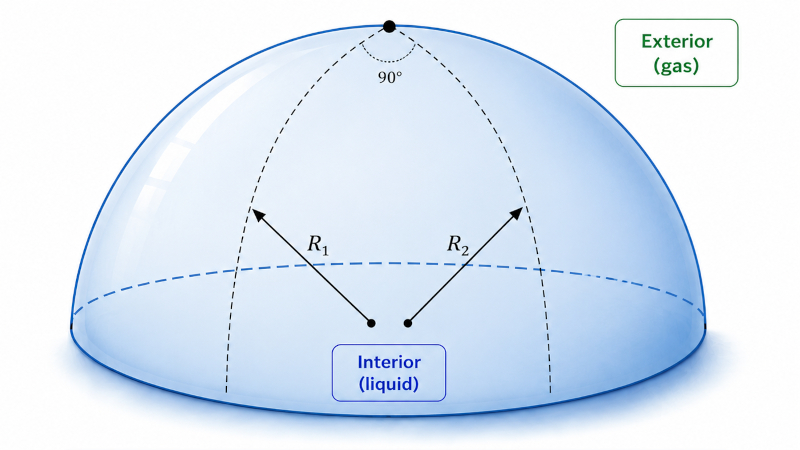
The general relationship is:
 $ \Delta p = \sigma \left(\displaystyle\frac{1}{ R_1 } + \displaystyle\frac{1}{ R_2 }\right)$ $ \Delta p = \sigma \left(\displaystyle\frac{1}{ R_1 } + \displaystyle\frac{1}{ R_2 }\right)$
|
with Pressure variation ($\Delta p$), Surface Tension ($\sigma$) and Curvature radio 1 ($R_1$) and Curvature radio 2 ($R_2$).
The equation shows that the pressure difference increases when the surface tension is greater and also when the radii of curvature are smaller. Therefore, a small bubble or a highly curved drop requires greater internal pressure than a large, slightly curved surface.
ID:(16259, 'gm')
Laplace's Law of a Surface with Symmetric Curvature
Description
Laplace's law for curved surfaces states that the pressure difference between the inside and outside of a liquid surface depends on the surface tension and its curvature. When a liquid-gas interface is curved, surface tension forces generate additional pressure toward the interior of the curvature, producing a pressure difference between both sides of the surface.
The general relationship is expressed as:
| $ \Delta p = \sigma \left(\displaystyle\frac{1}{ R_1 } + \displaystyle\frac{1}{ R_2 }\right)$ |
where p corresponds to the pressure difference between the inside and outside, the surface tension of the membrane and $R_1$, $R_2$ the principal radii of curvature of the surface in two perpendicular directions.
When the surface has the same curvature in both directions, as occurs in a sphere or an approximately spherical bubble, it holds that $R_1 = R_2 = R$ and the equation simplifies to:
|
$ \Delta p = \displaystyle\frac{2 \sigma }{ r }$
|
with Pressure variation ($\Delta p$), Surface Tension ($\sigma$) and Curvature radio ($r$).
The equation shows that the pressure difference increases when the surface tension is greater and also when the radii of curvature are smaller. Therefore, a small bubble or a highly curved drop requires greater internal pressure than a large, slightly curved surface.
ID:(16260, 'gm')
Laplace's Law with Surface Membrane
Description
When the system corresponds only to a liquid with a free surface, the pressure difference between the inside and the outside is governed by the surface tension of the medium itself. On an approximately spherical surface, Laplace's law takes the form:
| $ \Delta p = \displaystyle\frac{2 \sigma }{ r }$ |
with Pressure variation ($\Delta p$), Surface Tension ($\sigma$) and Curvature radio ($r$). Surface tension represents the tangential force generated by the molecular interactions of the liquid itself on the interface.
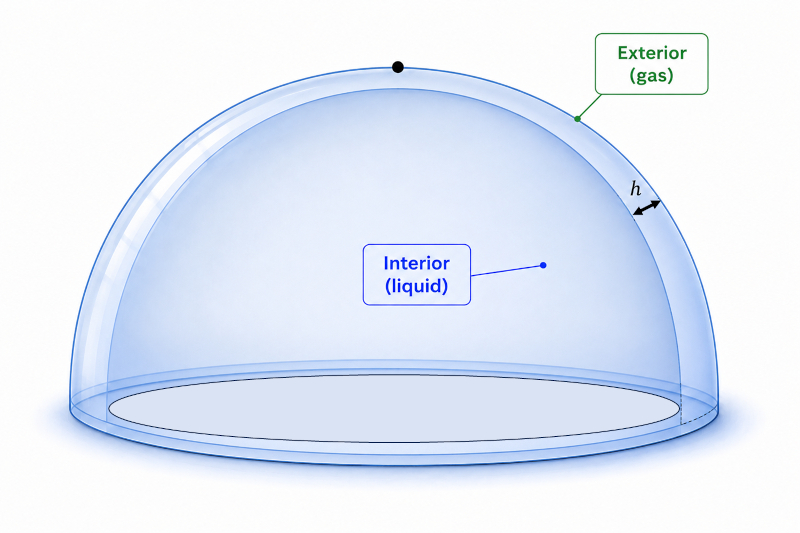
However, many real systems do not only have a free surface, but also a membrane or mechanical wall that supports the forces produced by internal pressure. This membrane can correspond to the same liquid material organized as a thin filmfor example in a soap bubbleor to an independent structural layer, such as a container, a biological membrane, or the wall of a blood vessel.
In these cases, the pressure difference no longer depends directly on the molecular surface tension of the liquid, but on the mechanical stress supported by the membrane. Laplace's equation is then written as:
|
$ \Delta p = \displaystyle\frac{2 T }{ r }$
|
with Pressure variation ($\Delta p$), Membrane surface tension ($T$) and Curvature radio ($r$).
The equation shows that a higher internal pressure requires a higher tension in the membrane to keep the structure stable. It also indicates that surfaces with a smaller radius need to withstand higher stresses to resist the same pressure difference.
ID:(16261, 'gm')
Membrane Tension
Description
Surface tension describes a force distributed along a surface and has units of force per length. In an infinitely thin ideal membrane, all the force necessary to balance the pressure difference between both sides of the surface is concentrated in a thin layer. In that mathematical limit, the internal area available to support the load tends to zero and, therefore, the internal mechanical stress required to support the structure tends to infinity.
In real physical systems, membranes have a finite thickness h. The surface force no longer acts on an ideal layer without thickness, but is distributed throughout the volume of the material. As a consequence, the mechanical load is distributed over a finite cross section and the internal stress remains limited.
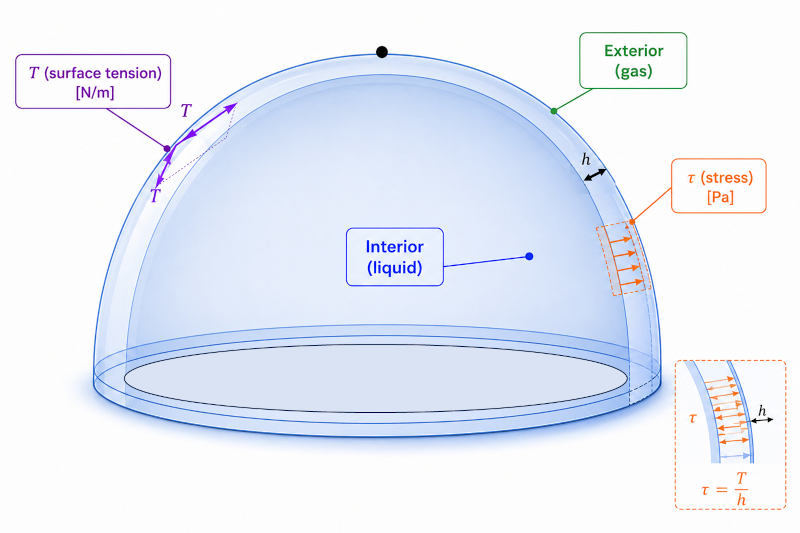
This relationship can be expressed as:
|
$ \tau = \displaystyle\frac{ T }{ h }$
|
with Membrane surface tension ($T$), Strain ($\tau$) and Membrane width ($h$).
The equation shows that, for the same surface tension, a thicker membrane distributes the charge better and reduces the internal tension. On the other hand, as the thickness decreases, the same force is concentrated in less material and the tension increases progressively. In the ideal limit of an infinitely thin membrane, the internal tension theoretically diverges towards infinity.
ID:(16264, 'gm')
Stress as a function of pressure difference
Description
Laplace's law describes how a pressure difference between the inside and outside of a curved surface generates mechanical stress on the membrane that separates both media. When a liquid surface or membrane is curved, internal pressure tends to expand it, while surface tension acts to reduce the surface area and maintain mechanical equilibrium.
For Pressure variation ($\Delta p$) with Surface Tension ($\sigma$) and Curvature radio ($r$) they are related by:
| $ \Delta p = \displaystyle\frac{2 \sigma }{ r }$ |
This equation shows that higher surface tension requires a greater pressure difference to maintain curvature, while smaller radius surfaces require higher internal pressures to remain stable.
In an ideal, infinitely thin membrane, all the mechanical load is concentrated on the surface. However, real membranes have a finite thickness h, so the surface force is distributed throughout the thickness of the material. As a consequence, the internal mechanical stress of the tissue or wall can be related to Surface Tension ($\sigma$) by:
| $ \Delta p = \displaystyle\frac{2 T }{ r }$ |
where Strain ($\tau$) and Membrane width ($h$).
Solving the mechanical stress and replacing we obtain:
|
$ \tau = \displaystyle\frac{ \Delta p \cdot r }{ 2 h }$
|
This expression corresponds to the classical form of Laplace's law for walls or membranes with finite thickness. The equation shows that the stress increases when the pressure difference or radius of the structure increases, and decreases when the wall thickness is greater.
The result explains why large or dilated cavities support greater mechanical stresses and why an increase in wall thickness reduces the internal load on the material. This principle is fundamental in cardiovascular physiology, biomechanics and membrane physics.
ID:(16262, 'gm')
Pressure and curvature mechanics
Description

Calculations
to  ,
then, select the variable:
,
then, select the variable:  to
to 
Calculations
Variable
 Given
Calculate
Given
Calculate
 Target :
Equation
To be used
Target :
Equation
To be used

Variables
ID:(2108, 0)
Palos Verdes, Costa de Corral, Chile