
 User:
User:



Flow of an incompressible liquid
Storyboard 
When a liquid is in motion, we refer to it as flow, and its measurement is based on the volume that passes through a section in a given period of time. Assuming that the volume moves without deformation, the velocity at which the liquid passes through the section remains constant. In this case, flow can also be defined as the product of velocity and the cross-sectional area.
ID:(875, 0)

Volume flow
Concept
During a time elapsed ($\Delta t$), the fluid with a mean Speed of Fluid ($v$) moves a tube element ($\Delta s$). If the section ($S$) represents the amount of fluid crossing that section in the time elapsed ($\Delta t$), it is calculated as:
$\Delta V = S \Delta s = Sv \Delta t$
This equation states that the volume of fluid flowing through section the section ($S$) during a time elapsed ($\Delta t$) is equal to the product of the cross-sectional area and the distance the fluid travels during that time.
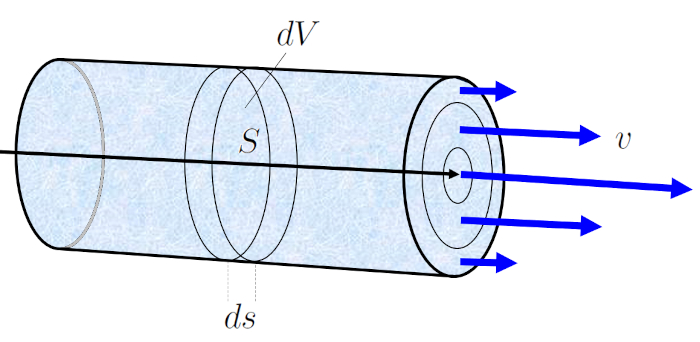
This facilitates the calculation of the volume element ($\Delta V$), which is the volume of fluid flowing through the channel in a specific period of the time elapsed ($\Delta t$), corresponding to the volume flow ($J_V$).
| $ J_V =\displaystyle\frac{ \Delta V }{ \Delta t }$ |
ID:(2212, 0)
Volume Flow and its Speed
Concept
Flow is defined as the volume the volume element ($\Delta V$) divided by time the time elapsed ($\Delta t$), which is expressed in the following equation:
| $ J_V =\displaystyle\frac{ \Delta V }{ \Delta t }$ |
and the volume equals the cross-sectional area the section Tube ($S$) multiplied by the distance traveled the tube element ($\Delta s$):
| $ \Delta V = S \Delta s $ |
Since the distance traveled the tube element ($\Delta s$) per unit time the time elapsed ($\Delta t$) corresponds to the velocity, it is represented by:
| $ j_s =\displaystyle\frac{ \Delta s }{ \Delta t }$ |
Thus, the flow is a flux density ($j_s$), which is calculated using:
| $ j_s = \displaystyle\frac{ J_V }{ S }$ |
It is important to note that in this model:

The flow density acts as an average velocity across the entire flow section.
ID:(15715, 0)
Variable section channel
Concept
Considering a tube that neither leaks nor receives additional liquid, the flow entering at point 1 The volume flow 1 ($J_{V1}$) will be equal to the flow exiting at point 2 The volume flow 2 ($J_{V2}$):
| $ J_{V1} = J_{V2} $ |
Within a channel or tube, there may be a change in cross-sectional area, either widening or narrowing.
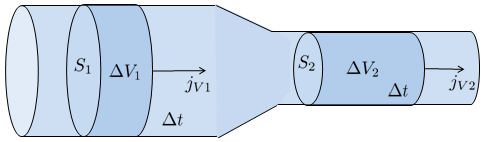
This variation will directly affect the flow through the flux density ($j_s$), which represents the velocity, increasing (if the section narrows) or decreasing (if it widens) according to the section Tube ($S$) to keep the volume flow ($J_V$) constant, as indicated by:
| $ j_s = \displaystyle\frac{ J_V }{ S }$ |
The conservation of flow, along with the definition of flow density, leads to the conservation law such that the section in point 1 ($S_1$), the section in point 2 ($S_2$), the flux density 1 ($j_{s1}$), and the flux density 2 ($j_{s2}$) satisfy:
| $ S_1 j_{s1} = S_2 j_{s2} $ |
ID:(2213, 0)
Validity of Continuity Equation
Concept
The continuity equation assumes that the flow is uniform, with no reverse flows or turbulence present. Therefore, it is necessary to verify that the flow is indeed laminar and free of turbulence, especially when applying the equation to analyze fluid flows in pipes and channels.There are various methods for detecting turbulence in the flow, such as using flow meters or visually observing the flow. It is essential to ensure that the flow is stable before applying the continuity equation, as any disturbance in the flow can affect the accuracy of the calculations and the overall efficiency of the system.
ID:(978, 0)

Flow of an incompressible liquid
Model
When a liquid is in motion, we refer to it as flow, and its measurement is based on the volume that passes through a section in a given period of time. Assuming that the volume moves without deformation, the velocity at which the liquid passes through the section remains constant. In this case, flow can also be defined as the product of velocity and the cross-sectional area.

Variables

Calculations
 to
to  ,
then, select the variable:
,
then, select the variable:  to
to 
Calculations
Variable
 Given
Calculate
Given
Calculate
 Target :
Equation
To be used
Target :
Equation
To be used

Equations
(ID 939)
(ID 3469)
(ID 3469)
(ID 3804)
(ID 3804)
Flow is defined as the volume the volume element ($\Delta V$) divided by time the time elapsed ($\Delta t$), which is expressed in the following equation:
| $ J_V =\displaystyle\frac{ \Delta V }{ \Delta t }$ |
and the volume equals the cross-sectional area the section Tube ($S$) multiplied by the distance traveled the tube element ($\Delta s$):
| $ \Delta V = S \Delta s $ |
Since the distance traveled the tube element ($\Delta s$) per unit time the time elapsed ($\Delta t$) corresponds to the velocity, it is represented by:
| $ j_s =\displaystyle\frac{ \Delta s }{ \Delta t }$ |
Thus, the flow is a flux density ($j_s$), which is calculated using:
| $ j_s = \displaystyle\frac{ J_V }{ S }$ |
(ID 4349)
Flow is defined as the volume the volume element ($\Delta V$) divided by time the time elapsed ($\Delta t$), which is expressed in the following equation:
| $ J_V =\displaystyle\frac{ \Delta V }{ \Delta t }$ |
and the volume equals the cross-sectional area the section Tube ($S$) multiplied by the distance traveled the tube element ($\Delta s$):
| $ \Delta V = S \Delta s $ |
Since the distance traveled the tube element ($\Delta s$) per unit time the time elapsed ($\Delta t$) corresponds to the velocity, it is represented by:
| $ j_s =\displaystyle\frac{ \Delta s }{ \Delta t }$ |
Thus, the flow is a flux density ($j_s$), which is calculated using:
| $ j_s = \displaystyle\frac{ J_V }{ S }$ |
(ID 4349)

Examples
(ID 15485)
During a time elapsed ($\Delta t$), the fluid with a mean Speed of Fluid ($v$) moves a tube element ($\Delta s$). If the section ($S$) represents the amount of fluid crossing that section in the time elapsed ($\Delta t$), it is calculated as:
$\Delta V = S \Delta s = Sv \Delta t$
This equation states that the volume of fluid flowing through section the section ($S$) during a time elapsed ($\Delta t$) is equal to the product of the cross-sectional area and the distance the fluid travels during that time.
This facilitates the calculation of the volume element ($\Delta V$), which is the volume of fluid flowing through the channel in a specific period of the time elapsed ($\Delta t$), corresponding to the volume flow ($J_V$).
| $ J_V =\displaystyle\frac{ \Delta V }{ \Delta t }$ |
(ID 2212)
Flow is defined as the volume the volume element ($\Delta V$) divided by time the time elapsed ($\Delta t$), which is expressed in the following equation:
| $ J_V =\displaystyle\frac{ \Delta V }{ \Delta t }$ |
and the volume equals the cross-sectional area the section Tube ($S$) multiplied by the distance traveled the tube element ($\Delta s$):
| $ \Delta V = S \Delta s $ |
Since the distance traveled the tube element ($\Delta s$) per unit time the time elapsed ($\Delta t$) corresponds to the velocity, it is represented by:
| $ j_s =\displaystyle\frac{ \Delta s }{ \Delta t }$ |
Thus, the flow is a flux density ($j_s$), which is calculated using:
| $ j_s = \displaystyle\frac{ J_V }{ S }$ |
It is important to note that in this model:
The flow density acts as an average velocity across the entire flow section.
(ID 15715)
Considering a tube that neither leaks nor receives additional liquid, the flow entering at point 1 The volume flow 1 ($J_{V1}$) will be equal to the flow exiting at point 2 The volume flow 2 ($J_{V2}$):
| $ J_{V1} = J_{V2} $ |
Within a channel or tube, there may be a change in cross-sectional area, either widening or narrowing.
This variation will directly affect the flow through the flux density ($j_s$), which represents the velocity, increasing (if the section narrows) or decreasing (if it widens) according to the section Tube ($S$) to keep the volume flow ($J_V$) constant, as indicated by:
| $ j_s = \displaystyle\frac{ J_V }{ S }$ |
The conservation of flow, along with the definition of flow density, leads to the conservation law such that the section in point 1 ($S_1$), the section in point 2 ($S_2$), the flux density 1 ($j_{s1}$), and the flux density 2 ($j_{s2}$) satisfy:
| $ S_1 j_{s1} = S_2 j_{s2} $ |
(ID 2213)
The continuity equation assumes that the flow is uniform, with no reverse flows or turbulence present. Therefore, it is necessary to verify that the flow is indeed laminar and free of turbulence, especially when applying the equation to analyze fluid flows in pipes and channels.There are various methods for detecting turbulence in the flow, such as using flow meters or visually observing the flow. It is essential to ensure that the flow is stable before applying the continuity equation, as any disturbance in the flow can affect the accuracy of the calculations and the overall efficiency of the system.
(ID 978)
(ID 15488)
ID:(875, 0)