
 User:
User:



Osmotic pressure
Storyboard 
Osmotic pressure is generated in a solution when a semipermeable membrane is present. This membrane allows the solvent to pass through while retaining the solute on one side, creating a pressure imbalance. As a result, there is a reduction in pressure on the solvent side, driving the solvent to move through the membrane toward the side containing the solute. This process continues until the pressure on the solute side increases enough to balance the initial pressure reduction or until the solute becomes diluted enough that the pressure difference is eliminated, reaching osmotic equilibrium.
ID:(660, 0)

Gas phase, water vapor
Concept
The gaseous phase, which in our case corresponds to water vapor, is the phase in which atoms can move relatively freely.

In this phase, there is only minimal interaction that can affect the behavior of atoms without significantly confining them.
ID:(15142, 0)
Liquid phase, water
Concept
The liquid phase, which in our case corresponds to water, is the phase in which atoms can move relatively freely while maintaining their unity and adapting to the shape that contains them.

In this phase, no specific structure is observed.
ID:(15140, 0)
Phase diagram of water
Concept
One of the most relevant phase diagrams for our planet is that of water. This diagram exhibits the three classical phases: solid, liquid, and gas, along with several phases featuring different crystalline structures of ice.
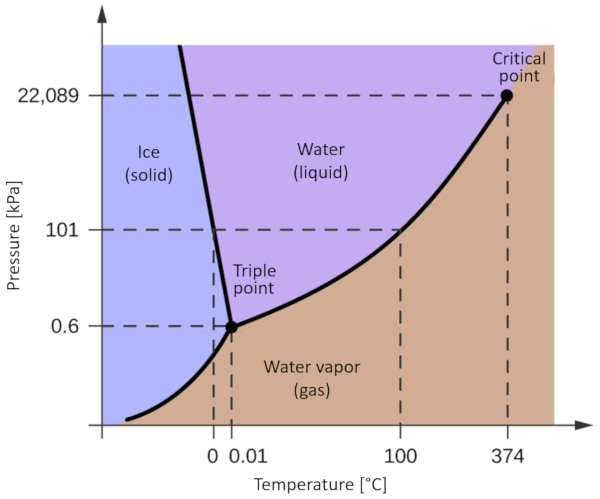
The significant distinction compared to other materials is that within a pressure range spanning from 611 Pa to 209.9 MPa, the solid phase occupies a greater volume than the liquid phase. This characteristic is reflected in the phase diagram as a negative slope along the boundary line separating the solid phase (hexagonal ice) and the liquid phase (water).
ID:(836, 0)
Solid phase, ice
Concept
The solid phase, which in our case corresponds to ice, is the phase in which atoms cannot move relatively and can only oscillate around their equilibrium point.

In this phase, one can observe a structure that is often crystalline and, therefore, regular.
ID:(15141, 0)

Osmotic pressure
Model
Osmotic pressure is generated in a solution when a semipermeable membrane is present. This membrane allows the solvent to pass through while retaining the solute on one side, creating a pressure imbalance. As a result, there is a reduction in pressure on the solvent side, driving the solvent to move through the membrane toward the side containing the solute. This process continues until the pressure on the solute side increases enough to balance the initial pressure reduction or until the solute becomes diluted enough that the pressure difference is eliminated, reaching osmotic equilibrium.

Variables

Calculations
 to
to  ,
then, select the variable:
,
then, select the variable:  to
to 
Calculations
Variable
 Given
Calculate
Given
Calculate
 Target :
Equation
To be used
Target :
Equation
To be used

Equations
(ID 4252)
If there is the pressure difference ($\Delta p$) between two points, as determined by the equation:
| $ dp = p - p_0 $ |
we can utilize the water column pressure ($p$), which is defined as:
| $ p_t = p_0 + \rho_w g h $ |
This results in:
$\Delta p=p_2-p_1=p_0+\rho_wh_2g-p_0-\rho_wh_1g=\rho_w(h_2-h_1)g$
As the height difference ($\Delta h$) is:
| $ \Delta h = h_2 - h_1 $ |
the pressure difference ($\Delta p$) can be expressed as:
| $ \Delta p = \rho_w g \Delta h $ |
(ID 4345)
The number of moles ($n$) corresponds to the number of particles ($N$) divided by the avogadro's number ($N_A$):
| $ n \equiv\displaystyle\frac{ N_s }{ N_A }$ |
If we multiply both the numerator and the denominator by the particle mass ($m$), we obtain:
$n=\displaystyle\frac{N}{N_A}=\displaystyle\frac{Nm}{N_Am}=\displaystyle\frac{M}{M_m}$
So it is:
| $ n = \displaystyle\frac{ M }{ M_m }$ |
(ID 4854)
Como la energ a molar libre de Gibbs es
| $ dg = - s dT + v dp + \mu dN $ |
se tiene que para el equilibrio entre un sistema con y sin material disuelto (
$\displaystyle\frac{V}{N_A}dp=\displaystyle\frac{V}{N_A}(p - \Phi)=\mu dN=\mu (N-N_s)$
Como sin material disuelto se debe asumir que el vapor satisface la ecuaci n de los gases se tiene que
$\mu\sim \displaystyle\frac{R}{N_A} T$
con lo que se obtiene que
| $ \Psi =\displaystyle\frac{ N_s }{ V_C } R T $ |
(ID 12820)
(ID 12827)

Examples
(ID 15287)
When a semipermeable membrane is placed at the bottom of a U-shaped tube and water is added, it can be observed that adding dissolved material causes the column with the solute to rise:

This phenomenon is due to the negative pressure generated by osmotic pressure.
(ID 2024)
(ID 15634)
ID:(660, 0)