
 User:
User:




Surface circulation in the oceans
Image 
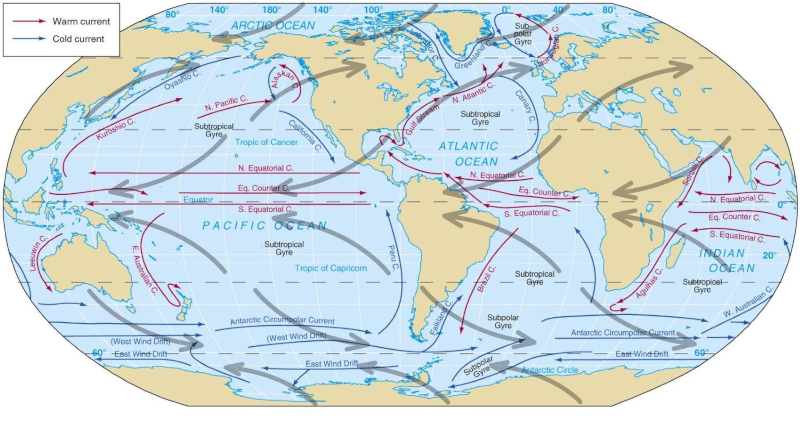
Wind-induced circulation in the atmosphere generates five major vortices: two in the Pacific, two in the Atlantic, and one in the Indian Ocean.
As anticipated by Coriolis law these rotate in the northern hemisphere in the negative direction (clockwise) and positive in the southern hemisphere (counterclockwise) ).
They are classified as cold and hot according to the temperature they are acquiring in the equatorial and polar zones.
ID:(11676, 0)
Circulation by dome formation
Image
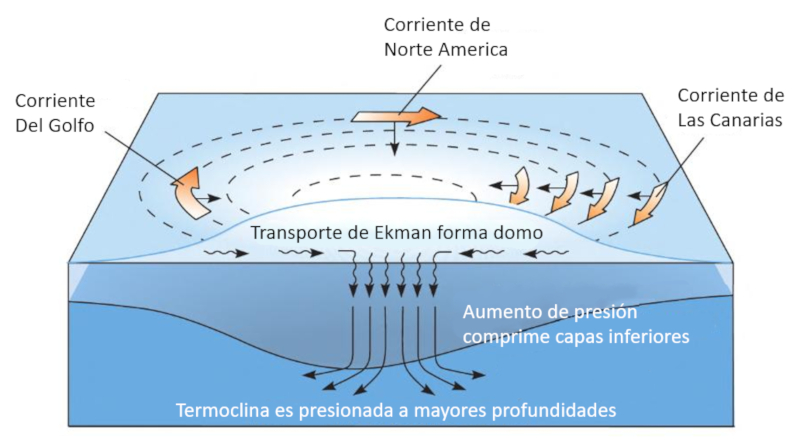
La formación del domo por el flujo hacia el centro del vórtice, que forma un transporte de Ekman, lleva a que la presión con
| $ p_t = p_0 + \rho_w g h $ |
generen flujos hacia la profundidad que arrastra agua mas cálida a las profundidades desplazando la termoclina (temperatura).
ID:(11685, 0)

Isobaric plane inclination
Description
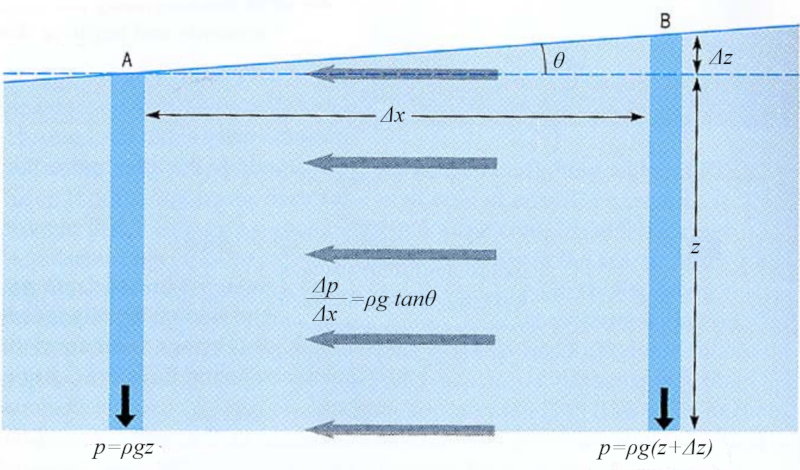
If the depth varies with horizontal position, it creates a pressure difference that contributes to the displacement of water.
ID:(12100, 0)
Depth Difference Generation
Description
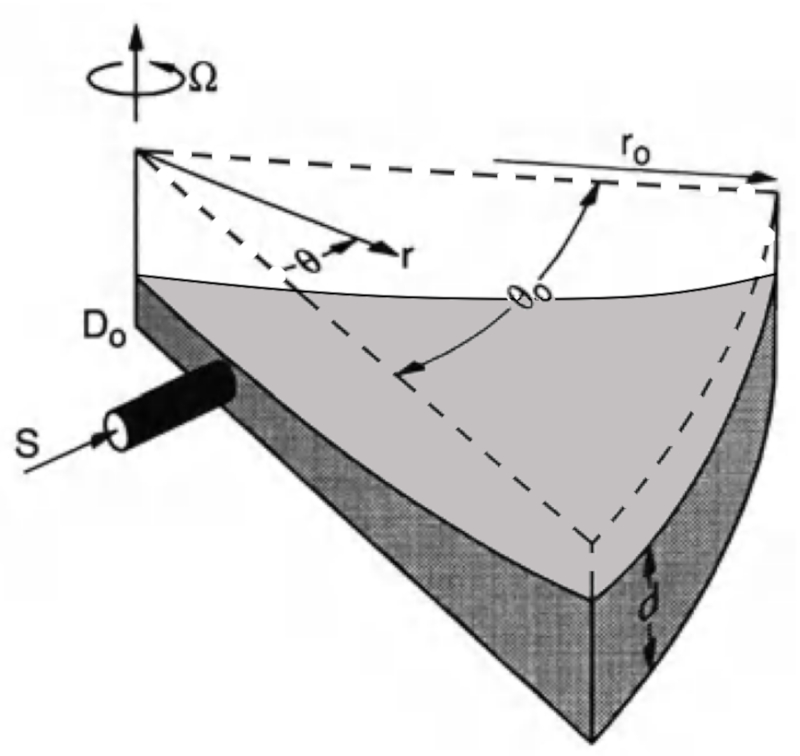
The experiment conducted by Stommel, Arons, and Faller demonstrated how a source and the Coriolis force created imbalances and pressure differences to displace water without the involvement of wind.
In this case, we have a rotating system, experiencing centrifugal acceleration, and a liquid source that alters the quantity at a point near the origin:
ID:(12101, 0)
Inclination of Isobaric Surfaces
Model

Variables

Calculations
 to
to  ,
then, select the variable:
,
then, select the variable:  to
to 
Calculations
Variable
 Given
Calculate
Given
Calculate
 Target :
Equation
To be used
Target :
Equation
To be used

Equations

Examples
Wind-induced circulation in the atmosphere generates five major vortices: two in the Pacific, two in the Atlantic, and one in the Indian Ocean.
As anticipated by Coriolis law these rotate in the northern hemisphere in the negative direction (clockwise) and positive in the southern hemisphere (counterclockwise) ).
They are classified as cold and hot according to the temperature they are acquiring in the equatorial and polar zones.
(ID 11676)
La formaci n del domo por el flujo hacia el centro del v rtice, que forma un transporte de Ekman, lleva a que la presi n con
| $ p_t = p_0 + \rho_w g h $ |
generen flujos hacia la profundidad que arrastra agua mas c lida a las profundidades desplazando la termoclina (temperatura).
(ID 11685)
If the depth varies with horizontal position, it creates a pressure difference that contributes to the displacement of water.
(ID 12100)
The experiment conducted by Stommel, Arons, and Faller demonstrated how a source and the Coriolis force created imbalances and pressure differences to displace water without the involvement of wind.
In this case, we have a rotating system, experiencing centrifugal acceleration, and a liquid source that alters the quantity at a point near the origin:
(ID 12101)
ID:(1526, 0)